Water Damage Cleanup in Atlanta, GA
Water damage restoration typically runs $1,383–$6,369 nationally, per our cost guide. Independent local pros serving Midtown, Grant Park, East Atlanta and nearby areas. Describe the problem and we'll route your request — free, no obligation.
- 24/7 routing — active-water emergencies get priority
- Independent local crews with extraction and drying equipment
- Insurance-ready documentation from the first visit
- Free to use — no obligation, no markup
Fast response from independent local providers. No obligation.
Typical national cost$1,383 – $6,369Cost guide →Local Help in Atlanta, GA
Water damage restoration in Atlanta brings together indoor drying, repair permits and the City's floodplain rules. Atlanta extends into Fulton and DeKalb counties, as the City's municipal tax locator explains. For a home inside Atlanta, begin repair-permit questions with the City rather than assuming that the county named on the tax record issues the building permit. The Department of City Planning's getting-started page explains repair exemptions and historic-property restrictions; the Department of Watershed Management handles floodplain questions.
Atlanta's floodplain guidance identifies historically modified floodplains, where former streams were enclosed in pipes but associated floodplains can still function as though the streams existed. It describes urban flooding when drainage cannot keep pace with heavy rain and backwater flooding when flow exceeds culvert capacity or debris blocks it. Ask the Floodplain Administrator about the specific structure before planning flood repairs.
For the historical record, FEMA identifies DR-1858-GA as Georgia Severe Storms and Flooding. Its incident period was September 18 through October 8, 2009, and its declaration date was September 24, 2009. That event record does not establish the cause of a present leak or the insurance terms for an individual house. Use the current loss documentation and your insurance policy when discussing today's cleanup and rebuilding work.
Atlanta Service Details
What providers in this area actually see: coverage, common jobs, local pricing factors, and rules worth knowing.
Service Area Notes
- The neighborhood names below come from Atlanta's official NPU by Neighborhood directory. It lists Midtown, Grant Park, East Atlanta, Kirkwood, Candler Park, Inman Park, Old Fourth Ward and West End as city neighborhoods. Use that directory for neighborhood orientation; the City's property information tools are the place to check a particular parcel's zoning and overlays.
- Fulton County's customer-service FAQ directs building-permit requests outside the Fulton Industrial District to the city where the property is located. Atlanta's rules described here govern Atlanta property; another municipality's repair decision belongs with that municipality's building office.
- DeKalb County's Permits, Plan Review & Inspections page distinguishes construction in unincorporated DeKalb from work inside incorporated cities. It says primary permitting inside an incorporated city is handled by that city's permitting office. If a city review requires DeKalb County services, the county says the city will provide a routing sheet. Ask the city about the building repair and any county review it requires.
Common Jobs in Atlanta
- Drying rooms and belongings after a leak or spill, with the moisture source repaired as part of the work; EPA emphasizes that cleaning alone will not prevent mold returning if the water problem remains.
- Assessing mold hidden behind drywall, wallpaper or paneling, beneath carpet and pads, or around leaking pipes; these are locations identified in EPA's homeowner mold guide.
- Deciding which moldy porous finishes can be retained: EPA warns that carpet and ceiling tile may need disposal because mold can occupy spaces that are difficult or impossible to clean completely.
- Repairing water-damaged walls and ceilings under Atlanta's applicable repair rules, with the City asked to distinguish an exempt repair from a larger alteration or floodplain project.
- Planning reconstruction of a flood-affected home with Watershed Management's floodplain review alongside the Office of Buildings' permit determination, rather than treating removal of standing water as approval to rebuild.
What Drives Pricing Here
- Published national benchmark: HomeAdvisor's water-damage repair guide, marked Updated Jun 17, 2026, reports a $3,874 average and says most homeowners spent $1,385 to $6,381 in 2025. These figures describe its national guide, not a published Atlanta price survey or a quote for your house.
- In that guide, the affected area's size, damage severity and water source influence the cost. HomeAdvisor distinguishes the extent of damage from the water's contamination category and says the materials affected determine associated replacement work. Compare the proposed scope for extraction and drying with the scope for repairing ceilings, walls, floors and other damaged building components.
- HomeAdvisor also identifies the amount of standing water and exposed appliances and fixtures as basement cost factors, and discusses mold remediation as an additional budget item. Ask for these items to be identified in the estimate instead of applying a national total to a room with unknown damage.
- For comparing bids, Georgia's Attorney General recommends written estimates from several companies using identical project specifications. The agency advises a written contract with guarantees, warranties and promises included, written start and completion dates, and payment terms considered alongside completed stages. It warns against paying for unfinished work. Keep those specifications consistent when comparing a drying proposal with a proposal that also includes rebuilding.
- For Atlanta permit charges, consult the City's getting-started page and ask the permitting office which approvals and current fees apply to the actual scope. Keep its permit determination with the repair documents.
Permits & Local Rules
- City repair exemption: Atlanta's getting-started page cites Ordinance 17-O-1307 and says otherwise-lawful repairs to single-family, duplex, multifamily or nonresidential structures with total valuation below $10,000 need no permit or permit fee. All work must still meet minimum code requirements. The valuation and scope exemptions do not apply to work affecting the exterior of a structure or site in a landmark or historic district, building or site governed by zoning Chapter 20. For Chapter 20 property, the page separately allows otherwise-lawful repairs below $2,500 without a certificate of appropriateness, building permit or permit fee.
- Limited finish repairs: the City's listed cost-independent exemptions apply only to existing single-family, two-family or duplex residential structures and their existing accessory structures. Examples include ceiling or wall drywall repair or replacement not exceeding three sheets, interior doors, and floor or wall coverings. The Chapter 20 exterior restriction above still applies. Confirm the full scope and floodplain status with City Planning.
- Floodplain authority: Atlanta Code § 74-204 calls for review and permit approval by the commissioner of Watershed Management, or an authorized designee, for use of lands and buildings and construction, reconstruction, repair, modification or demolition of structures within all floodplains, including Special Flood Hazard Areas. Ask the Floodplain Administrator to apply its proposal-review requirements and determine whether a certified flood study or field-run survey is needed.
- Damage and improvement thresholds: § 74-203 defines substantial damage as restoration cost equaling or exceeding 50 percent of the structure's predamage value. Substantial improvement includes combined repairs, reconstruction, alterations or improvements over ten years whose cumulative cost equals or exceeds 50 percent of its value before improvement. Refer valuation and existing-structure eligibility questions to Watershed Management; the code supplies specific valuation methods.
- Licensing office: Georgia's State Licensing Board for Residential and General Contractors administers residential and commercial general contractor licensing under Title 43, Chapter 41. Its current FAQ directs questions about regulated work and license categories to the Board and recognizes the specialty-trade exception. For an Atlanta rebuild involving several kinds of work, ask the Board which license category and any statutory exemptions apply to the proposed contract. Use the Board's license search to check the individual or qualifying agent rather than relying on a business name alone.
- Specialty work: the Board's Traditional Specialty Contractors policy allows work within a specialty without a residential or general contractor license. It lists drywall, insulation, cabinets and countertops, wood flooring, and damp proofing and waterproofing, among other trades. This does not authorize work requiring a Chapter 14 license by someone not duly licensed under that chapter; applicable national, state and local codes and ordinances still apply. Its separate guidance covers listed specialists working for a licensed residential or general contractor under a valid permit, while preserving their specialty-trade legal requirements. Refer owner-builder or other exemption questions to the Board rather than treating cleanup, specialty finishes and reconstruction as one licensing category.
Flood & Storm Risk Notes
- A mapped flood zone and a parcel boundary answer different questions. Watershed Management says its floodplain rules apply when the structure is wholly within or touches a flood zone shown on a FEMA Flood Insurance Rate Map; even painting, interior remodeling or new flooring then requires a permit. If the zone crosses the property but not a structure, the structure may not be subject to those rules. Request the City's determination for the building itself.
- Atlanta Code § 74-201 cautions that neither land outside its designated floodplain areas nor permitted uses within them are guaranteed freedom from flooding. Section 74-203 recognizes mapped and unmapped floodplains.
- For mold or contaminated-water cleanup, EPA's guide directs sewage-related damage to a professional experienced in cleaning and repairing contaminated buildings. If HVAC contamination is known or suspected, EPA says not to operate the system and to consult its air-duct guidance before further action. Health concerns belong with a health professional before cleanup begins.
Neighborhoods & Suburbs Served
Midtown · Grant Park · East Atlanta · Kirkwood · Candler Park · Inman Park · Old Fourth Ward · West End
Emergency Response Expectations
Atlanta's flood guidance says to avoid walking or driving through floodwater and follow evacuation directions. Once safe, record photos or video, water amount and location, and the storm's date and time; notify your insurer and use the City's reporting service.
Atlanta FAQs
Does a repair below the City valuation threshold automatically avoid floodplain review?
Ask City Planning and the Floodplain Administrator to reconcile both reviews for your repair. Give them the proposed scope and property information; do not treat a general repair valuation exemption as an official determination about a structure's floodplain obligations.
Which state office handles the trades needed to rebuild after water damage?
The residential and general contractor Board is the starting point for that contract's Chapter 41 questions. Georgia's Attorney General explains that plumbers, electricians and air-conditioning contractors fall under the Georgia Construction Industry Licensing Board. Ask the Secretary of State about the specific trade and the applicable license or exemption. A specialty exception from residential or general contractor licensing does not establish eligibility to perform a separately regulated trade.
How should I check the company name on a restoration contract?
The Secretary of State FAQ distinguishes an individual license holder, who works in that person's name or as a sole proprietor or DBA, from a qualifying agent who works for a registered business organization. It says a commercial general contractor can perform the same work as a residential contractor. Check the relevant license type and business relationship with the Board; the title residential-basic is not the sole possible credential for residential rebuilding.
Will ordinary homeowners insurance pay for flood cleanup?
FloodSmart explains that most homeowners and renters policies do not cover flood damage. NFIP building and contents coverage are generally purchased separately, with separate deductibles. Ask the agent to review the actual cause of loss and both coverage forms. FloodSmart distinguishes flood-related sewer backup from backup caused by clogged pipes, and its buying guide identifies personal belongings kept in basements among the excluded items. Review its complete coverage summary before assuming a basement's finishes and stored possessions have identical protection. For a new policy, ask the agent to apply the program's waiting-period rules and exceptions before relying on an effective date.
Sources
- Atlanta City Planning: getting started, repair exemptions and historic-property limits
- Atlanta Department of Watershed Management: floodplain management and repair review
- Atlanta Code: Chapter 74, Article VI, Flood Area Regulations (§§ 74-201–74-209)
- Atlanta: municipal tax locator confirms Fulton and DeKalb county geography
- Atlanta: official NPU by Neighborhood directory
- Fulton County: customer-service FAQ, building-permit jurisdiction
- DeKalb County: permits, plan review and inspections; incorporated-city jurisdiction
- Georgia Secretary of State: residential and commercial general contractor FAQ and license search
- Georgia Secretary of State: Traditional Specialty Contractors policy and Chapter 14 limits
- Georgia Attorney General: home building, repairs, estimates, contracts and disputes
- EPA: A Brief Guide to Mold, Moisture and Your Home
- FEMA: Georgia Severe Storms and Flooding, DR-1858-GA, incident and declaration dates
- FloodSmart: buying flood insurance, separate coverages and waiting-period exceptions
- HomeAdvisor: national water damage repair guide, Updated Jun 17, 2026; 2025 spending (third-party estimate)
Last reviewed 2026-11-14
Services Available in Atlanta
Emergency Water Removal
Standing water extracted fast — urgent routing to independent local crews with truck-mounted extraction and drying equipment, 24/7.
Learn more →Flood Cleanup
Storm and flood water cleanup with contamination-aware handling — extraction, sanitization, and structured drying by independent local crews.
Learn more →Water Damage Restoration
From dry-out through rebuild — independent local restoration crews handle mitigation, mold prevention, and putting your home back together.
Learn more →Mold Remediation
Visible mold or musty odor after water damage? Independent local crews handle containment, removal, and moisture-source correction.
Learn more →Sewage Backup Cleanup
Sewage in the house is a health hazard, not a mop job — urgent routing to local crews equipped for Category 3 cleanup and sanitization.
Learn more →Fire Damage Restoration
Smoke, soot, and firefighting-water cleanup after a house fire — routed to independent local restoration crews who also document the loss for your insurer.
Learn more →Free Tools Before You Call
Ballpark the cost or narrow down the problem before talking to an Atlanta provider.
Water Damage Restoration Cost Calculator
Estimate what water damage cleanup and restoration should cost — by area affected, water source, how far it spread, and how long it's been wet.
Use the free tool →Water Emergency — What Do I Do Right Now?
Burst pipe, leaking ceiling, or flooded basement? Answer a few questions for an ordered, do-this-now checklist — and know when to stay out.
Use the free tool →Mold Risk Timer — How Fast Does Mold Grow After Water Damage?
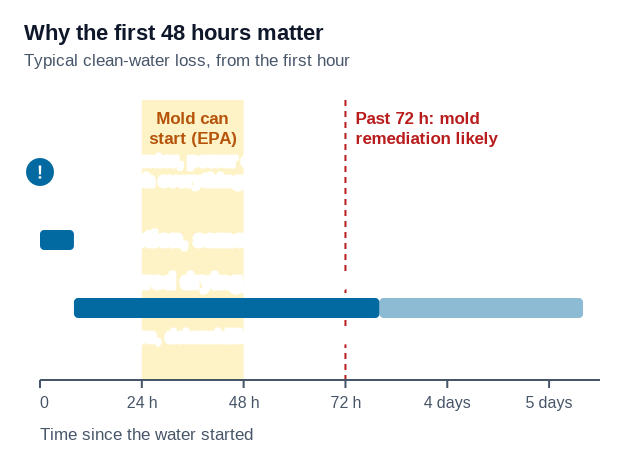
Enter how long ago the water hit and what got wet — see where you are in the 24–48 hour mold window and which materials can still be saved.
Use the free tool →Need help in Atlanta, GA?
Send the short form — urgent requests get priority routing.