Water Damage Cleanup in Houston, TX
Water damage restoration typically runs $1,383–$6,369 nationally, per our cost guide. Independent local pros serving Alief, Clear Lake, Kingwood and nearby areas. Describe the problem and we'll route your request — free, no obligation.
- 24/7 routing — active-water emergencies get priority
- Independent local crews with extraction and drying equipment
- Insurance-ready documentation from the first visit
- Free to use — no obligation, no markup
Fast response from independent local providers. No obligation.
Typical national cost$1,383 – $6,369Cost guide →Local Help in Houston, TX
Houston homeowners planning water damage restoration need to separate cleanup from the approvals for rebuilding. Houston Public Works publishes a Residential Repairs Permit Guidelines handout, a repair specification form and flood-damage guidance. These documents address different questions: what is being replaced, whether building or trade permits apply, and whether the property needs floodplain review. A small drywall repair exemption does not answer all three.
The City's February 2026 One-Stop Residential Projects guide lists storm, fire and flood damage repair as work requiring Structural and Flood reviews. It calls for a damage report from Structural Inspections; that report identifies whether electrical, plumbing or HVAC permits and plans are required. If plans are required, submit the types specified in the report; structural plans must be sealed by a licensed engineer. Ask that department about the damage report before settling on a reconstruction scope.
For a house in a regulated flood area, repair cost also matters to the City's Chapter 19 review. Substantial damage is damage from any origin for which restoring the structure to its before-damaged condition would equal or exceed 50 percent of its market value immediately before the damage. The comparison concerns the structure, rather than an insurance deductible or the amount a homeowner chooses to spend. The Floodplain Management Office handles the City's substantial-damage determinations.
Houston Service Details
What providers in this area actually see: coverage, common jobs, local pricing factors, and rules worth knowing.
Service Area Notes
- The neighborhood names below are Houston Super Neighborhood names from the City's official directory: Alief, Clear Lake, Kingwood, Greater Meyerland Area, Greater Heights and Kashmere Gardens. They identify parts of the city for orientation. The directory is a neighborhood reference, not a list of separate municipalities or permitting authorities.
- Use the Houston Permitting Center for the City repair process discussed here. Outside municipal limits in Harris County, start with the Office of the County Engineer's Permits Division instead. Its published FAQ addresses development in unincorporated Harris County and links a property-information map. Confirm the property's jurisdiction before applying either office's repair guidance; a county permit inquiry does not replace a City building review.
Common Jobs in Houston
- Water removal and room drying after a burst pipe, overflowing toilet or damaged washing-machine hose, examples of sudden water losses in Texas Department of Insurance guidance
- Removing flood-damaged finishes and preparing a like-for-like repair scope for the City's review
- Replacing wet wall covering and insulation while coordinating inspections before drywall closes the wall
- Evaluating moldy carpet or ceiling tiles for disposal; EPA warns that porous materials can be difficult or impossible to clean completely
- Contaminated-water cleanup with experienced professional help, as EPA recommends when sewage or other contaminated water caused the damage
What Drives Pricing Here
- Published national benchmark: HomeAdvisor's water-damage restoration guide, updated June 17, 2026, reports an average of $3,874, with most homeowners spending between $1,385 and $6,381 in 2025. This is the guide's national context, not a Houston bid. Its stated factors include the affected area's size, damage severity, water source and spread, and the materials needing replacement.
- Separate the proposed work in an estimate: water removal and drying, material disposal, mold work and rebuilding. HomeAdvisor identifies mold remediation and repairs to drywall, flooring, ceilings and structural parts as budget considerations. Houston's repair guidance adds a practical reason to distinguish the work: building review and separate trade permits depend on the repair scope. Ask for an estimate that the permitting office can compare with the proposed work.
- The City's flood/storm repair brochure provides its own cost-estimate inclusion and exclusion lists. Attached building components, finishes and equipment appear in its included items. Its excluded items include survey costs and permit fees, along with specified site work, appliances and damage-prevention or health-and-safety demolition. Refer to the complete brochure when preparing the floodplain submission; an insurer's payment or a drying-only invoice is not a substitute for the City's requested cost information.
- Insurance can leave different portions of a restoration bill with the owner. TDI says most homeowner and renters policies cover sudden and accidental water damage, while gradual leaks or seepage and flood damage are generally excluded from home policies. It separately explains that most home policies do not include mold cleanup and testing after a damaged item is removed, although added protection may be available. Ask the agent about the cause of loss and the specific policy.
- Check current permit and mold-program charges with the responsible office. No application fee is presented as a cleanup price here, and no local labor rate or post-storm surcharge is assumed.
Permits & Local Rules
- Building exemptions: the City's residential repair guidelines exempt painting, tarping, wallpapering, tiling, carpeting, cabinet and countertop repair or replacement, and similar finish work. The cabinet allowance does not exempt replacement of plumbing or electrical fixtures. The drywall allowance covers repair on existing walls that are not part of a fire-rated assembly and does not exceed an aggregate of 100 square feet. Same-material exterior wood fascia, trim and soffit repairs have an aggregate 128-square-foot limit; roof covering has an aggregate 100-square-foot limit. Properties in the floodplain are directed to contact the Floodplain Management Office before repairs.
- Repair specification review: ask the Houston Permitting Center plan review group whether Form CE-1059, the Residential Repair Spec List, applies to the proposed water-damage repairs. Use the complete form in the City's permit package for its eligibility limits, code requirements and demolition provisions before choosing a repair application route.
- Inspection timing: the Residential Repairs Permit Guidelines say inspections must be scheduled before any drywall is replaced. Covered work within walls may require drywall removal before the permit can be finalized. The handout also requires final inspections when work is complete and says all permits must be finalized. Coordinate the drying and rebuilding schedule with the inspection requirements.
- Contractor credentials: the February 2026 City guide says Houston does not license or register general contractors. That is a statement about the City, not a statewide licensing conclusion. Its trade guidance distinguishes electrical, mechanical and plumbing work and the corresponding state licenses and City registrations. Ask the appropriate inspection group about applicable trade credentials and any homeowner permit route; ownership alone is not presented here as an exemption.
- Mold oversight: TDLR administers Occupations Code Chapter 1958 and 16 TAC Chapter 78. The statute's section 1958.102(c) exempts remediation from licensure when mold contamination affects a total surface area for the project of less than 25 contiguous square feet. Other owner, tenant, residential-property and construction exemptions have their own eligibility conditions; use the statute and agency guidance to establish whether one applies. Do not treat the size of one visible patch as the project's total contamination area.
- Licensed small-project work: TDLR explains that hiring a licensed mold remediation contractor for an area below that threshold still brings the law and rules into play, including a work plan following a licensed mold assessment consultant's protocol. The contractor does not submit a notification for that small project. For regulated larger projects, use TDLR's notification guidance for timing, emergency provisions, required contents and amendments instead of assuming every job follows an identical waiting period.
- Floodplain permits: Chapter 19 section 19-16 requires a floodplain development permit in addition to other required permits for development activity in a Houston special flood hazard area. Section 19-31 specifies that substantial improvements and substantial damage are regulated only in the special flood hazard area, a subset of the Houston special flood hazard area. Ask Floodplain Management to identify the property's mapped area and applicable standards before rebuilding; the broader area includes the 500-year floodplain.
Flood & Storm Risk Notes
- Houston's May 2024 flood/storm damage brochure is specifically for single-family homes and duplexes. It identifies drywall, wall framing, siding, roof repairs, doors, windows and floor decking among repair subjects needing flood-permit consideration. Its warning that some structurally exempt items may still need flood permits is particularly relevant when restoring finishes after water removal.
- The City's floodplain FAQ distinguishes a house outside the Houston special flood hazard area from one inside it. A house outside does not need a floodplain development permit for flood repairs, but building and trade permits may still apply. Within the broader regulated area, the 500-year floodplain is subject to flood-damage repair regulation even though the FAQ says it is not subject to the substantial-damage rule. Use Chapter 19 and the Floodplain Management Office for a property-specific determination.
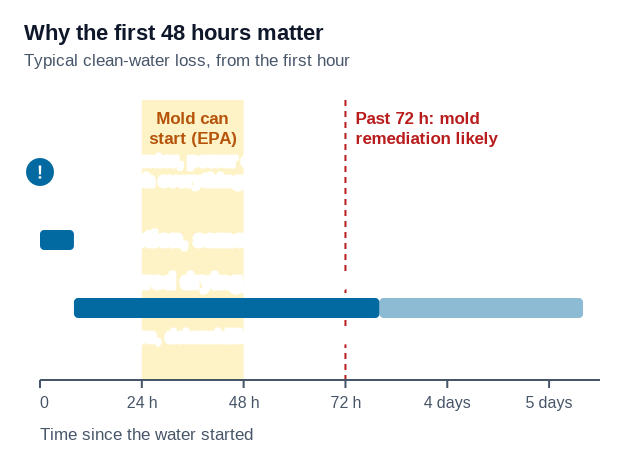
- Moisture remains a separate restoration issue after the permit questions. EPA advises drying water-damaged areas and items within 24–48 hours to prevent mold growth. It also says to fix plumbing leaks, dry items completely and avoid painting or caulking moldy surfaces. Its advice concerns moisture control; it does not establish a Houston permit exemption or replace Texas mold licensing rules.
Neighborhoods & Suburbs Served
Alief · Clear Lake · Kingwood · Greater Meyerland Area · Greater Heights · Kashmere Gardens
Emergency Response Expectations
For immediate cleanup decisions, use TDI's water-loss guidance and EPA's mold guide. TDI advises prompt notice to the insurer, damage photographs or video before repairs, retaining damaged items until the adjuster sees them, temporary protective repairs and receipts, and waiting for the insurer to see the damage before permanent repairs. EPA directs sewage or other contaminated-water damage to experienced professional help and says not to run an HVAC system known or suspected to be mold-contaminated.
Houston FAQs
Can I close the walls as soon as the damaged drywall is removed?
Arrange the City's required inspections before replacement drywall is installed. CE-1058 warns that covering work inside walls without inspection can mean removing drywall before final approval. Drying matters as well: EPA says surfaces should be cleaned and dried before painting. Have the proposed wall repair and any affected building systems reviewed before scheduling the finish work.
Does a substantial-damage finding mean there are no repair options?
Ask Floodplain Management about Chapter 19 rather than assuming the result. Section 19-11(b) allows the owner of a substantially damaged structure to request a temporary flood damage repair permit for limited repairs, under requirements and conditions set by the city engineer in conformance with FEMA guidance. A substantial-damage determination must be appealed before that request. Issuance is discretionary; the provision is not blanket permission to rebuild.
What does FEMA list for Hurricane Harvey?
FEMA identifies Texas Hurricane Harvey as DR-4332-TX, with an incident period of August 23 through September 15, 2017, and a declaration date of August 25, 2017. The declaration map linked from FEMA's designated-area page, dated October 11, 2017, shows Harris County designated for Individual Assistance and Public Assistance. This historical declaration is not a promise of assistance for a later household loss. Consult FEMA's disaster page for its notices and designated-area information.
When can a new NFIP flood policy begin?
FEMA's flood-insurance overview says an NFIP policy typically has a 30-day waiting period, except when purchased as required by a government-backed lender or related to a community flood-map change. Its separate post-wildfire guidance describes another exception with specific conditions. Ask a flood-insurance agent which provision applies; do not assume buying coverage as a storm approaches protects an existing loss.
Sources
- Houston Public Works: Residential Repairs Permit Guidelines, CE-1058
- Houston: One-Stop Residential Projects, February 2026
- Houston: residential permit package and repair specification form
- Houston: Flood/Storm Damage Repairs brochure
- Houston: Repairing Flood Damage in the Floodplain FAQ
- Houston Code Chapter 19: Floodplain
- Houston: Super Neighborhoods Directory
- Harris County Engineer: Permit FAQ
- Texas Occupations Code Chapter 1958
- TDLR: Mold FAQs
- TDLR: Mold Remediation Notifications
- TDI: Water damage, mold and insurance
- EPA: A Brief Guide to Mold, Moisture and Your Home
- FEMA: Texas Hurricane Harvey, DR-4332-TX
- FEMA: DR-4332 designated-area map, October 11, 2017
- FEMA: Flood Insurance
- FEMA: Post-wildfire waiting-period exception
- HomeAdvisor: national water damage restoration cost, updated June 17, 2026 (third-party estimate)
Last reviewed 2026-11-14
Services Available in Houston
Emergency Water Removal
Standing water extracted fast — urgent routing to independent local crews with truck-mounted extraction and drying equipment, 24/7.
Learn more →Flood Cleanup
Storm and flood water cleanup with contamination-aware handling — extraction, sanitization, and structured drying by independent local crews.
Learn more →Water Damage Restoration
From dry-out through rebuild — independent local restoration crews handle mitigation, mold prevention, and putting your home back together.
Learn more →Mold Remediation
Visible mold or musty odor after water damage? Independent local crews handle containment, removal, and moisture-source correction.
Learn more →Sewage Backup Cleanup
Sewage in the house is a health hazard, not a mop job — urgent routing to local crews equipped for Category 3 cleanup and sanitization.
Learn more →Fire Damage Restoration
Smoke, soot, and firefighting-water cleanup after a house fire — routed to independent local restoration crews who also document the loss for your insurer.
Learn more →Free Tools Before You Call
Ballpark the cost or narrow down the problem before talking to a Houston provider.
Water Damage Restoration Cost Calculator
Estimate what water damage cleanup and restoration should cost — by area affected, water source, how far it spread, and how long it's been wet.
Use the free tool →Water Emergency — What Do I Do Right Now?
Burst pipe, leaking ceiling, or flooded basement? Answer a few questions for an ordered, do-this-now checklist — and know when to stay out.
Use the free tool →Mold Risk Timer — How Fast Does Mold Grow After Water Damage?
Enter how long ago the water hit and what got wet — see where you are in the 24–48 hour mold window and which materials can still be saved.
Use the free tool →Need help in Houston, TX?
Send the short form — urgent requests get priority routing.