Water Damage Cleanup in Milwaukee County, WI
Water damage restoration typically runs $1,383–$6,369 nationally, per our cost guide. Independent local pros serving Milwaukee, Wauwatosa, West Allis and nearby communities. Describe the problem and we'll route your request — free, no obligation.
- 24/7 routing — active-water emergencies get priority
- Independent local crews with extraction and drying equipment
- Insurance-ready documentation from the first visit
- Free to use — no obligation, no markup
Fast response from independent local providers. No obligation.
Typical national cost$1,383 – $6,369Cost guide →Local Help in Milwaukee County, WI
Milwaukee County sits in the designated area of two recent Wisconsin flood disasters. FEMA lists DR-4892 (severe storms, straight-line winds, flooding and mudslides) with an incident period of Aug 9 to Aug 12, 2025 and a declaration date of Sep 11, 2025, and DR-4923 (severe storms, tornadoes and flooding) with an incident period of Apr 13 to Apr 23, 2026 and a declaration date of Jun 30, 2026. OpenFEMA's Milwaukee County rows for both mark the Individuals and Households Program as declared and Public Assistance as not declared, and FEMA's DR-4892 page says the last day for individuals and families to apply has passed.
The Milwaukee Metropolitan Sewerage District (MMSD) explains that rain or groundwater, which it calls clear water, can overwhelm a home's sanitary lateral and cause sewage and water to back up into the basement. It names connected downspouts, foundation drains and lateral defects such as roots as clear-water sources, and it reminds owners that they are responsible for the lateral that connects the home to the municipal sewer line.
Milwaukee County Service Details
What providers in this area actually see: coverage, common jobs, local pricing factors, and rules worth knowing.
Service Area Notes
- The Census Bureau's 2020 place-by-county file lists these incorporated places in Milwaukee County: the cities of Milwaukee, Cudahy, Franklin, Glendale, Greenfield, Oak Creek, St. Francis, South Milwaukee, Wauwatosa and West Allis, and the villages of Bayside, Brown Deer, Fox Point, Greendale, Hales Corners, River Hills, Shorewood, West Milwaukee and Whitefish Bay.
- The City of Milwaukee's building rules are in its own Code of Ordinances, chapter 200, and its Permit & Development Center publishes the fee summaries; those city ordinances do not govern the suburbs. Wauwatosa's Building & Safety Division, for example, says it enforces state administrative codes and city ordinances for building construction, electrical installations and plumbing, so ask the building office of the city or village where the property sits.
Common Jobs in Milwaukee County
- Pumping out basements after storm flooding or a sanitary backup
- Cleaning and disinfecting a basement after sewage backs up
- Drying and repairs after a pipe bursts in freezing weather
- Removing wet drywall, carpet, paneling and insulation from finished basements
- Mold assessment after slow leaks or repeated seepage
- Photo, moisture and receipt records for insurance or FEMA assistance claims
What Drives Pricing Here
- HomeAdvisor's national guide (updated Jun 17, 2026) says water damage restoration costs homeowners $3,874 on average, with most spending between $1,385 and $6,381 in 2025. Those are national figures, not quotes for Milwaukee County homes.
- Water category matters in the same guide. HomeAdvisor counts sewage backups from drains and septic systems among the causes of black water flooding, and its per-square-foot table puts black water (Category 3) at $7.50, against $5.25 for gray water (Category 2) and $3.50 for clean water (Category 1).
- Permit fees: the City of Milwaukee's Permit & Development Center summary says its fees are summarized from Milwaukee Code of Ordinances chapters 81 and 200 and that the ordinances supersede it if they conflict; the summary prints only "Updated" dates, not an effective date, so ask the center for the fee that applies to your job; for a suburban property, ask that city or village's building office.
Permits & Local Rules
- Inside the City of Milwaukee, MCO 200-24 requires a permit, and the code's fee, before anyone alters, repairs or demolishes a building or structure, installs equipment in it or starts an excavation, among the other work it names, apart from the exceptions the section lists. Under MCO 200-33-2-c, repairs that do not involve a structural part of an existing building or structure, room arrangement, fenestration, exits, stairways, electrical work, plumbing, equipment or fire protection can be made without a permit, provided the repairs are not in conflict with any regulation of the code. Section 200-24 adds that a permit exemption does not authorize work done in violation of the code or any other law or rule. For work on drains, a sump discharge, wiring or framing, ask the Permit & Development Center which permits apply.
- Contractor certification: under Wis. Stat. 101.654, no person may obtain a building permit unless the person annually obtains a certificate of financial responsibility from the Department of Safety and Professional Services (DSPS), completes the continuing education requirements and furnishes proof of completion to the permit issuer. The requirement does not apply to an owner who resides or will reside in the dwelling and applies for a permit to work on it, and the continuing education part does not apply to a holder of a current DSPS license when the permitted work is work that license covers. The statute lists the proof DSPS requires, including a bond or liability insurance, worker's compensation and unemployment insurance where those laws apply, and coursework; a certificate is valid for one year after issuance unless suspended or revoked. DSPS describes the resulting Dwelling Contractor credential as certification to obtain building permits for one- and two-family dwellings.
- Floodplains: NR 116.01 says s. 87.30(1), Stats., requires municipalities to adopt reasonable and effective floodplain zoning ordinances for floodplains where serious flood damage may occur, within one year after adequate hydraulic and engineering data become available, and DNR's chapter NR 116 provides a uniform basis for those ordinances. NR 116.15 applies to uses and buildings that do not conform to a floodplain zoning ordinance. Under NR 116.15(1)(c), no modification or addition to a nonconforming building, or a building with a nonconforming use, that over the life of the building would exceed 50% of its present equalized assessed value may be allowed unless the entire building is permanently changed to a conforming building with a conforming use; the cost of elevating it to the flood protection elevation is excluded from that 50%. Under NR 116.15(1)(d), a nonconforming building, or a building with a nonconforming use, that is destroyed or so badly damaged that it cannot be practically restored, which the rule defines as restoration costing more than 50% of present equalized assessed value, cannot be replaced, reconstructed or rebuilt unless NR 116.12 to 116.14 are met.
- NR 116.15(1)(am) does not count ordinary maintenance repairs as a modification; it lists internal and external painting, decorating, paneling, replacement of doors, windows and other nonstructural components, and maintenance, repair or replacement of existing private sewage systems, water supply systems or connections to public utilities. The section applies only insofar as it is consistent with ss. 59.69(10) and 62.23(7)(h), Stats., and s. 87.30(1d) sets separate rules for nonconforming buildings damaged by a nonflood disaster, so ask your city or village's floodplain zoning administrator how its ordinance applies to your building.
- FEMA's Substantial Damage Quick Guide measures its test against the market value of the structure, not including the value of the land: when a structure in a Special Flood Hazard Area has repair costs equal to or above 50% of that value, it is substantially damaged and must be brought into compliance with current local floodplain management standards. Local officials make these determinations under their land use authority and locally adopted regulations; state and federal officials do not. Where a community has adopted a stricter standard, FEMA's examples being 45% of market value or counting repairs over a set period, that standard applies.
Flood & Storm Risk Notes
- Flood declarations: OpenFEMA's Milwaukee County rows include declarations with flooding in their titles declared in 1969 (DR-264), 1973 (DR-376), 1976 (DR-496), 1986 (DR-775), 1993 (DR-994), 1997 (DR-1180), 1998 (DR-1238), 2000 (DR-1332), 2004 (DR-1526), 2008 (DR-1768), 2010 (DR-1933), 2020 (DR-4477, severe winter storm and flooding), 2025 (DR-4892) and 2026 (DR-4923).
- Older laterals: MMSD tells owners that if a home is older than 1950, or if water frequently backs up into the basement, it's time to get the pipe checked.
- Climate: NOAA's 1991-2020 normals for the Milwaukee Mitchell Airport station (USW00014839) give 34.57 inches of annual precipitation, with 3.86 inches in April and 4.38 inches in June, 48.7 inches of annual snowfall and a January normal minimum temperature of 17.2°F.
Communities Served
Milwaukee · Wauwatosa · West Allis · Greenfield · Oak Creek · Franklin · Cudahy · South Milwaukee · Shorewood · Whitefish Bay
Emergency Response Expectations
Before cleanup, the Office of the Commissioner of Insurance suggests photographing the damage, keeping swatches of damaged carpet, upholstery or curtains if possible, not throwing out damaged property without the claim adjuster's agreement, and keeping repair receipts. The Milwaukee Health Department says people with mold allergies, weakened immune systems, underlying lung disease, asthma or COPD should not take part in mold cleanup. This site forwards requests to independent restoration contractors and does not do the work itself.
Milwaukee County FAQs
Can I replace wet drywall in the City of Milwaukee without a permit?
Possibly. MCO 200-33-2-c lets repairs be made without a permit when they do not involve a structural part, room arrangement, fenestration, exits, stairways, electrical work, plumbing, equipment or fire protection and are not in conflict with any regulation of the code; MCO 200-24 lists other exceptions. If wiring, pipes or framing behind the wall need work, or the house is in a mapped floodplain, ask the city first; suburbs follow their own ordinances.
Does Wisconsin license mold remediation companies?
The Milwaukee Health Department says that, despite a business's claims, the State of Wisconsin and the City of Milwaukee do not certify or license businesses specifically for mold abatement. Before hiring, it suggests checking with the Wisconsin Department of Agriculture, Trade and Consumer Protection (DATCP) and the Better Business Bureau for complaints, asking for recent customers who can give referrals, and requesting a written report about your property. DHS suggests considering a contractor for large mold problems or when mold keeps returning and the moisture source has not been found.
Will homeowners insurance pay for a flooded basement?
Typically not for flood damage. The Office of the Commissioner of Insurance (OCI) said in August 2025 that homeowners insurance does not typically cover flood damage, but that it's important to document damage, communicate with the insurer and consider filing a claim. It added that if a presidential disaster declaration makes FEMA assistance available, homeowners may need to provide proof of a denied homeowners claim before they can receive that assistance. For future floods, plan ahead: FEMA says a new NFIP policy typically takes effect only after a 30-day wait, except when a government-backed lender requires the coverage or the purchase is tied to a change in the community's flood map, and a FEMA fact sheet sets out a post-wildfire exception decided case by case.
What does MMSD's Pipe Check program require?
MMSD lists these requirements: the property is in the MMSD service area and is a one- or two-family home; there is no income requirement; an Approved Contractor completes a site visit, which the homeowner pays for; the homeowner submits a W-9, because the incentive is taxable; the homeowner signs a participation waiver; and an Approved Contractor completes all the required work identified in the site visit. The contractor gives an estimate before you sign a contract, MMSD pays the incentive directly to the contractor, and MMSD says the incentives do not cover the full cost of the work.
Sources
- FEMA OpenFEMA: Disaster Declarations Summaries, Milwaukee County, WI (queried Nov. 7, 2026)
- FEMA: Wisconsin Severe Storms, Straight-line Winds, Flooding, and Mudslides (DR-4892-WI)
- FEMA: Wisconsin Severe Storms, Tornadoes, and Flooding (DR-4923-WI)
- FEMA: Substantial Damage Quick Guide
- FEMA: Flood Insurance (NFIP 30-day waiting period)
- FEMA: National Flood Insurance Post-Wildfire 30-Day Exception
- City of Milwaukee: Code of Ordinances ch. 200, subchapter 4 (Permits, s. 200-24)
- City of Milwaukee: Code of Ordinances ch. 200, subchapter 5 (Fees, s. 200-33)
- City of Milwaukee Permit & Development Center: Plan Review and Permit Fee Schedules
- City of Milwaukee Health Department: mold exposure after flooding (Aug. 14, 2025)
- City of Wauwatosa: Building & Safety, Inspection Services
- MMSD: Residential Pipe Check program
- Wisconsin Legislature: Wis. Stat. 101.654, contractor certification
- Wisconsin DSPS: Dwelling Contractor (DC) credential
- Wisconsin Legislature: Wis. Stat. 87.30, floodplain zoning
- Wisconsin Legislature: Wis. Admin. Code NR 116.15, nonconforming uses and buildings
- Wisconsin OCI: flood damage tips (press release, Aug. 14, 2025)
- Wisconsin DHS: Mold
- NOAA NCEI: 1991-2020 annual normals, Milwaukee Mitchell AP (USW00014839)
- NOAA NCEI: 1991-2020 monthly normals, Milwaukee Mitchell AP (USW00014839)
- U.S. Census Bureau: 2020 Census places by county, Wisconsin
- HomeAdvisor: Water Damage Restoration Cost (updated Jun 17, 2026) (third-party estimate)
Last reviewed 2026-11-07
Nearby Counties
Services Available in Milwaukee County
Emergency Water Removal
Standing water extracted fast — urgent routing to independent local crews with truck-mounted extraction and drying equipment, 24/7.
Learn more →Flood Cleanup
Storm and flood water cleanup with contamination-aware handling — extraction, sanitization, and structured drying by independent local crews.
Learn more →Water Damage Restoration
From dry-out through rebuild — independent local restoration crews handle mitigation, mold prevention, and putting your home back together.
Learn more →Mold Remediation
Visible mold or musty odor after water damage? Independent local crews handle containment, removal, and moisture-source correction.
Learn more →Sewage Backup Cleanup
Sewage in the house is a health hazard, not a mop job — urgent routing to local crews equipped for Category 3 cleanup and sanitization.
Learn more →Fire Damage Restoration
Smoke, soot, and firefighting-water cleanup after a house fire — routed to independent local restoration crews who also document the loss for your insurer.
Learn more →Free Tools Before You Call
Ballpark the cost or narrow down the problem before talking to a Milwaukee County provider.
Water Damage Restoration Cost Calculator
Estimate what water damage cleanup and restoration should cost — by area affected, water source, how far it spread, and how long it's been wet.
Use the free tool →Water Emergency — What Do I Do Right Now?
Burst pipe, leaking ceiling, or flooded basement? Answer a few questions for an ordered, do-this-now checklist — and know when to stay out.
Use the free tool →Mold Risk Timer — How Fast Does Mold Grow After Water Damage?
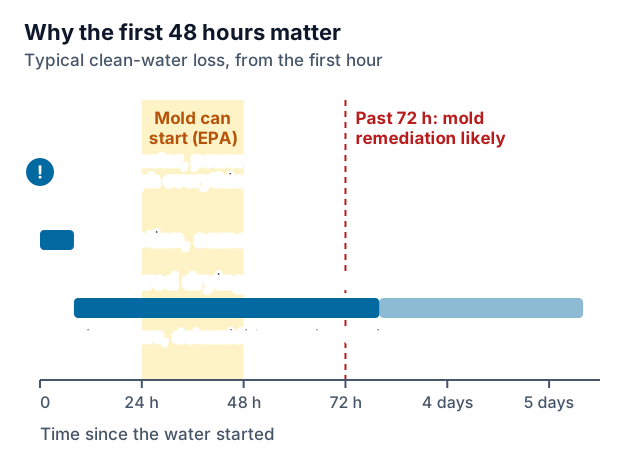
Enter how long ago the water hit and what got wet — see where you are in the 24–48 hour mold window and which materials can still be saved.
Use the free tool →Need help in Milwaukee County, WI?
Send the short form — urgent requests get priority routing.