Water Damage Cleanup in San Antonio, TX
Water damage restoration typically runs $1,383–$6,369 nationally, per our cost guide. Independent local pros serving Alamo Heights, Olmos Park, Terrell Hills and nearby areas. Describe the problem and we'll route your request — free, no obligation.
- 24/7 routing — active-water emergencies get priority
- Independent local crews with extraction and drying equipment
- Insurance-ready documentation from the first visit
- Free to use — no obligation, no markup
Fast response from independent local providers. No obligation.
Typical national cost$1,383 – $6,369Cost guide →Local Help in San Antonio, TX
Inside San Antonio's city limits, repair permits come from Development Services (DSD), which issues residential building permits for property within the City limits, and Appendix F of the Unified Development Code (UDC) names the director of public works, or a designee, as the floodplain administrator. SAWS, the water utility, draws its own line at the water meter (see the FAQs).
For floodplain purposes, UDC Appendix F defines substantial damage two ways: damage of any origin where restoring the structure to its before-damaged condition would cost 50 percent or more of its pre-damage market value, or flood-related damage on two separate occasions within ten years where repairs at the time of each flood average 25 percent or more of that value. The City also tracks improvements: the percentage for each floodplain development permit on a structure accumulates for ten years from the first one, so earlier permitted work counts toward the 50 percent threshold.
FEMA's DR-4935-TX, Texas Severe Storms, Straight-line Winds, Tornadoes, and Flooding, was declared September 1, 2026 for an incident period of July 12 to August 4, 2026. Its designated-areas page lists Bexar County for Individual Assistance, under which individuals and households in the designated counties are eligible to apply for financial and direct services, but not for Public Assistance.
San Antonio Service Details
What providers in this area actually see: coverage, common jobs, local pricing factors, and rules worth knowing.
Service Area Notes
- The permit, floodplain and contractor rules here are the City of San Antonio's. The Census Bureau's 2020 place-by-county file places San Antonio city in Bexar, Comal and Medina counties.
- Alamo Heights, Olmos Park, Terrell Hills, Balcones Heights, Castle Hills, Leon Valley, Helotes, Converse and Windcrest are separate incorporated places in Bexar County in that same Census file, outside the city limits that DSD's permit page refers to. Alamo Heights, for example, posts its own building and floodplain development permit forms, and Leon Valley's Planning and Zoning Department issues its own building and trade permits.
- Timberwood Park appears in the Census file as a census designated place, not a city. Outside any city's limits, the Texas Water Development Board's Flood Community Assistance Program page offers a lookup for the floodplain administrator who serves your community; ask that office which permits apply.
Common Jobs in San Antonio
- Water extraction and drying of slab floors, drywall and lower cabinets when a supply line, water heater or appliance fails on the customer side of the SAWS meter
- Cleanup and drying after a water pipe splits during a hard freeze
- Pulling and replacing soaked carpet, tile, paint and cabinets, the finish work City Code Chapter 10 lists as exempt from permits
- Flood cuts, insulation removal and rebuilding after storm or creek water enters a home, with a repair estimate itemized for a floodplain substantial damage review
- Mold assessment and mold remediation, which Texas licenses separately
- Photos, moisture logs and repair receipts for a homeowners or flood insurance claim, or for a SAWS account review after a customer-side leak is fixed
What Drives Pricing Here
- National benchmark: HomeAdvisor's cost guide (updated Jun 17, 2026) says that on average, water damage restoration costs homeowners $3,874, with most spending between $1,385 and $6,381 in 2025. That is a national figure, not a San Antonio quote.
- Water category: the same HomeAdvisor guide lists average restoration prices per square foot of $3.50 for Category 1 (clean water), $5.25 for Category 2 (gray water) and $7.50 for Category 3 (black water).
- Floodplain arithmetic: the items UDC Sec. 35-F126(b) counts toward a substantial damage determination include materials and labor (with the estimated value of donated or discounted materials and owner or volunteer labor), demolition and debris disposal, sales tax, contractor overhead and profit, and interior finishes such as floor and wall finishes, built-in cabinets and insulation; the section gives the full list.
- What may be left out: Sec. 35-F126(a) lets items such as clean-up and trash removal following structure damage, plug-in appliances, and the cost of temporarily stabilizing a building so it is safe to enter and evaluate be excluded from that determination; the section lists every excludable item and its conditions.
- Which policy pays: TDI's water and mold page names a burst pipe, a toilet overflow or a broken washer hose as the sudden and accidental damage most homeowner and renters policies cover; it says most home policies exclude gradual leaks and seepage and that floods call for their own flood policy.
- Compliance money: FEMA says flood insurance policyholders in high-risk flood areas may receive up to $30,000 of Increased Cost of Compliance coverage to help bring a building into compliance with the local floodplain ordinance, but only after the community determines it was substantially or repetitively damaged by flood; repetitive damage also requires flood insurance claim payments for each of the two losses.
- State mold fees: under 16 TAC section 78.80 (as amended with a September 1, 2018 effective date), TDLR charges $25 for an initial mold remediation notification, whether or not the dwelling unit is owner-occupied.
Permits & Local Rules
- General rule: City Code Chapter 10, Sec. 10-6(a), requires an owner or authorized agent who intends to construct, enlarge, alter, repair, move, demolish or change the occupancy of a building, or to install, alter, repair, remove, convert or replace a regulated electrical, gas, mechanical or plumbing system, to apply to the building official and obtain the required permit first, unless an exemption in Sec. 10-6 applies.
- Finish work: Sec. 10-6(e)(1)g exempts painting, papering, tiling, carpeting, cabinets, counter tops and similar finish work. DSD's No Permit Required List, whose projects typically do not require a permit, also names carpeting and wood/laminate flooring and repairing of sheet rock; the code's list does not name sheet rock, and Sec. 10-6(g) keeps the cutting away of walls or partitions out of ordinary repairs, so ask DSD before a flood cut. Sec. 10-6(e) also says an exemption never authorizes work that violates the chapter or other city or state law, and DSD's list cautions that properties in Historic, Neighborhood Conservation or Corridor Districts may face design and material restrictions.
- Leaks: Sec. 10-6(e)(5) exempts stopping a leak in drain, water, soil, waste or vent piping; if a concealed trap or pipe of those kinds turns defective and must come out for new material, the code calls that new work, and a permit and inspection are required. Clearing stoppages, fixing leaks in pipes, valves or fixtures, and pulling and resetting water closets are also exempt, provided the repair does not involve or require the replacement or rearrangement of valves, pipes or fixtures.
- Emergency and ordinary repairs: under Sec. 10-6(f), when equipment replacements and repairs must be performed in an emergency, the permit application is due to the building official within the next business day. Sec. 10-6(g) lets ordinary repairs proceed without application or notice but excludes from them a list of work, among it cutting away any wall or partition, cutting structural supports, changing required egress, and altering or replacing water supply, drainage, gas or vent piping or electric wiring; read the full list before treating a repair as ordinary.
- Plumbing permits: the people Sec. 10-6(j) authorizes to obtain one include a Responsible Master Plumber who is duly licensed and registered with a company, and a homeowner doing plumbing work on the homestead where he or she lives, as long as the homeowner alone makes the installation, with no other person's assistance. Its other categories cover specific kinds of work; see the subsection.
- Contractor registration: inside the city, residential construction and home improvement work must be done under a contractor registered under Secs. 10-115 and 10-116 who holds a valid and authenticated home builder registration card from the building official (Sec. 10-115(a)). The exceptions are (1) a person who will own a detached single-family dwelling for a period of 12 months after the building permit and final inspection for that dwelling, or an accessory building to it, are completed; (2) building trade subcontractors doing work for the residential building contractor, for example framing, flooring, drywall or painting subcontractors; and (3) a person repairing, replacing or modifying non-structural building components of an existing residential detached accessory structure of 300 square feet or less.
- Floodplain permits: UDC Sec. 35-F131 requires a floodplain development permit for all land development in any area of special flood hazard. Sec. 35-F126(a) names two exceptions for which Public Works may review the application but no floodplain development permit will be required: basic building maintenance not exceeding $2,000, and carpeting or re-carpeting installed over finished flooring such as wood or tiling; ask Public Works before relying on either. Under Sec. 35-F132(a) the floodplain administrator must approve the application before any development, with no cut or fill, building or other site alteration until then. Sec. 35-F132(b)(6) allows an existing structure to be remodeled when the work is not a substantial improvement; if it is, the structure must be brought into compliance with the floodplain ordinance.
- Ten-year tracking: under Sec. 35-F126(c), building permits may be denied if the proposed improvements bring the cumulative improvement to 50 percent or more; once ten years have passed since the initial floodplain development permit, the next permit restarts the period.
- Historic districts: the Office of Historic Preservation's guide says the UDC requires a Certificate of Appropriateness for every exterior modification and repair on a residential or commercial property with an H, HS, HE or HL historic zoning overlay, side yards, rear yards and spots not readily visible from the street included; starting without one may lead to a Stop Work Order, and serious cases to a municipal case.
- Mold licensing: Texas Occupations Code section 1958.101 requires a mold assessment license to perform mold assessment and a mold remediation license to perform mold remediation, subject to the exemptions in section 1958.102. Each exemption there (for owners and tenants, remediation of areas under 25 contiguous square feet, people who built or improved a one- or two-family dwelling, and owners of residential property with fewer than 10 dwelling units) carries conditions and carve-backs, so read the statute or the site's Texas guide before relying on one.
- TDLR notice: under 16 TAC section 78.110, the remediation contractor or company files a notification with TDLR for contamination covering a total surface area of 25 contiguous square feet or more at least five calendar days ahead of the anticipated start. The rule treats it as an emergency when a delay in remediating after water damage would increase mold contamination; the notification is then due as soon as practicable, and at the latest on the next working day after the licensee identifies the emergency. The section also sets the form, fee, confirmation and amendment requirements.
Flood & Storm Risk Notes
- Rain and frost: for San Antonio International Airport (station USW00012921), NOAA's 1991-2020 normals list 32.38 inches of annual precipitation, an average of 9.4 days a year with 1.00 inch or more of precipitation, and 14.0 days a year with a low of 32°F or less.
- Housing age: the Census Bureau's ACS 5-year estimates for 2020-2024 (table B25035) give San Antonio city, Texas a median year structure built of 1985, margin of error ±1.
- City flood resources: San Antonio Public Works' Know Your Flood Risk page offers one-on-one site visits for guidance on property protection, retrofitting and drainage improvements, and links FEMA's Digital Flood Insurance Rate Maps and Bexar County's HALT low-water crossing map, which carries flood updates and emergency road closures.
Neighborhoods & Suburbs Served
Alamo Heights · Olmos Park · Terrell Hills · Balcones Heights · Castle Hills · Leon Valley · Helotes · Converse · Windcrest · Timberwood Park
Emergency Response Expectations
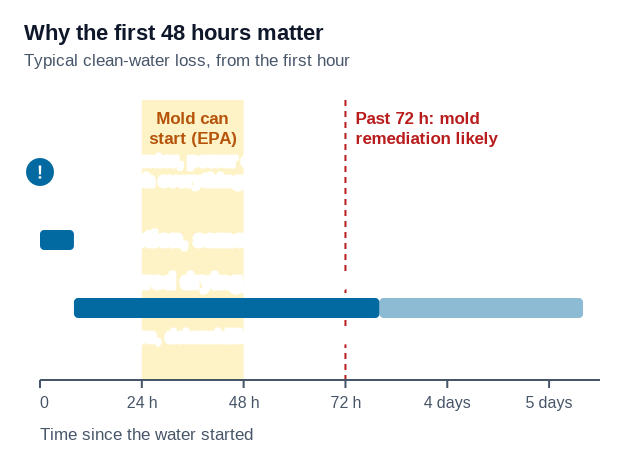
For a suspected leak at home, SAWS says to shut off the main water service at the meter; TDI also says to know where the shutoff valves under your sinks and next to appliances are. EPA advises drying water-damaged areas and items within 24-48 hours to prevent mold. TDI suggests photos before repairs and keeping damaged items until the adjuster sees them. When equipment replacements and repairs must be performed in an emergency, Chapter 10 Sec. 10-6(f) requires the permit application by the next business day. During a flood, the City's flood-risk page points to Bexar County's HALT map for road closures.
San Antonio FAQs
Does replacing wet carpet, paint and cabinets in San Antonio need a City permit?
Chapter 10 exempts painting, papering, tiling, carpeting, cabinets, counter tops and similar finish work from permits. Cutting away walls, replacing defective concealed pipe and structural work are not covered by those exemptions, and a home in a historic district or the floodplain may face other reviews, so confirm with DSD before rebuilding.
The leak is near my SAWS meter box. Who fixes it?
SAWS says it maintains the line from the main to the meter and the customer is responsible for repairs from the meter toward the house. Its Report a Problem page adds that SAWS cannot repair plumbing on private property, so a leak on your side needs a plumber. Once the leak is repaired, SAWS says it can review your account for a possible adjustment if you submit the repair receipts.
Can the company that tests my house for mold also remove it?
Not on the same project if it holds a TDLR license. Under Occupations Code section 1958.155, one license holder cannot perform both the mold assessment and the mold remediation for a project, and one person cannot own an interest in both the assessing and the remediating entity on it. The exception is a license holder employed by a school district on that district's own project.
How long before a new flood insurance policy takes effect?
FEMA's flood insurance page says an NFIP policy typically has a 30-day waiting period before it goes into effect; the exceptions it names are coverage purchased as required by a government-backed lender and coverage related to a community flood map change.
Sources
- San Antonio Development Services: Residential Permits
- San Antonio Development Services: No Permit Required List
- San Antonio City Code Sec. 10-6, Permits (Municode)
- San Antonio City Code Sec. 10-115, Contractor registrations (Municode)
- San Antonio UDC Sec. 35-F106, Floodplain definitions (Municode)
- San Antonio UDC Sec. 35-F126, SI/SD determination (Municode)
- San Antonio Public Works: Know Your Flood Risk
- San Antonio OHP: Before Getting Started (historic project review)
- SAWS: Report a Problem
- SAWS: Reading your water meter to help identify leaks
- City of Alamo Heights: Applications and Forms
- City of Leon Valley: Permits and Applications
- U.S. Census Bureau: 2020 Census places by county, Texas
- U.S. Census Bureau: ACS 2020-2024 5-year, B25035 Median Year Structure Built, San Antonio city, Texas
- NOAA NCEI: 1991-2020 annual/seasonal normals, San Antonio Intl AP (USW00012921)
- FEMA: Texas Severe Storms, Straight-line Winds, Tornadoes, and Flooding (DR-4935-TX)
- FEMA: DR-4935-TX designated areas
- FEMA: Flood Insurance (NFIP waiting period)
- FEMA: Increased Cost of Compliance coverage
- Texas Department of Insurance: water damage and mold coverage tips
- EPA: A Brief Guide to Mold, Moisture and Your Home
- Texas Legislature: Occupations Code ch. 1958, mold assessors and remediators
- Texas Administrative Code, Title 16, §78.80 (mold program fees)
- Texas Administrative Code, Title 16, §78.110 (mold remediation notification)
- TWDB: Flood Community Assistance Program (floodplain administrator lookup)
- HomeAdvisor: Water Damage Restoration Cost (updated Jun 17, 2026) (third-party estimate)
Last reviewed 2026-11-13
Services Available in San Antonio
Emergency Water Removal
Standing water extracted fast — urgent routing to independent local crews with truck-mounted extraction and drying equipment, 24/7.
Learn more →Flood Cleanup
Storm and flood water cleanup with contamination-aware handling — extraction, sanitization, and structured drying by independent local crews.
Learn more →Water Damage Restoration
From dry-out through rebuild — independent local restoration crews handle mitigation, mold prevention, and putting your home back together.
Learn more →Mold Remediation
Visible mold or musty odor after water damage? Independent local crews handle containment, removal, and moisture-source correction.
Learn more →Sewage Backup Cleanup
Sewage in the house is a health hazard, not a mop job — urgent routing to local crews equipped for Category 3 cleanup and sanitization.
Learn more →Fire Damage Restoration
Smoke, soot, and firefighting-water cleanup after a house fire — routed to independent local restoration crews who also document the loss for your insurer.
Learn more →Free Tools Before You Call
Ballpark the cost or narrow down the problem before talking to a San Antonio provider.
Water Damage Restoration Cost Calculator
Estimate what water damage cleanup and restoration should cost — by area affected, water source, how far it spread, and how long it's been wet.
Use the free tool →Water Emergency — What Do I Do Right Now?
Burst pipe, leaking ceiling, or flooded basement? Answer a few questions for an ordered, do-this-now checklist — and know when to stay out.
Use the free tool →Mold Risk Timer — How Fast Does Mold Grow After Water Damage?
Enter how long ago the water hit and what got wet — see where you are in the 24–48 hour mold window and which materials can still be saved.
Use the free tool →Need help in San Antonio, TX?
Send the short form — urgent requests get priority routing.