Water Damage Cleanup in Jacksonville, FL
Water damage restoration typically runs $1,383–$6,369 nationally, per our cost guide. Independent local pros serving Avondale, Brooklyn, Murray Hill and nearby areas. Describe the problem and we'll route your request — free, no obligation.
- 24/7 routing — active-water emergencies get priority
- Independent local crews with extraction and drying equipment
- Insurance-ready documentation from the first visit
- Free to use — no obligation, no markup
Fast response from independent local providers. No obligation.
Typical national cost$1,383 – $6,369Cost guide →Local Help in Jacksonville, FL
Jacksonville water damage repairs can involve the Building Inspection Division, floodplain review and Florida licensing checks. Jacksonville and Duval County have a consolidated government, but the city's building authority does not extend to every municipality within the county. For a home inside Jacksonville, the city division handles building-code enforcement and permit applications. Its commercial-permitting page expressly separates that authority from the other Duval municipalities' building and zoning enforcement.
A flooded home also needs a property-specific review. The city's Flood Protection Information page directs owners to Development Services for official flood-zone determinations and available elevation certificates. Ask about the parcel's floodplain requirements while defining the repair, rather than relying on a neighborhood name or the fact that an earlier storm missed the house. The city identifies coastal, inland and river flooding in Duval County.
Drying and reconstruction raise different questions. EPA's homeowner mold guide emphasizes correcting the water problem and drying affected materials. DBPR regulates construction contracting through its Construction Industry Licensing Board and separately regulates mold-related services. For a proposed restoration contract, ask DBPR about the relevant license and ask the building office which repair approvals apply.
Jacksonville Service Details
What providers in this area actually see: coverage, common jobs, local pricing factors, and rules worth knowing.
Service Area Notes
- The consolidated city/county arrangement means a Jacksonville property uses the city's Building Inspection Division; it is not a referral to a separate unincorporated-Duval building department. The city's own jurisdiction explanation limits the division's authority to Jacksonville. Confirm the municipality for the parcel before choosing a permit portal.
- Jacksonville's Zoning FAQs identify Atlantic Beach, Neptune Beach, Jacksonville Beach and the Town of Baldwin as maintaining their own zoning and building departments. Their regulations are administered separately from the consolidated government. Bring work in those municipalities to the respective municipality's office, rather than submitting it as a Jacksonville city repair.
- Avondale, Brooklyn, Murray Hill, Ortega, Riverside and Springfield are neighborhood names on the city's District 7 list, under The Places We Call Home. These are the names used below. They identify neighborhoods within the city; the separate beach municipalities are not Jacksonville neighborhoods for permitting purposes.
Common Jobs in Jacksonville
- Plumbing leak damage: the city's permit FAQ distinguishes stopping a plumbing leak from replacing equipment. Describe both the source repair and the damaged walls or floors when asking about the rebuilding permit.
- Wet carpet and ceiling tile: EPA says porous materials may need disposal if they become moldy, because growth can fill spaces that are difficult or impossible to clean completely.
- Air-conditioning moisture: EPA recommends keeping drip pans clean and condensate drain lines unobstructed and flowing properly. For equipment replacement after water damage, consult the city about the mechanical work.
- Historic exterior repairs: the Property Appraiser's historic-designation guide says exterior changes to locally designated landmarks or properties in local historic districts require an approved Certificate of Appropriateness before work starts. Ask Historic Preservation about the property's designation before replacing damaged exterior features.
What Drives Pricing Here
- Published national benchmark: HomeAdvisor's water-damage guide, updated June 17, 2026, gives a $3,874 average, with most homeowners spending between $1,385 and $6,381 in 2025. These are HomeAdvisor's national figures, not a Jacksonville estimate. The guide identifies affected area, severity and water type as cost factors.
- Separate the work in a written proposal. HomeAdvisor discusses damage to drywall, ceilings and floors, pipe repairs and mold removal as repair components. Ask which of those items the proposed price includes, alongside extraction and drying. A figure for water removal should not be read as an itemized rebuilding offer.
- Flood insurance changes the payment discussion. FEMA's overview cautions that flood damage falls outside most homeowners policies. A separate flood policy can insure the building, its contents or both. Check the actual insured property and cause of loss with the insurer when discussing a river-water loss versus an interior leak.
- Permitting costs need confirmation from the responsible office. Jacksonville's FAQ distinguishes building fees from electrical, plumbing, mechanical and other permit fees. Ask the division for the charges attached to the actual rebuilding scope. For a floodplain repair, also ask what work the flood review will require before agreeing to a reconstruction price.
Permits & Local Rules
- Repair permits and limited exclusions: Jacksonville's FAQ includes water-heater replacement, air-conditioning replacement, new electrical service and rewiring among permit examples. It lists stopping plumbing leaks and replacing plumbing fixtures after the stop, excluding water heaters, as work not requiring a permit. Its drain-stoppage exclusion applies only when the repair does not involve or require replacement or rearrangement of valves, pipes or fixtures. Confirm the combined repair scope with the division.
- Small single-family projects: section 553.79(1)(g), Florida Statutes, exempts the dwelling owner or the owner's contractor for work on the owner's property valued below $7,500. It excludes property partially or entirely in a Florida Building Code flood hazard area and electrical, plumbing, structural, mechanical or gas work on property containing a single-family dwelling. The statute bars dividing a construction project to avoid this paragraph. Qualification requires a written exemption request to the local enforcement agency with the contract or other documentation demonstrating the work's nature and value. Local government has no legal duty to the owner, contractor or their successors or assigns for this exempt work. Ask the division to apply the statute to the proposed repair.
- Contractor status: DBPR describes certified contractors as able to contract statewide without satisfying each jurisdiction's competency requirements; registered contractors are limited to the jurisdictions for which registration was issued. Ask the board about the classification for the reconstruction being offered. For an owner-builder proposal, use section 489.103(7) and the permitting office's full instructions instead of assuming ownership alone establishes an exemption.
- Mold licensing scope: DBPR licenses individuals for mold assessment and remediation. Under section 468.8411, assessment includes physical sampling and detailed evaluation of building-history and inspection data concerning mold growth greater than 10 square feet. Remediation concerns removal, cleaning, sanitizing, demolition or other treatment, including prevention, of mold or contaminated matter greater than 10 square feet that was not purposely grown there. Chapter 489 work still requires a person licensed under that chapter or compliance with that chapter. Ask DBPR to review the exemptions in section 468.841 for the proposed work; the law includes residential owners assessing or remediating their own property.
- Mold contracts and related companies: section 468.8422 requires the assessment or remediation contract in a document or electronic record signed or otherwise authenticated by the parties. Section 468.8419 addresses assessment/remediation conflicts, including related companies and a certified Division I contractor exception. Have DBPR apply the complete section to a proposed arrangement before accepting the same business for both roles.
Flood & Storm Risk Notes
- Floodplain permits: Jacksonville's flood-protection page directs owners to the Building Inspection Division before building, altering, regrading or filling property. Its development examples include reconstruction, rehabilitation and additions. Ask that office about the permit and Development Services about the flood-zone determination, even when the visible damage appears limited to interior finishes. Section 652.304 assigns substantial-damage and improvement determinations to the Floodplain Administrator in coordination with the Building Official, including evaluation of previous permits as the definitions specify.
- Substantial damage: Section 652.904 of Jacksonville's floodplain code use restoration cost equal to or above 50% of the building or structure's pre-damage market value, whatever caused the damage. They also include flood damage on two separate occasions during ten years when repair costs at each event, on average, equal or exceed 25% of the structure's pre-damage market value.
- Substantial improvement: the code counts combined repairs, alterations, reconstruction, rehabilitation, additions and other improvements during ten years, starting with the first improvement or repair. The threshold is cumulative cost equaling or exceeding 50% of the building or structure's market value before work starts. Repairs to a substantially damaged structure count regardless of the work actually performed. Excluded are projects correcting building-official-identified existing health, sanitary or safety violations to the minimum needed for safe living, and historic alterations preserving the structure's historic designation. The city's shorter flood webpage says exceeds 50%; ask the floodplain staff to apply the code's definitions and history to the property.
- Hurricane record: FEMA identifies Florida Hurricane Milton as DR-4834-FL, declared October 11, 2024, for an incident period of October 5 through November 2, 2024. The initial notice names Duval County for Individual Assistance and debris removal and emergency protective measures under Public Assistance. These are historical declaration details, not a promise of an open assistance program or payment for a particular repair.
- Historic housing context: the city's designation guide identifies Springfield as both a local and National Register historic district. It says most of Ortega is National Register-listed but not locally designated, and warns that local and National Register boundaries can differ. Ask about the individual property's status rather than assuming every house in a named neighborhood follows the same exterior-review process.
Neighborhoods & Suburbs Served
Avondale · Brooklyn · Murray Hill · Ortega · Riverside · Springfield
Emergency Response Expectations
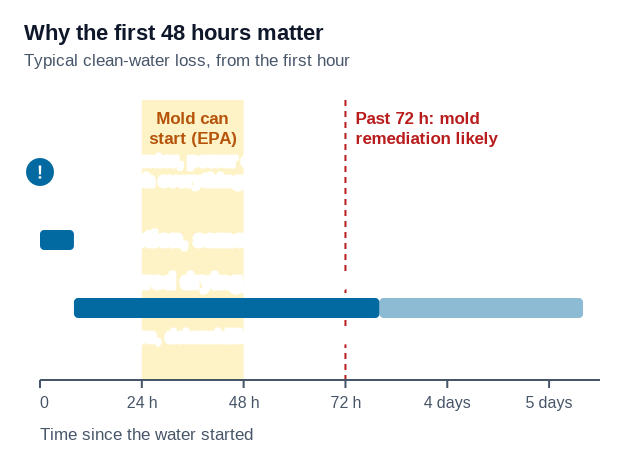
Jacksonville's flood-safety guidance says to stay away from power and electrical wires and have electricity turned off by JEA. Do not walk through flowing water or drive through flooded areas. For sewage or other contaminated-water damage, EPA advises using a professional experienced in cleaning and repairing contaminated buildings. EPA says drying wet materials within 24–48 hours after a leak or spill prevents mold growth in most cases.
Jacksonville FAQs
Where do Jacksonville repair plans go?
The Building Inspection Division's FAQ sends permit application packages through JaxEPICS. It asks renovation applicants to make clear when a mechanical, electrical or plumbing trade is not being revised, so reviewers can identify the extent of work. Use the division's project instructions for the full submission requirements.
When should I discuss inspections during rebuilding?
Discuss the inspection sequence with the division before work is concealed. The city's Residential Inspection guide cautions that its general sequence may not apply to every project. If work proceeds beyond the appropriate inspection point, portions of construction may have to be removed so the inspector can see the required elements. Ask the inspector or design professional which inspections apply to the repair.
Can one business assess mold and then remediate it?
Take that arrangement to DBPR. Section 468.8419 sets separate 12-month restrictions on remediation after an assessment and assessment after remediation, with company relationships included and an exception for certified Division I contractors. The statute, rather than a general promise of independent testing, governs the arrangement.
Does buying an NFIP policy immediately insure an existing flood loss?
FEMA advises planning ahead: an NFIP policy typically has a 30-day waiting period. Its overview names exceptions for coverage purchased as required by a government-backed lender or related to a community flood-map change. Ask the insurer for the applicable effective date and full exception terms before relying on new coverage.
Is a moldy wall ready to paint after the stain fades?
EPA advises cleaning the mold and drying the surface before painting or caulking. It says the moisture problem must be completely fixed before cleanup can be considered finished. For suspected hidden growth, its homeowner guide recommends considering an experienced professional because disturbing mold can release spores.
Sources
- Jacksonville: building authority and other Duval municipalities
- Jacksonville Zoning FAQs: separate municipal building departments
- Jacksonville District 7: official neighborhood list
- Jacksonville Building Inspection: permit and plan FAQs
- Jacksonville: residential inspection guidance
- Jacksonville: flood protection, flood-zone records and safety
- Jacksonville Code section 652.904: flood damage and improvement definitions
- Jacksonville Code section 652.304: who makes flood determinations
- Jacksonville Property Appraiser: historic designations and exterior review
- Florida DBPR: construction licensing classifications
- Florida DBPR: mold-related services questions
- Florida Senate: 2026 section 553.79, permit exceptions
- Florida Senate: 2026 section 489.103, owner-builder referral
- Florida Senate: 2026 section 468.8411, mold scope
- Florida Senate: 2026 section 468.841, mold exemptions
- Florida Senate: 2026 section 468.8419, assessment and remediation relationships
- Florida Senate: 2026 section 468.8422, mold contracts
- EPA: homeowner moisture, drying and mold guide
- FEMA: flood insurance and waiting-period overview
- FEMA: Florida Hurricane Milton, DR-4834-FL
- FEMA: Milton initial notice designating Duval County
- HomeAdvisor: national water-damage cost guide, updated June 17, 2026 (third-party estimate)
Last reviewed 2026-11-14
Services Available in Jacksonville
Emergency Water Removal
Standing water extracted fast — urgent routing to independent local crews with truck-mounted extraction and drying equipment, 24/7.
Learn more →Flood Cleanup
Storm and flood water cleanup with contamination-aware handling — extraction, sanitization, and structured drying by independent local crews.
Learn more →Water Damage Restoration
From dry-out through rebuild — independent local restoration crews handle mitigation, mold prevention, and putting your home back together.
Learn more →Mold Remediation
Visible mold or musty odor after water damage? Independent local crews handle containment, removal, and moisture-source correction.
Learn more →Sewage Backup Cleanup
Sewage in the house is a health hazard, not a mop job — urgent routing to local crews equipped for Category 3 cleanup and sanitization.
Learn more →Fire Damage Restoration
Smoke, soot, and firefighting-water cleanup after a house fire — routed to independent local restoration crews who also document the loss for your insurer.
Learn more →Free Tools Before You Call
Ballpark the cost or narrow down the problem before talking to a Jacksonville provider.
Water Damage Restoration Cost Calculator
Estimate what water damage cleanup and restoration should cost — by area affected, water source, how far it spread, and how long it's been wet.
Use the free tool →Water Emergency — What Do I Do Right Now?
Burst pipe, leaking ceiling, or flooded basement? Answer a few questions for an ordered, do-this-now checklist — and know when to stay out.
Use the free tool →Mold Risk Timer — How Fast Does Mold Grow After Water Damage?
Enter how long ago the water hit and what got wet — see where you are in the 24–48 hour mold window and which materials can still be saved.
Use the free tool →Need help in Jacksonville, FL?
Send the short form — urgent requests get priority routing.