Water Damage Cleanup in Dallas, TX
Water damage restoration typically runs $1,383–$6,369 nationally, per our cost guide. Independent local pros serving Irving, Garland, Richardson and nearby areas. Describe the problem and we'll route your request — free, no obligation.
- 24/7 routing — active-water emergencies get priority
- Independent local crews with extraction and drying equipment
- Insurance-ready documentation from the first visit
- Free to use — no obligation, no markup
Fast response from independent local providers. No obligation.
Typical national cost$1,383 – $6,369Cost guide →Local Help in Dallas, TX
A Dallas water loss can involve three different reviews: the City's building official for reconstruction, Dallas Water Utilities for work in a regulated floodplain, and the Texas Department of Licensing and Regulation (TDLR) for regulated mold work. Start by identifying the property jurisdiction and the proposed repair scope. A drying estimate does not establish whether the rebuilding qualifies for a permit exemption or floodplain approval.
Dallas's building-inspection FAQ identifies nonstructural interior remodeling of single-family or two-family dwellings as exempt when it adds no floor area and changes no exterior doors or windows. It separately exempts stopping leaks in pipes, drains or plumbing fixtures when the repair requires no replacement or rearrangement of valves, pipes or fixtures. Those limits matter when a wet-room repair expands into replacing plumbing or changing the structure; ask Building Inspection to review the actual scope.
Floodplain review has a different test. Dallas Development Code Section 51A-5.101 defines substantial damage as damage from any origin whose restoration to the before-damaged condition would cost at least 50 percent of the structure's market value before the damage. Section 51A-5.104 treats substantially damaged structures as substantial improvements. A pipe loss therefore should not be dismissed from floodplain review simply because rain did not cause it.
Dallas Service Details
What providers in this area actually see: coverage, common jobs, local pricing factors, and rules worth knowing.
Service Area Notes
- The Census Bureau's 2020 place-by-county relationship file identifies Dallas city in Dallas, Collin, Denton, Kaufman and Rockwall counties. City limits, rather than the county name in a mailing address, are the starting point for the Dallas building rules discussed here. Dallas County's Department of Unincorporated Area Services handles development permits in the county's unincorporated areas, not the City's building-permit process.
- Irving, Garland, Richardson, Farmers Branch and Duncanville appear as incorporated cities in Dallas County in that Census file. These nearby places are listed for geographic orientation. Dallas's repair exemptions are not their permit rules: Irving has a Building Inspections Division, and Garland's Building Inspection Department handles homeowner permit questions. For a property in another municipality, use that municipality's building office.
Common Jobs in Dallas
- Removing standing water and drying rooms after a burst pipe, overflowing toilet or broken washing-machine hose, the sudden-loss examples identified by the Texas Department of Insurance (TDI)
- Repairing the leak and restoring wet finishes, with the Dallas leak exemption checked separately from any replacement or rearrangement of plumbing
- Evaluating moldy carpet and ceiling tiles for removal; EPA says mold can be difficult or impossible to remove completely from porous materials
- Cleaning contaminated-water damage with experienced professional help, as EPA recommends for sewage or other contaminated water
- Preparing a written reconstruction scope for City review when walls, structural components, electrical wiring, plumbing or mechanical systems are involved
- Documenting damaged belongings and temporary repairs for the insurer before proceeding with permanent reconstruction
What Drives Pricing Here
- Published national context: HomeAdvisor's water-damage repair guide, updated June 17, 2026, reports a $3,874 average and says most homeowners spent between $1,385 and $6,381 in 2025. The guide relates the bill to the affected area's size and damage severity. These figures describe its national guide, not a Dallas estimate or an insurance settlement.
- Water condition: HomeAdvisor's table prints $3.50 per square foot for Category 1 clean water, $5.25 for Category 2 gray water and $7.50 for Category 3 black water restoration service. Use the guide as an attributed comparison, not a diagnosis of the water in a particular home. EPA directs homeowners with sewage or other contaminated-water damage to experienced professional help.
- Rebuilding scope: Dallas's General Repair Scope of Work form excludes wall or partition removal, structural work, egress changes and specified system alterations. Ask for an estimate that distinguishes drying, material removal and reconstruction, so Building Inspection can evaluate what is actually proposed. The form warns that field findings beyond the proposed general-repair scope may lead to a stop-work order and amended permits, plans and additional fees.
- Insurance treatment: TDI says most homeowners and renters policies cover sudden and accidental water damage, but most home policies exclude gradual leaks or seepage and flood damage. It also says most home policies do not include mold cleanup and testing after the damaged item is removed. Ask the insurer about the particular cause and any added mold protection instead of assuming the whole restoration bill is covered.
- Permit charges and mold-program charges should be checked with the responsible office. No local fee amount is quoted here. A form's revision date does not establish when a fee became effective, and a mold credential application charge is not a homeowner's restoration price.
Permits & Local Rules
- Building review: Dallas's FAQ directs readers to Chapter 52, Section 301(b), for the complete permit-exemption list. Its interior-remodeling exemption is limited to nonstructural work in single-family or two-family dwellings, without added floor area or changes to exterior doors or windows. Historic and conservation districts have additional exterior-work requirements. Do not extend that limited exemption to structural rebuilding or assume all wet drywall work has the same permit status.
- General-repair form: the City's attachment excludes removal of any wall or partition or any part of one; permanent, partial or complete removal of a structural component; and changing, strengthening, bracing or adding load-bearing floor, wall, ceiling or roof elements. It also excludes removal or rearrangement of any part of a required means of egress. Send the form to Building Inspection when deciding whether a proposed flood cut fits this route.
- Systems on that form: excluded additions, alterations or relocations include fire-protection systems or any portion of them; water supply, sewer, drainage, gas, oil, waste, vent or similar piping; electrical wiring other than low-voltage communication wiring in a one- or two-family dwelling; and mechanical components such as ductwork or elevator devices. The form is not a blanket permission to open walls or replace damaged building systems.
- Registration and trades: the City's Planning and Development guide tells homeowners to search DallasNow contractor registrations, confirm Active status and expiration, and match the registration to the trade. General, electrical, plumbing and mechanical are distinct search categories. For state trade-license requirements and any homeowner exception, consult the appropriate licensing agency and Building Inspection; a City registration lookup does not replace that inquiry.
- Mold regulation: TDLR administers Occupations Code Chapter 1958 and 16 TAC Chapter 78. Section 1958.102(c) exempts a person from licensure for remediation where contamination affects a total surface area for the project of less than 25 contiguous square feet. TDLR explains that a licensed mold remediation contractor hired for such a small project still follows the law and rules, including a work plan based on a licensed assessment consultant's protocol, but need not submit a project notification. Other owner, residential-property and construction exemptions have their own conditions; consult the statute and TDLR rather than treating ownership or a small patch as a universal exemption.
- Floodplain approval: under Section 51A-5.104(b)(2), an owner of a structure in an FP area needs the director of water utilities' approval before making improvements. The director may approve proposed work if the cumulative value of all improvements for the preceding five years is less than 50 percent of the market or tax appraisal value of existing improvements on the property, whichever is greater. Values follow FEMA P-758 as revised, and all improvements, including additions, must satisfy Section 51A-5.105(g). The section classifies substantially damaged structures as substantial improvements and separately addresses limited reconstruction exceptions; ask Floodplain Management about the property's options before committing to rebuilding.
Flood & Storm Risk Notes
- Dallas Water Utilities' floodplain page describes the Trinity River and its tributaries as the City's drainage system, naming White Rock Creek and Fivemile Creek. Its Floodplain Management Section offers site visits concerning flooding, drainage and erosion, historical neighborhood flood information, and consultation on the floodplain permitting process. That is the relevant City office for a property-specific drainage or floodplain question.
- The City's floodplain webpage says interior improvements valued at 'up to 50%' of the appraised structure value can be made every five years with approval. The linked development code instead uses 'less than 50 percent,' a cumulative five-year test and the greater of market or tax appraisal value. Use the code's wording and have the director's office resolve the application to your house; do not use the webpage phrase as permission to reach exactly 50 percent.
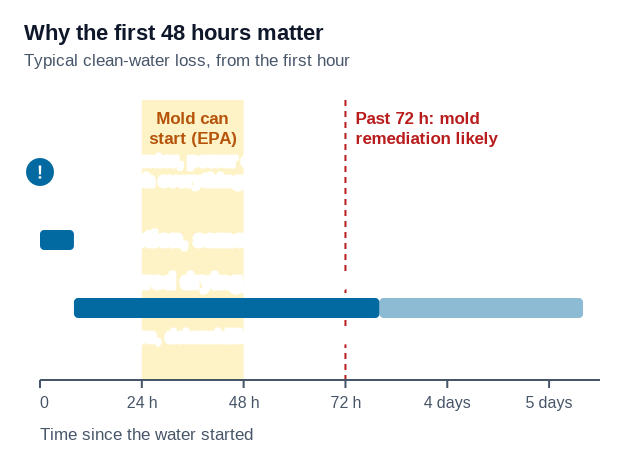
- Moisture control remains part of the repair. EPA advises drying water-damaged areas and items within 24–48 hours to prevent mold growth, fixing the water problem and cleaning mold promptly. It cautions against painting or caulking over moldy surfaces. These are cleanup recommendations, not a guarantee that a room is dry or that hidden contamination is absent.
Neighborhoods & Suburbs Served
Irving · Garland · Richardson · Farmers Branch · Duncanville
Emergency Response Expectations
Dallas's flood-safety guidance says to avoid flowing water and flooded driving areas, stay away from power lines and electrical wires, and have electricity turned off by the power company. Follow evacuation directions from emergency officials. For cleanup after safe access is established, use TDI's water-loss guidance and EPA's contaminated-water precautions.
Dallas FAQs
Which office should review repairs inside Dallas city limits?
Use City Building Inspection for the building scope and permit exemptions. For a structure in an FP area, involve Dallas Water Utilities Floodplain Management as well. Dallas County's unincorporated-area development permit is a different process. A county address alone does not establish that the county office handles a house inside a municipality.
Does a City contractor registration establish mold credentials?
Check both systems. DallasNow identifies City contractor registrations by trade; TDLR regulates mold assessment and remediation credentials. TDLR's FAQ says it does not inspect or test homes for mold and cannot order a landlord or property owner to clean it up. Use the agency's license search and exemption guidance when selecting mold assessment or remediation help.
Can I buy flood insurance immediately before a storm?
FloodSmart states a standard 30-day wait after purchase. Its exceptions are no wait when purchasing while making, increasing, extending or renewing a mortgage, and no wait for a coverage change at policy renewal; a one-day wait applies to property in a newly designated high-risk flood zone when purchased within 12 months of the update, or when flooding is caused or worsened by wildfire on federal land and the policy is bought within 60 days of containment. Ask the agent which rule applies. Building and contents protection are typically bought separately and have separate deductibles.
What records should I keep while the home is being dried?
TDI recommends a damaged-property list and, if possible, photographs or video before repairs. Retain receipts for temporary protective work. Its guidance says to notify the insurer promptly, keep damaged items until the adjuster has seen them and avoid permanent repairs until the insurance company sees the damage. Coordinate that documentation with urgent water removal and drying rather than delaying protection of the property.
Sources
- TDLR: mold law and Chapter 78 rules
- Dallas Building Inspection: repair and permit FAQs
- Dallas: General Repair Scope of Work form
- Dallas Planning and Development guide: contractor verification
- Dallas Water Utilities: Floodplain and Drainage Management
- Dallas Development Code: floodplain regulations linked by the City
- Dallas Code Section 51A-5.104: improvements in FP areas
- Dallas County: unincorporated-area development permits
- Census Bureau: 2020 Texas place-by-county relationship file
- Garland Building Inspection
- Irving Building Inspections
- Texas Occupations Code Chapter 1958: mold regulation and exemptions
- TDLR: mold licensing and minimum-area FAQ
- TDI: water damage, mold and insurance
- EPA: A Brief Guide to Mold, Moisture and Your Home
- FloodSmart: buying a policy and waiting-period exceptions
- HomeAdvisor: national water damage repair guide, updated June 17, 2026 (third-party estimate)
Last reviewed 2026-11-14
Services Available in Dallas
Emergency Water Removal
Standing water extracted fast — urgent routing to independent local crews with truck-mounted extraction and drying equipment, 24/7.
Learn more →Flood Cleanup
Storm and flood water cleanup with contamination-aware handling — extraction, sanitization, and structured drying by independent local crews.
Learn more →Water Damage Restoration
From dry-out through rebuild — independent local restoration crews handle mitigation, mold prevention, and putting your home back together.
Learn more →Mold Remediation
Visible mold or musty odor after water damage? Independent local crews handle containment, removal, and moisture-source correction.
Learn more →Sewage Backup Cleanup
Sewage in the house is a health hazard, not a mop job — urgent routing to local crews equipped for Category 3 cleanup and sanitization.
Learn more →Fire Damage Restoration
Smoke, soot, and firefighting-water cleanup after a house fire — routed to independent local restoration crews who also document the loss for your insurer.
Learn more →Free Tools Before You Call
Ballpark the cost or narrow down the problem before talking to a Dallas provider.
Water Damage Restoration Cost Calculator
Estimate what water damage cleanup and restoration should cost — by area affected, water source, how far it spread, and how long it's been wet.
Use the free tool →Water Emergency — What Do I Do Right Now?
Burst pipe, leaking ceiling, or flooded basement? Answer a few questions for an ordered, do-this-now checklist — and know when to stay out.
Use the free tool →Mold Risk Timer — How Fast Does Mold Grow After Water Damage?
Enter how long ago the water hit and what got wet — see where you are in the 24–48 hour mold window and which materials can still be saved.
Use the free tool →Need help in Dallas, TX?
Send the short form — urgent requests get priority routing.