Water Damage Cleanup in Charlotte, NC
Water damage restoration typically runs $1,383–$6,369 nationally, per our cost guide. Independent local pros serving Dilworth, Fourth Ward, Hermitage Court and nearby areas. Describe the problem and we'll route your request — free, no obligation.
- 24/7 routing — active-water emergencies get priority
- Independent local crews with extraction and drying equipment
- Insurance-ready documentation from the first visit
- Free to use — no obligation, no markup
Fast response from independent local providers. No obligation.
Typical national cost$1,383 – $6,369Cost guide →Local Help in Charlotte, NC
For a water-damaged Charlotte house, the repair plan can involve both Mecklenburg County Code Enforcement and City approvals. Code Enforcement issues building, electrical, plumbing and mechanical permits. Its director's official profile identifies countywide plan review, permitting and inspection responsibility, including Charlotte and the surrounding towns. Charlotte's floodplain regulations and Historic District Commission can add reviews tied to the property. Describe the damaged components and proposed replacements when asking which approvals apply.
Charlotte-Mecklenburg Storm Water Services distinguishes the FEMA Floodplain, showing where flooding is likely now, from the Community Floodplain, showing future flooding based on expected upstream development. Its restrictions apply to both. The City's mapping page says flooding can occur inside or outside designated floodplains. For restoration planning, use the property-specific map and ask the Floodplain Administrator about the building's required elevation before committing to reconstruction.
One documented disaster affecting the county is North Carolina Tropical Storm Helene, FEMA DR-4827-NC. FEMA's current event page gives September 25 through December 18, 2024 as the incident period and September 28, 2024 as the declaration date. Its designated-areas page lists Mecklenburg County for Individual Assistance and Public Assistance. Those designations document that disaster; questions about a present loss belong with the insurer and the applicable assistance program.
Charlotte Service Details
What providers in this area actually see: coverage, common jobs, local pricing factors, and rules worth knowing.
Service Area Notes
- Dilworth, Fourth Ward, Hermitage Court, McCrorey Heights, Oaklawn Park, Plaza Midwood, Wesley Heights and Wilmore appear on Charlotte's official Local Historic Districts page. These names orient the neighborhood list below. District maps on that page identify boundaries; a neighborhood name alone does not establish whether an individual property is in a regulated district.
- The county building office serves Charlotte as well as unincorporated Mecklenburg County and the towns of Cornelius, Davidson, Huntersville, Matthews, Mint Hill and Pineville. Its partner-agency directory separately lists each town's planning or zoning office and Charlotte's municipal departments. A county building permit and municipal land-use review answer different questions; ask the relevant municipality about its part of a repair project.
- For floodplain work, use the ordinance for the actual jurisdiction. Storm Water Services publishes separate floodplain regulations for Charlotte, unincorporated Mecklenburg County and the towns. Charlotte's UDO Article 27 describes its own land-use jurisdiction, including its extraterritorial jurisdiction. Ask Storm Water Services to identify the applicable ordinance for the parcel rather than applying Charlotte's provisions throughout the county.
Common Jobs in Charlotte
- Drying water-damaged rooms and belongings while correcting the leak or moisture source. EPA identifies moisture control as central to mold control and recommends prompt attention to wet materials.
- Examining concealed damp areas after water damage. EPA identifies the backs of drywall, wallpaper and paneling, carpet undersides and pads, and spaces around pipes as possible hidden-mold locations; disturbing suspected growth calls for caution.
- Separating salvageable surfaces from moldy porous materials. EPA explains that carpet and ceiling tiles may need disposal when mold occupies spaces that cannot be cleaned completely.
- Rebuilding damaged walls, floors or other components after the county has reviewed the repair scope and Storm Water Services has addressed any floodplain restrictions. Retain the scope used for those reviews with the reconstruction proposal.
What Drives Pricing Here
- HomeAdvisor's national water-damage restoration guide, updated June 17, 2026, reports an average of $3,874 and says most homeowners spent between $1,385 and $6,381 in 2025. This is the guide's national benchmark, not a Charlotte survey or a price for a particular flooded house.
- The guide identifies the affected area's size, damage severity, water source and spread as cost factors. It says affected materials determine replacement work and tells readers to budget for mold remediation and repairs to drywall, floors, ceilings and structural components. Request a proposal that identifies the drying work and the building repairs separately enough to compare their scopes.
- For basement damage, HomeAdvisor discusses standing-water depth, the extent of damage, and appliances and fixtures exposed to the water. Its discussion also distinguishes contaminated sources. Ask what the estimate includes for removal, drying, damaged contents and reconstruction instead of treating the national average as an allowance for every component.
- Mecklenburg's permitting page links the Land Use & Environmental Services Agency Fee Ordinance. Ask Code Enforcement which current charges and reviews fit the proposed repairs; the project description should match the work actually planned. For a floodplain structure, discuss the proposed repair valuation with Storm Water Services as well as the building-permit office.
Permits & Local Rules
- Building-permit exemption: G.S. 160D-1110(c) covers construction, installation, repair, replacement or alteration costing $40,000 or less in a single-family residence, farm building or commercial building, performed in accordance with the current State Building Code. The exemption does not cover addition, repair or replacement of load-bearing structures, but windows, doors, exterior siding and porch or exterior-deck pickets, railings, stair treads and decking can be replaced when the subsection's other requirements are met. Plumbing additions or design changes are excluded, while replacements meeting the other requirements and not changing size or capacity are allowed. Other exclusions are addition, replacement or design changes to heating, air-conditioning or electrical wiring, devices, appliances or equipment, except like-kind electrical devices and lighting fixtures; materials the Code does not permit; added roofing, excluding replacement; and changes to which the North Carolina Fire Code applies. The county's summary does not reproduce every statutory qualification.
- Permit determination: the statute contains specific plumbing and electrical exceptions elsewhere as well. Submit the complete scope to Code Enforcement when water has affected several systems. A finish-only description should not stand in for a proposal that also replaces framing or equipment. Ask the office to identify required trade permits, plan review and inspections rather than assuming a dollar amount settles every approval.
- Contractor check: the North Carolina Licensing Board for General Contractors provides a consumer FAQ and license search. G.S. 87-1 defines general contracting by the undertaking, including bidding, construction and superintending or managing covered work at $40,000 or more; it separately includes erection of a North Carolina labeled manufactured modular building meeting the State Building Code. The statute has exceptions. Refer owner-occupancy, farming or other exemption questions to the Board and the statute rather than treating a homeowner as unconditionally exempt. Verify the proposed contracting name and license status through the Board.
- Floodplain permit: Charlotte UDO Article 27, section 27.2.C, requires a floodplain development permit before development activities governed by that chapter begin. The City's mapping guidance says renovation approval depends on location within the floodplain, the building floor's elevation and renovation cost compared with the existing structure's value. Ask the Floodplain Administrator which permit and elevation provisions apply to the repair; a building-permit exemption does not supply that determination.
- Ten-year damage review: UDO section 27.8 defines substantial damage as damage of any origin over a ten-year period whose restoration cost equals or exceeds 50 percent of the structure's market value before the damages. It also includes flood-related damages before November 16, 2018 whose repair cost at the flood event equaled or exceeded 25 percent of predamage market value, if within the relevant ten-year period. Give the administrator prior damage and repair information as well as the latest estimate.
- Improvement review: the chapter's substantial-improvement definition combines repairs, reconstruction, rehabilitation, additions and other improvements over ten years at the 50-percent threshold, measured against market value before the improvement's start of construction. It includes substantially damaged structures regardless of actual repair work. It also includes repairs, reconstruction, rehabilitation, additions or other improvements, alone or combined, before November 16, 2018 for which repair costs at the flood event equaled or exceeded 25 percent of market value before damage or before the improvement began, if within the relevant ten-year period. The definition excludes minimum corrections of existing state or community health, sanitary or safety code violations identified by the community code enforcement official as necessary for safe living conditions; historic alterations that preserve historic designation; and replacements subject to Section 27.3.E. Ask the administrator to apply these provisions and the defined start-of-construction trigger to the repair history.
Flood & Storm Risk Notes
- Historic exterior repairs have their own City review. Charlotte's Historic District page says changes to the outside of a building, including windows and doors, or to property in a local historic district need Historic District Commission permission. It describes the Certificate of Appropriateness as necessary even when a building permit is not required. Ask HDC about a proposed exterior restoration and consult the district map before selecting replacement materials.
- For a mapped floodplain house, the City directs owners to determine the required elevation and whether the floor is below it. Buildings below that elevation face renovation restrictions. Its mapping page links the interactive floodzone map and floodplain-development information; use those resources for a parcel-specific discussion of repair options.
- Mold cleanup needs more than a new finish. EPA's residential guide advises resolving the moisture problem and cleaning and drying affected surfaces before painting or caulking. It warns against operating an HVAC system known or suspected to contain mold and recommends consulting its duct guidance before further action. For health concerns, consult a health professional before cleanup.
Neighborhoods & Suburbs Served
Dilworth · Fourth Ward · Hermitage Court · McCrorey Heights · Oaklawn Park · Plaza Midwood · Wesley Heights · Wilmore
Emergency Response Expectations
Charlotte's floodplain guidance warns that floodplains can be dangerous during heavy storms and should be avoided when water is present. For sewage or other contaminated-water damage, EPA recommends a professional experienced in cleaning and repairing affected buildings. Consult the linked guidance before entering cleanup work.
Charlotte FAQs
Which office should review a Charlotte water-damage rebuild?
Mecklenburg County Code Enforcement handles the building and trade-permit questions inside Charlotte. Storm Water Services handles the floodplain questions, while HDC addresses changes to property in a local historic district. The county's partner-agency page explains that other agencies can place project holds until their requirements are met. Ask which reviews apply to the actual parcel and scope.
Can a small visible mold patch conceal a larger problem?
EPA identifies hidden growth behind finishes and around leaks. It recommends an experienced professional when hidden mold is suspected, and a professional experienced with contaminated buildings for sewage or other contaminated-water damage. Its guidance on small visible areas does not replace those cautions. Ask how inaccessible wet materials will be evaluated before closing walls or floors.
Does an NFIP policy begin covering a house immediately?
FloodSmart states a 30-day wait after purchase, with four exceptions: no wait when buying while making, increasing, extending or renewing a mortgage; no wait for coverage changes at policy renewal; a one-day wait for a newly designated high-risk property when purchased within 12 months of the map update; and a one-day wait when flooding is caused or worsened by a wildfire on federal land and the policy is purchased within 60 days of containment. Ask the agent to confirm the applicable effective date.
Are flood insurance and homeowners insurance interchangeable for cleanup?
FloodSmart says most homeowners and renters policies do not cover flood damage. NFIP building and contents protection are typically purchased separately and carry separate deductibles. Ask the insurer about the source of the water and the actual policy terms, including restrictions affecting basement contents, before assuming the same coverage pays for every damaged item.
Sources
- Mecklenburg Code Enforcement: permitting and fee-ordinance link
- Mecklenburg Code Enforcement: countywide jurisdiction
- Mecklenburg Code Enforcement: partner-agency reviews
- North Carolina: G.S. 160D-1110, permits and exceptions
- North Carolina: G.S. 87-1, general contractor definition and exceptions
- NC Licensing Board for General Contractors: consumer FAQ and license search
- Charlotte: floodplain maps and development review
- Charlotte UDO Article 27: current floodplain regulations
- Storm Water Services: separate municipal and county regulations
- Charlotte: Local Historic Districts, maps and exterior-repair approvals
- FEMA: North Carolina Tropical Storm Helene, DR-4827-NC
- FEMA: DR-4827 designated areas, Mecklenburg County
- EPA: residential mold, moisture and cleanup guidance
- FloodSmart: NFIP purchasing, coverage and waiting-period exceptions
- HomeAdvisor: national water-damage restoration costs, updated June 17, 2026 (third-party estimate)
Last reviewed 2026-11-14
Services Available in Charlotte
Emergency Water Removal
Standing water extracted fast — urgent routing to independent local crews with truck-mounted extraction and drying equipment, 24/7.
Learn more →Flood Cleanup
Storm and flood water cleanup with contamination-aware handling — extraction, sanitization, and structured drying by independent local crews.
Learn more →Water Damage Restoration
From dry-out through rebuild — independent local restoration crews handle mitigation, mold prevention, and putting your home back together.
Learn more →Mold Remediation
Visible mold or musty odor after water damage? Independent local crews handle containment, removal, and moisture-source correction.
Learn more →Sewage Backup Cleanup
Sewage in the house is a health hazard, not a mop job — urgent routing to local crews equipped for Category 3 cleanup and sanitization.
Learn more →Fire Damage Restoration
Smoke, soot, and firefighting-water cleanup after a house fire — routed to independent local restoration crews who also document the loss for your insurer.
Learn more →Free Tools Before You Call
Ballpark the cost or narrow down the problem before talking to a Charlotte provider.
Water Damage Restoration Cost Calculator
Estimate what water damage cleanup and restoration should cost — by area affected, water source, how far it spread, and how long it's been wet.
Use the free tool →Water Emergency — What Do I Do Right Now?
Burst pipe, leaking ceiling, or flooded basement? Answer a few questions for an ordered, do-this-now checklist — and know when to stay out.
Use the free tool →Mold Risk Timer — How Fast Does Mold Grow After Water Damage?
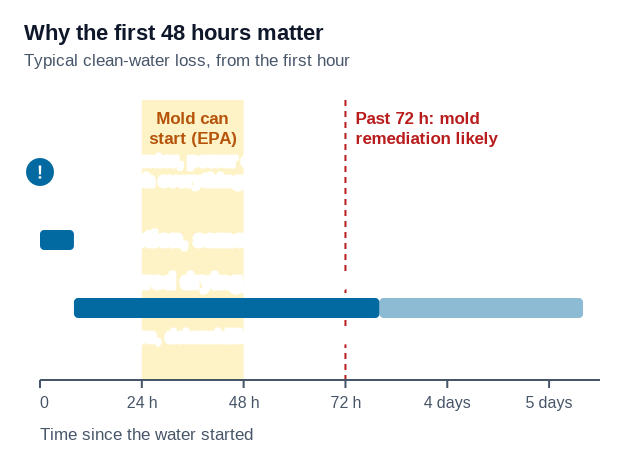
Enter how long ago the water hit and what got wet — see where you are in the 24–48 hour mold window and which materials can still be saved.
Use the free tool →Need help in Charlotte, NC?
Send the short form — urgent requests get priority routing.