Water Damage Cleanup in Florida, FL
Water damage restoration typically runs $1,383–$6,369 nationally, per our cost guide. Independent local pros serving Tampa, Orlando, Jacksonville and nearby areas. Describe the problem and we'll route your request — free, no obligation.
- 24/7 routing — active-water emergencies get priority
- Independent local crews with extraction and drying equipment
- Insurance-ready documentation from the first visit
- Free to use — no obligation, no markup
Fast response from independent local providers. No obligation.
Typical national cost$1,383 – $6,369Cost guide →Local Help in Florida, FL
This statewide guide covers the Florida rules behind water extraction, structural drying and mold work. The Department of Business and Professional Regulation (DBPR) licenses mold assessors and mold remediators under Part XVI of Chapter 468, Florida Statutes. The Department of Financial Services (DFS) publishes consumer answers on flood insurance. The Division of Emergency Management (FDEM) is the State Coordinating Agency of the National Flood Insurance Program (NFIP) and works with municipalities and counties that administer local flood damage reduction regulations.
Two 2024 hurricanes show the range of Florida water damage. The National Hurricane Center (NHC) reports that Helene made landfall in the Big Bend region as a category 4 hurricane about 10 nautical miles southwest of Perry around 0310 UTC on September 27, with storm surge inundation of 12 to 16 feet above ground level from just west of Keaton Beach through Steinhatchee. Milton made landfall on Siesta Key at 0030 UTC on October 10 with maximum sustained winds near 100 kt (category 3), and the NHC puts surge inundation at 6 to 9 feet above ground level from Venice southward to Boca Grande. FEMA lists Florida Hurricane Helene as DR-4828-FL, declared September 28, 2024, and Florida Hurricane Milton as DR-4834-FL, declared October 11, 2024.
Asked on November 7, 2026 for records with state FL and a 2024 year of loss, the OpenFEMA NFIP Redacted Claims (v3) API printed a count of 80,446. FEMA describes that dataset as claims transactions drawn from the NFIP system of record, refreshed about monthly with a lag (last data refresh September 9, 2026). It holds NFIP claims only.
Florida Service Details
What providers in this area actually see: coverage, common jobs, local pricing factors, and rules worth knowing.
Service Area Notes
- This page covers the whole state. Local guides on this site cover Tampa, Orlando and Jacksonville, plus Charlotte County and Sarasota County; they are linked below, and local building offices, flood maps and storm history are left to them.
- Charlotte and Sarasota counties are on the southwest Gulf coast below Tampa Bay, Jacksonville is in the northeast corner of the state, and Orlando is in Central Florida.
- The state rules on this page apply everywhere in Florida, including towns with no local guide here; requests from those places go to independent providers nearby, and repair permit questions belong with the city or county building department for the address.
Common Jobs in Florida
- Water removal and drying of flooring, walls and cabinetry after a supply line, water heater or air-conditioner condensate line leaks
- Flood cuts and removal of soaked drywall, insulation and flooring after storm surge or rising water
- Drying ceilings and attic insulation after rain gets past storm-damaged roofing
- Mold remediation by a DBPR-licensed mold remediator
- Documenting a homeowners or flood claim with photos, moisture readings and lists of damaged items
What Drives Pricing Here
- Which policy responds: FEMA says most homeowners insurance does not cover flood damage and that flood insurance is a separate policy that can cover buildings, contents or both. The DFS flood FAQ lists water or moisture damage resulting from a condition primarily confined to the insured building among losses NFIP policies do not cover; how a homeowners policy treats such a leak depends on its wording.
- Two flood deductibles: DFS says separate deductibles apply to NFIP building and contents coverage, and both are applied when a flood damages both.
- No living expenses: according to DFS, the Standard Flood Insurance Policy covers only direct physical flood damage to the dwelling and pays no additional living expenses while repairs are made.
- Hurricane deductible: for a personal lines residential policy with a separate hurricane deductible, section 627.701(4)(b), F.S., requires the insurer to compute and prominently display the deductible's actual dollar value on the declarations page at issuance and, at renewal, on the renewal declarations page or the premium renewal notice.
- Code-compliance money: FEMA says NFIP policyholders whose buildings are in the Special Flood Hazard Area (SFHA) and are determined substantially damaged may be eligible for up to $30,000 in Increased Cost of Compliance coverage toward floodproofing, elevating, relocating or demolishing; DFS notes none is left if the building claim is paid up to the $250,000 policy limit.
Permits & Local Rules
- What the license covers: section 468.8411, F.S., defines mold assessment and mold remediation by reference to mold growth or mold-contaminated matter of greater than 10 square feet, and remediation covers matter not purposely grown at that location. Remediation may not be work that requires a chapter 489 contractor license unless a person licensed under that chapter does it or the work complies with that chapter. DBPR's FAQ names rule chapter 61-31, F.A.C., alongside the statute.
- Exemptions: section 468.841(2) exempts from the remediation provisions a residential property owner who performs mold remediation on his or her own property, and section 468.841(1) does the same for a residential property owner doing mold assessment on his or her own property. Section 468.841 lists further exemptions in both subsections, each with its own limits; read the full section or ask DBPR before relying on any of them.
- Keeping assessment and remediation apart: section 468.8419(1)(d) says a person may not perform or offer to perform mold remediation on a structure where the mold assessor or the assessor's company provided a mold assessment within the last 12 months. Under 468.8419(2)(d), a mold remediator, a company employing one, or a company controlled by a company that also has a financial interest in a company employing one may not perform or offer to perform a mold assessment on a structure where the remediator or the remediator's company provided a mold remediation within the last 12 months. Neither bar applies to a certified contractor classified in section 489.105(3) as a Division I contractor, though DBPR may adopt rules requiring that contractor's contract to tell the homeowner of the right to request competitive bids. DBPR's FAQ quotes both 12-month bars without the Division I exception; the statute includes it, so confirm with DBPR if it matters to your job.
- Insurance and contracts: section 468.8421 requires a mold assessor to carry general liability and errors and omissions coverage for both preliminary and postremediation mold assessment of at least $1 million, and a mold remediator to carry a general liability policy of not less than $1,000,000 that includes specific coverage for mold-related claims. DBPR's FAQ says each licensee needs their own coverage or must be specifically named on the company's policy. Under section 468.8422, a mold assessment or remediation contract must be in a document or electronic record, signed or otherwise authenticated by the parties.
- Companies and individuals: section 468.8418 lets a corporation or partnership offer mold assessment or remediation to the public through licensees, but a corporation cannot hold the license, and neither the company nor the individual licensee is relieved of responsibility for the work. Ask for the name and DBPR license number of the person who will do the work.
- Floodplain rules and permits: FDEM's floodplain office helps communities administer local floodplain ordinances and the flood provisions of the Florida Building Code. FEMA says that after a disaster, local floodplain management ordinances require local officials in NFIP communities to inspect disaster-damaged structures and complete substantial damage assessments in the SFHA, and that permits are required for all repairs in the SFHA regardless of damage determinations. Elsewhere, ask the city or county building department which repairs need a permit.
Flood & Storm Risk Notes
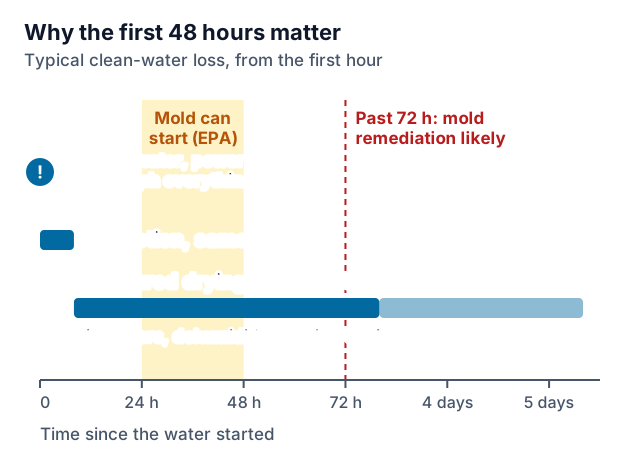
- Moisture and mold: the Florida Department of Health (DOH) says common molds can take hold when water stands for even 24 hours, and its prevention list includes drying wet building materials and carpets within 24 hours and using an air conditioner or dehumidifier to keep indoor humidity below 60 percent.
- Coastal exposure: FDEM says Florida has more than 22 million residents, 80 percent of whom live or work along or near the coast, and that as of late 2023 more than 1.7 million NFIP policies were in force in the state, nearly 35 percent of all policies nationwide.
Neighborhoods & Suburbs Served
Tampa · Orlando · Jacksonville · Charlotte County · Sarasota County
Emergency Response Expectations
DOH says water leaks must be fixed first when solving mold problems, and EPA says that if wet or damp materials or areas are dried 24-48 hours after a leak or spill, in most cases mold will not grow. Where sewage or other contaminated water caused the damage, DOH says to call a professional experienced in cleaning and fixing buildings damaged by contaminated water. For a flood loss under an NFIP policy, DFS says to report it immediately to the company or agent that wrote the policy and to file a proof of loss within 60 days of the loss; it also lists losses caused by failure to use reasonable means to preserve property after a flood among NFIP exclusions.
Florida FAQs
Does Florida's mold license law reach a small patch of mold?
The statute's definitions of mold assessment and mold remediation refer to mold growth or contaminated matter of greater than 10 square feet. Separately, a residential property owner remediating his or her own property is exempt from the remediation provisions. DOH says that if the moldy area is less than about 10 square feet, in most cases you can handle the job yourself, and that after a lot of water damage, or when growth covers more than 10 square feet, you should consult EPA's guide Mold Remediation in Schools and Commercial Buildings.
When does a new NFIP flood policy start covering a Florida home?
DFS says the answers in its flood FAQ apply specifically to policies within the jurisdiction of the National Flood Insurance Program (NFIP). For an NFIP policy, DFS says there is normally a 30-day waiting period, with two basic exceptions: no wait when the first purchase is made in connection with making, increasing, extending or renewing a loan, if the application and premium are presented at or before loan closing; and a 1-day wait when the first purchase is made during the 13 months after the community's Flood Insurance Rate Map is revised or updated. DFS also lists five further FEMA exceptions, each with its own terms, so read its FAQ or ask your agent. A flood policy from an authorized private insurer or a surplus lines insurer falls outside those answers; check that policy's own effective-date terms with the insurer.
How long do I have to give notice of a property insurance claim in Florida?
Under section 627.70132, F.S., a claim or reopened claim is barred unless notice was given to the insurer under the policy's terms within 1 year after the date of loss, and a supplemental claim within 18 months after the date of loss. For hurricanes, tornadoes, windstorms, severe rain or other weather-related events, the date of loss is the hurricane's landfall date or the date the National Oceanic and Atmospheric Administration verifies the event. The section also tolls these limits for certain deployed servicemembers and sets a separate deadline for condominium loss assessment claims.
Can I sign my insurance benefits over to the restoration company?
Not under a policy issued on or after January 1, 2023, apart from narrow exceptions. Section 627.7152(13), F.S., says that, except as provided in subsection (11), a policyholder may not assign any post-loss benefit, in whole or in part, under a residential property policy, or a commercial property policy as defined in section 627.0625(1), issued on or after January 1, 2023, and an attempted assignment is void, invalid and unenforceable. Subsection (11) excludes an assignment to a later purchaser of the property who has an insurable interest following a loss, a chapter 709 power of attorney letting a management company, family member, guardian or similarly situated person act on the claim, and liability coverage. For a policy issued before 2023, ask the insurer or DFS which rules apply.
Does an NFIP policy pay for a sewer or drain backup?
DFS says there is no coverage for loss caused directly or indirectly by backups through sewers or drains, sump pump discharges or overflows, or seepage or leaks on or through the covered property, unless there is a general condition of flooding in the area and the flood is the proximate cause.
Who decides whether a flooded Florida home is substantially damaged?
The community's building official or floodplain administrator, according to FEMA; FEMA and your insurer do not. FEMA applies the test in the high-risk flood area (SFHA), and FDEM quotes the NFIP definition, under which a structure is substantially damaged when the cost of restoring it to its pre-damage condition would equal or exceed 50 percent of its market value before the damage occurred, whatever the origin of the damage. FEMA adds that where a community has adopted a stricter rule, for example 45 percent of market value or adding up repairs over a set period, that rule applies, and that a substantially damaged structure must be brought into compliance with community floodplain regulations in every aspect.
Sources
- Online Sunshine (2026 Florida Statutes): Chapter 468, Part XVI
- Section 468.841, F.S.: Exemptions
- Section 468.8411, F.S.: Definitions
- Section 468.8418, F.S.: Certification of partnerships and corporations
- Section 468.8419, F.S.: Prohibitions; penalties
- Section 468.8421, F.S.: Insurance
- Section 468.8422, F.S.: Contracts
- Florida Administrative Code: Rule Chapter 61-31 (Florida Department of State)
- Florida DBPR: Mold-Related Services FAQs
- Section 627.701, F.S.: Liability of insureds; coinsurance; deductibles
- Section 627.70132, F.S.: Notice of property insurance claim
- Section 627.7152, F.S.: Assignment agreements
- Florida DFS: Flood Insurance Coverage FAQs
- FEMA: Flood Insurance
- FEMA Fact Sheet: Frequently Asked Questions: Substantial Damage (September 28, 2026)
- FDEM: State Floodplain Management Program
- FEMA: Florida Hurricane Helene (DR-4828-FL)
- FEMA: Florida Hurricane Milton (DR-4834-FL)
- NHC Tropical Cyclone Report: Hurricane Helene (AL092024)
- NHC Tropical Cyclone Report: Hurricane Milton (AL142024)
- FEMA OpenFEMA: NFIP Redacted Claims v3 (API queried November 7, 2026)
- Florida Department of Health: Mold
- EPA: A Brief Guide to Mold, Moisture and Your Home
Last reviewed 2026-11-07
Services Available in Florida
Emergency Water Removal
Standing water extracted fast — urgent routing to independent local crews with truck-mounted extraction and drying equipment, 24/7.
Learn more →Flood Cleanup
Storm and flood water cleanup with contamination-aware handling — extraction, sanitization, and structured drying by independent local crews.
Learn more →Water Damage Restoration
From dry-out through rebuild — independent local restoration crews handle mitigation, mold prevention, and putting your home back together.
Learn more →Mold Remediation
Visible mold or musty odor after water damage? Independent local crews handle containment, removal, and moisture-source correction.
Learn more →Sewage Backup Cleanup
Sewage in the house is a health hazard, not a mop job — urgent routing to local crews equipped for Category 3 cleanup and sanitization.
Learn more →Fire Damage Restoration
Smoke, soot, and firefighting-water cleanup after a house fire — routed to independent local restoration crews who also document the loss for your insurer.
Learn more →Free Tools Before You Call
Ballpark the cost or narrow down the problem before talking to a Florida provider.
Water Damage Restoration Cost Calculator
Estimate what water damage cleanup and restoration should cost — by area affected, water source, how far it spread, and how long it's been wet.
Use the free tool →Water Emergency — What Do I Do Right Now?
Burst pipe, leaking ceiling, or flooded basement? Answer a few questions for an ordered, do-this-now checklist — and know when to stay out.
Use the free tool →Mold Risk Timer — How Fast Does Mold Grow After Water Damage?
Enter how long ago the water hit and what got wet — see where you are in the 24–48 hour mold window and which materials can still be saved.
Use the free tool →Need help in Florida, FL?
Send the short form — urgent requests get priority routing.