Water Damage Cleanup in Las Vegas, NV
Water damage restoration typically runs $1,383–$6,369 nationally, per our cost guide. Independent local pros serving Las Vegas, North Las Vegas, Henderson and nearby areas. Describe the problem and we'll route your request — free, no obligation.
- 24/7 routing — active-water emergencies get priority
- Independent local crews with extraction and drying equipment
- Insurance-ready documentation from the first visit
- Free to use — no obligation, no markup
Fast response from independent local providers. No obligation.
Typical national cost$1,383 – $6,369Cost guide →Local Help in Las Vegas, NV
NOAA's 1991-2020 climate normals for the airport station that NCEI lists as Las Vegas McCarran AP (USW00023169) list 4.18 inches of precipitation in a normal year, 0.74 inches of it from June through August and 1.81 inches from December through February. They also average 78.2 days a year with a high of 100°F or more and 0.2 days with an inch or more of rain.
A City of Las Vegas preparedness post from August 30, 2026 says that despite its arid reputation the city is prone to flash flooding, that flooding in Las Vegas typically results from sudden storms that dump a lot of rain in a short amount of time, that the city's hard, dry soil doesn't absorb water quickly, and that pavement and buildings also reduce natural drainage. The Clark County Regional Flood Control District's flood history page says at least 35 people have died as a result of flooding in the county since 1960, and it lists Presidential Disasters in 1999 among the economic impacts.
For Las Vegas city, table B25035 of the Census Bureau's American Community Survey (2024 5-year estimates) reports a median year structure built of 1994, margin of error ±1.
Las Vegas Service Details
What providers in this area actually see: coverage, common jobs, local pricing factors, and rules worth knowing.
Service Area Notes
- In the Census Bureau's 2020 place-by-county file for Nevada, Las Vegas, Henderson, North Las Vegas, Boulder City and Mesquite are the incorporated places in Clark County. Paradise, Spring Valley, Enterprise, Sunrise Manor, Summerlin South, Whitney and Winchester are among the county's census designated places (CDPs), which the Bureau's geography glossary describes as not legally incorporated under the laws of the state in which they are located.
- Clark County's Building Administrative Code (Title 22, Chapter 22.02) defines its jurisdiction as the unincorporated area of Clark County. The City of Las Vegas building permit page asks applicants to make sure they are within the city jurisdiction before applying, so check the address first if it sits near a city line.
- Henderson and North Las Vegas run their own building offices: Henderson's Building and Fire Safety Department and the North Las Vegas Building Safety Division each say they issue permits and inspect work in their cities.
Common Jobs in Las Vegas
- Opening and drying walls after a leak in concealed supply or drain piping
- Replacing a failed water heater and drying the closet or garage around it
- Leaks that cross from one condominium or townhome unit into another
- Removing silt and debris after storm runoff gets into a garage or living area
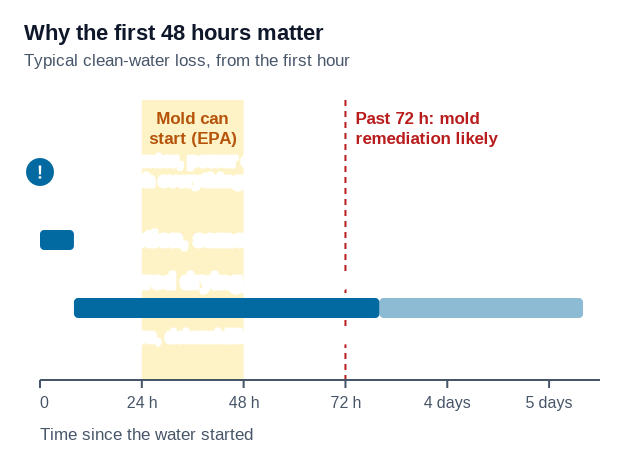
- Mold cleanup where wet drywall, carpet or insulation stayed wet past the first two days
What Drives Pricing Here
- Published national figures: HomeAdvisor's cost guide for water damage restoration, last updated Jun 17, 2026, gives a $3,874 average; most homeowners, it says, paid $1,385 to $6,381 in 2025, and a single project can cost anywhere from $450 to $16,000. HomeAdvisor publishes these for the whole country; they are not Las Vegas quotes.
- How dirty the water is: HomeAdvisor's per-square-foot table for restoration service runs from $3.50 for clean water (Category 1) through $5.25 for gray water (Category 2) to $7.50 for black water (Category 3).
- How far the water spread: the same guide puts Class 1 damage (a small part of a single room) at $150 to $400, Class 2 (an entire room, including the walls up to at least 12 inches) at $500 to $1,000, and Class 3 (nearly every part of one or more rooms) at $1,000 to $3,000.
- What has to be rebuilt: HomeAdvisor lists drywall repair at about $300 to $850 ($1.50 to $3 per square foot to replace it), ceiling repair at around $450 to $1,600, burst pipe repair at typically $1,000 to $4,000, and mold removal at roughly $1,100 to $3,400 ($2,225 on average).
- Skipped permits: the city guide warns that starting required work without a permit may bring investigation fees. The city's permit page describes a year-round amnesty program for homeowners who self-disclose non-permitted or non-code-compliant work.
Permits & Local Rules
- Inside the city, plumbing: the City of Las Vegas guide "When Do I Need a Permit? A Homeowner's Guide" says it is a guide only and not all inclusive. Among plumbing work that needs a permit it lists installing or replacing a water heater or water softener, altering piping inside a wall, ceiling or beneath a floor, and emergency repair, alteration, or replacement of damaged or leaking concealed piping. Its simple general rule also calls for a permit if you open up the interior or exterior walls of the structure.
- Inside the city, no-permit items: the same guide lists painting, papering, cabinets, countertops and similar finish work, floor covering, "except for trim and decorative work". Minor interior or exterior stucco, lath or drywall repair is exempt only if no framing needs replacement or repair, a stucco repair does not exceed 32 square feet, and the area is not a fire-resistance rated assembly made of more than one layer of drywall on each side or of special materials needed to keep its rating. Clearing stoppages or repairing leaks in pipes, valves or fixtures is exempt only when the repair does not involve or require replacing or rearranging concealed piping.
- Unincorporated Clark County: section 22.02.190 exempts painting, papering, paneling, floor coverings, cabinets, moldings, countertops and similar finish work from a building permit, and exempts minor lath or drywall repair only where no framing needs replacement or repair, the repaired area does not exceed thirty square feet, and the area is not a fire-resistance-rated assembly with more than one layer of wall board on each side or special materials needed to keep its rating. Section 22.02.195 exempts stopping leaks in drains, soil, waste or vent pipe, but a concealed trap, drainpipe, soil, waste or vent pipe that becomes defective and has to be removed and replaced counts as new work needing a permit and inspection; clearing stoppages or repairing leaks is exempt only without replacement or rearrangement of concealed piping.
- Contractor license: NRS 624.031(6) exempts work to repair or maintain property valued under $1,000, including labor and materials, unless a building permit is required; the work is of a type performed by a plumbing, electrical, refrigeration, heating or air-conditioning contractor; it is of a type performed by a contractor in a Board classification that significantly affects the health, safety and welfare of the general public; it is part of a larger project valued at $500 or more, or one where contracts under $500 were awarded to evade the chapter; or it is done by a licensee or a licensee's employee. The Contractors Board's exemptions page shows an older version of the section; the Legislature's text is current. Clark County says contractors and subcontractors issued county permits must have an active Nevada State Contractor's License and an active Multi-Jurisdictional Business License number.
- Owners doing their own work: NRS 624.031(5) covers an owner building or improving a residential structure on the property for his or her own occupancy and not intended for sale or lease; the sale or lease of a newly built structure, or offering it for sale or lease, within 1 year after its completion creates a rebuttable presumption that it was built with intent to sell or lease, and an owner who wants the exemption must apply to the Board for it. The city guide reads this as applying mainly to owners of single family homes and not to condominiums or apartments, and it says only licensed plumbers and electricians, along with homeowners working on their own homes, may legally do plumbing or electrical work in Nevada.
- Flood zones and the 50% test: the NFIP definitions in 44 CFR 59.1 call a structure substantially damaged, from any origin, when bringing it back to its condition before the damage would cost 50 percent or more of the market value the structure had before the damage occurred. The Nevada Division of Water Resources' 2020 NFIP guide says that for buildings in flood zones local officials must require damaged buildings to be brought into full compliance if the costs to repair to pre-damage condition equal or exceed 50% of the market value. The flood control district says a flood zone determination for a specific property can be obtained from the Public Works Department of the entity where the structure is located.
- City disaster assessments: a 2019 city post says owners of property within city limits damaged by a flood, fire or earthquake would need a Building & Safety disaster assessment of the damage and of what is needed to make the structure safe and code compliant; permits and plans may be required depending on the extent of the damage.
Flood & Storm Risk Notes
- Monthly rain: the station's 1991-2020 monthly normals list 0.80 inches for February, 0.38 inches for July and 0.32 inches for August, and its annual normals average 11.0 days a year with 0.10 inch or more of precipitation.
- 1999 flash flood: FEMA's page for DR-1281-NV, Nevada Severe Storms and Flash Flooding, gives an incident period of Jul 8 to Jul 16, 1999 and a declaration date of Jul 20, 1999. The Federal Register notice for that declaration names Clark County for Individual Assistance and Public Assistance.
- 2005 rains: FEMA's DR-1583-NV page, Nevada Heavy Rains and Flooding, lists an incident period of Jan 7 to Jan 13, 2005 and a declaration date of Mar 7, 2005; its Federal Register notice designates Clark and Lincoln Counties for Public Assistance.
- Flood insurance locally: the flood control district says flood insurance is available to all residents of Clark County and its incorporated cities whether or not the property is in a flood zone, that it is mandatory in a Special Flood Hazard Area (typically Zone A, AO, AE or AH) when the structure is collateral for a federally backed loan, and that typical homeowners' insurance does not cover flood damage. It says all subdivisions constructed after 1992 have been designed to be flood-protected from a 100-year flood design flow, that flood protection for homes built before 1992 may not have been designed to the same minimum standards.
- Water service lines: under Chapter 6 of the Las Vegas Valley Water District's service rules, service connections, including laterals, meters, boxes, shut-off valves and backflow assemblies, are District property, and the District is responsible for maintaining, repairing or replacing them, subject to any agreements covering their installation. All pipe and fittings on the customer's side of the meter or backflow prevention assembly two inches and below at the end of the brass tail piece, or all facilities within the property, are installed by and owned by the property owner.
Neighborhoods & Suburbs Served
Las Vegas · North Las Vegas · Henderson · Paradise · Spring Valley · Enterprise · Sunrise Manor · Summerlin South · Whitney · Winchester
Emergency Response Expectations
During a Las Vegas storm, the city says never to drive through flooded roads, to avoid washes and underpasses, and to seek higher ground. Afterward it advises staying out of flooded buildings until they have been inspected, photographing damage for insurance, using caution around damaged electrical systems and drying the home quickly to prevent mold; the flood control district's after-the-flood page passes on the Red Cross advice to dry the house and its contents within 24 to 48 hours where possible, and to assume mold growth if you cannot get back to dry it in that window.
Las Vegas FAQs
Water from the unit above came into my Las Vegas condo. Who repairs what?
Start with the declaration. For a common-interest community under NRS Chapter 116, NRS 116.3107 says that, except to the extent provided by the declaration, subsection 2 and NRS 116.31135, the association provides for maintenance, repair and replacement of the common elements and each owner does the same for his or her unit. If damage is inflicted on the common elements or on a unit through which access is taken for that work, the section makes the owner responsible for the damage, or the association if it is responsible, liable for the prompt repair.
I rent and there is mold after a leak. Who do I contact?
The Southern Nevada Health District says it does not have jurisdictional enforcement over rental housing and does not respond to Landlord/Tenant issues. It classes mold as a non-essential service problem and suggests a dated letter to the landlord asking for repairs under NRS 118A, saying the problem should be fixed or showing satisfactory progress within 14 business days of the landlord receiving it. NRS 118A.355 itself speaks of 14 days after the landlord receives written notice and does not let a tenant proceed over a condition caused by the tenant's own deliberate or negligent act or omission, or that of a household member or other person on the premises with the tenant's consent, or when the landlord's failure to remedy within 14 days is due to the tenant refusing lawful access, so read the statute or ask a legal aid office, such as Nevada Legal Services, which the health district names, before relying on either count.
Can I buy flood insurance in Las Vegas right before monsoon season?
You can, but FEMA's flood insurance page says new NFIP coverage typically waits 30 days to take effect. It names two exceptions: a policy a government-backed lender requires, and one connected with a change to the community's flood map. The flood control district says policies covering personal property are available to renters as well as homeowners.
Sources
- NOAA NCEI: U.S. Climate Normals 1991-2020, Las Vegas McCarran AP (USW00023169)
- City of Las Vegas: Flash floods happen fast
- City of Las Vegas: Disaster assessments (May 1, 2019)
- City of Las Vegas: Building and offsite permits
- City of Las Vegas: When Do I Need a Permit? A Homeowner's Guide
- Clark County Code 22.02.035: Definitions (jurisdiction)
- Clark County Code 22.02.190: Building permit exemptions
- Clark County Code 22.02.195: Plumbing permit exemptions
- Clark County Building Department: Licensing and payment requirements
- City of Henderson: Building and Fire Safety
- City of North Las Vegas: Building Safety
- Nevada Legislature: NRS 624.031
- Nevada State Contractors Board: Exemptions
- Nevada Legislature: NRS 116.3107
- Nevada Legislature: NRS 118A.355
- Southern Nevada Health District: Landlord/tenant disputes
- Regional Flood Control District: Flood insurance information
- Regional Flood Control District: After the flood
- Regional Flood Control District: History of flooding
- FEMA: DR-1281-NV, Nevada Severe Storms and Flash Flooding
- Federal Register: FEMA-1281-DR declaration notice (Aug. 11, 1999)
- FEMA: DR-1583-NV, Nevada Heavy Rains and Flooding
- Federal Register: FEMA-1583-DR declaration notice (Mar. 18, 2005)
- FEMA: Flood insurance (NFIP waiting period)
- eCFR: 44 CFR 59.1, NFIP definitions
- Nevada Division of Water Resources: NFIP in Nevada Quick Guide (2020)
- Las Vegas Valley Water District: Service rules, Chapter 6
- Census Bureau: ACS 2024 5-year B25035, Las Vegas city
- Census Bureau: 2020 places by county, Nevada
- Census Bureau: Geography glossary
- HomeAdvisor: Water Damage Restoration Cost (updated Jun 17, 2026) (third-party estimate)
Last reviewed 2026-11-13
Services Available in Las Vegas
Emergency Water Removal
Standing water extracted fast — urgent routing to independent local crews with truck-mounted extraction and drying equipment, 24/7.
Learn more →Flood Cleanup
Storm and flood water cleanup with contamination-aware handling — extraction, sanitization, and structured drying by independent local crews.
Learn more →Water Damage Restoration
From dry-out through rebuild — independent local restoration crews handle mitigation, mold prevention, and putting your home back together.
Learn more →Mold Remediation
Visible mold or musty odor after water damage? Independent local crews handle containment, removal, and moisture-source correction.
Learn more →Sewage Backup Cleanup
Sewage in the house is a health hazard, not a mop job — urgent routing to local crews equipped for Category 3 cleanup and sanitization.
Learn more →Fire Damage Restoration
Smoke, soot, and firefighting-water cleanup after a house fire — routed to independent local restoration crews who also document the loss for your insurer.
Learn more →Free Tools Before You Call
Ballpark the cost or narrow down the problem before talking to a Las Vegas provider.
Water Damage Restoration Cost Calculator
Estimate what water damage cleanup and restoration should cost — by area affected, water source, how far it spread, and how long it's been wet.
Use the free tool →Water Emergency — What Do I Do Right Now?
Burst pipe, leaking ceiling, or flooded basement? Answer a few questions for an ordered, do-this-now checklist — and know when to stay out.
Use the free tool →Mold Risk Timer — How Fast Does Mold Grow After Water Damage?
Enter how long ago the water hit and what got wet — see where you are in the 24–48 hour mold window and which materials can still be saved.
Use the free tool →Need help in Las Vegas, NV?
Send the short form — urgent requests get priority routing.