Water Damage Cleanup in Tampa, FL
Water damage restoration typically runs $1,383–$6,369 nationally, per our cost guide. Independent local pros serving Davis Islands, Ballast Point, Bayshore Beautiful and nearby areas. Describe the problem and we'll route your request — free, no obligation.
- 24/7 routing — active-water emergencies get priority
- Independent local crews with extraction and drying equipment
- Insurance-ready documentation from the first visit
- Free to use — no obligation, no markup
Fast response from independent local providers. No obligation.
Typical national cost$1,383 – $6,369Cost guide →Local Help in Tampa, FL
Tampa homeowners repairing water damage deal with different approvals for the building, the contractor and any mold work. City Construction Services reviews plans, issues building permits and inspects projects within city limits. Florida DBPR regulates construction contracting through the Construction Industry Licensing Board and separately licenses mold-related services. Start with the city for the repair scope and DBPR for the proposed contractor’s license; one check does not replace the other.
Tampa’s Post-Hurricane Permitting Guide, updated April 2026, makes its waivers conditional on a declared disaster and the Mayor exercising emergency powers. Publication does not mean those waivers are active. Confirm the current status with Construction Services before relying on a storm-era handout.
Tampa also distinguishes the permit application by building type. Its Residential Permits page applies to single-family residences and duplexes, while a condominium requires a commercial permit despite its residential occupancy. For rebuilding inside a condo, use that distinction when asking the city about the application. The city’s alteration guide separately describes work on existing one-family townhouse units no more than three stories tall.
Tampa Service Details
What providers in this area actually see: coverage, common jobs, local pricing factors, and rules worth knowing.
Service Area Notes
- The neighborhood names below come from the city’s own District Four neighborhood-association list: Davis Islands, Ballast Point, Bayshore Beautiful, Bayshore Gardens, Golfview and Palma Ceia. They identify Tampa neighborhoods, rather than a service radius or a promise about availability.
- City limits determine the building office. Tampa Construction Services handles city projects; Hillsborough County Development Services maintains building-permitting records for unincorporated Hillsborough County. Its records guide explicitly asks users to confirm that the parcel is in the unincorporated county. Use the city’s permit system for a Tampa city repair and the county’s HillsGovHub resources for a county-jurisdiction property.
- Existing permit records can help identify earlier work. The county’s records guide lists building plans, permit applications, inspection results, elevation certificates and completion or occupancy certificates among the records it maintains for unincorporated parcels. For a city property, request the corresponding information through Tampa Construction Services rather than treating county records as a substitute.
Common Jobs in Tampa
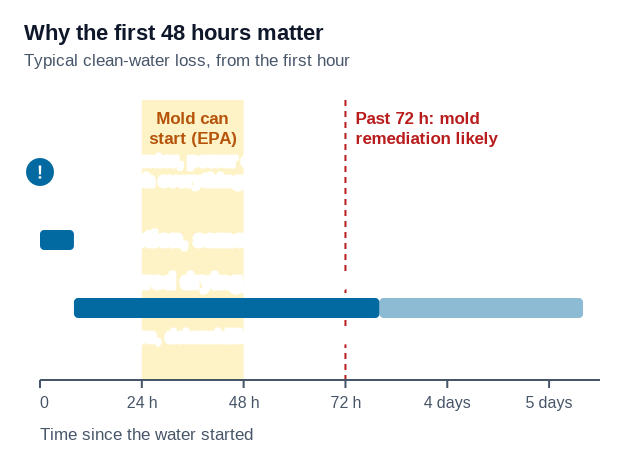
- Wet-wall and floor cleanup: EPA advises drying water-damaged areas and belongings within 24–48 hours to prevent mold growth.
- Moldy finishes: EPA says absorbent materials such as carpet and ceiling tile may need disposal, and warns against painting or caulking over mold.
- Interior reconstruction: Tampa’s Residential Alterations guide includes kitchen and bathroom remodeling and both structural and nonstructural remodeling among its examples.
- Equipment and envelope repairs: the alteration guide addresses plan information for work involving HVAC, water heaters, windows, doors, walls, foundations and roof or floor framing; use the full checklist for the actual scope.
What Drives Pricing Here
- National reference, not a Tampa bid: HomeAdvisor’s water damage guide, updated June 17, 2026, reports a $3,874 average and says most homeowners spent $1,385–$6,381 in 2025. Its published factors include the affected area’s size, the water category and the extent of damage. Those national figures do not establish what a particular Tampa home will cost.
- Water condition: HomeAdvisor’s restoration-service table lists per-square-foot averages of $3.50 for Category 1 clean water, $5.25 for Category 2 gray water and $7.50 for Category 3 black water. The guide distinguishes water category from damage class, which describes the extent of damage. Ask for the estimate to identify the water involved and the materials affected instead of choosing a price band from the storm’s name.
- Repair scope: HomeAdvisor treats drywall and ceiling repairs, burst-pipe repairs and mold removal as cost components. Ask a written estimate to distinguish water removal and drying from the repair of the leak, mold work and rebuilding. Check the proposed reconstruction against the city’s permit guidance before agreeing to the finished scope.
- Permit charges: consult Construction Services for applicable fees and any active storm-related waiver. Tampa’s hurricane guide distinguishes a fee waiver from a waiver of the permit itself.
Permits & Local Rules
- Small-project exemption: section 553.79(1)(g), Florida Statutes, covers an owner of a single-family dwelling or the owner’s contractor doing work valued below $7,500 on the owner’s property. It excludes property partly or wholly in a Florida Building Code flood hazard area and excludes electrical, plumbing, structural, mechanical or gas work on property containing a single-family dwelling. Projects cannot be divided to evade the rule. Qualification requires a written request to the local enforcement agency with the contract or other documentation showing the work’s nature and value. The statute assigns the local government no legal duty to the owner, contractor or their successors or assigns for this exempt work. Send the request to the correct building office and confirm its handling before relying on the exemption.
- Storm-only drywall allowance: under the declared-disaster and mayoral-emergency conditions in Tampa’s April 2026 guide, the drywall permit waiver is limited to repairs two feet or less above the finished floor. Its finishing-work allowance is for standalone finishing; finishing combined with electrical and plumbing work requires a permit. Ask the city about work beyond these limits.
- Flood paperwork: under that guide’s same emergency conditions, a repair in a Special Flood Hazard Area needs a Substantial Improvement Determination form even if the repair itself needs no permit. With a permit, submit it in the application; without one, use Accela’s Administrative Records option, which the guide says is activated only following a declared disaster.
- Alteration applications: Tampa’s Residential Alterations guide is minimum filing guidance, not an all-inclusive list. It specifies the Residential Building Alterations (Renovations) record type and requires the applicant-signed substantial-improvement determination with the project application when the structure stands in an SFHA. Consult the entire guide for plans, signatures and project-dependent documents; a partial list is not an application checklist.
- Construction licensing: DBPR distinguishes certified contractors, allowed to contract statewide without meeting each jurisdiction’s competency requirements, from registered contractors, whose contracting is limited to the jurisdictions for which registration was issued. Ask DBPR whether the license covers the proposed rebuilding work. For an owner-builder proposal, refer directly to section 489.103(7) and Construction Services; do not assume that owning the home by itself establishes eligibility.
- Mold scope: section 468.8411 defines assessment by reference to mold growth greater than 10 square feet and remediation by reference to mold or contaminated matter greater than 10 square feet that was not purposely grown there. Mold remediation cannot include chapter 489 contracting work unless done by someone licensed under that chapter or in compliance with it. Section 468.841 contains exemptions, including residential owners assessing or remediating their own property; consult its full text or DBPR for the other exemption categories and their limits.
Flood & Storm Risk Notes
- Tampa’s substantial-damage definition in section 5-121.245 covers damage of any origin when restoring the structure to its pre-damage condition would cost at least 50% of its pre-damage market value. It also includes flood damage on two separate occasions within ten years when repair costs at each flood, on average, reach at least 25% of the structure’s pre-damage market value.
- The same section measures substantial improvement over one year, with cumulative costs reaching 50% of the structure’s market value before work starts. The year begins on the later date of approved final inspection on trade permits or issuance of the completion or occupancy certificate for projects needing plan review. Any repairs to a substantially damaged structure count regardless of work actually performed. Excluded are minimum improvements needed for safe living conditions to correct existing health, sanitary or safety violations identified by the building official, and historic-structure alterations that preserve historic designation. Ask the city to apply these definitions to the repair history.
- Helene: FEMA identifies Florida Hurricane Helene as DR-4828-FL, declared September 28, 2024, with an incident period September 23–October 7, 2024. Its initial notice names Hillsborough County for Individual Assistance and for Public Assistance debris removal and emergency protective measures, Categories A and B, including direct federal assistance.
- Milton: FEMA’s DR-4834-FL page gives an October 11, 2024 declaration and an October 5–November 2, 2024 incident period. Hillsborough appears in the initial notice for Individual Assistance and Categories A and B Public Assistance, including direct federal assistance. These are historical declarations; FEMA’s disaster pages say their individual-assistance application periods are closed.
Neighborhoods & Suburbs Served
Davis Islands · Ballast Point · Bayshore Beautiful · Bayshore Gardens · Golfview · Palma Ceia
Emergency Response Expectations
EPA advises using a professional experienced with contaminated-water damage when sewage or other contaminated water caused the loss. It also warns against running an HVAC system known or suspected to be mold-contaminated, because it could spread mold through the building. For immediate cleanup choices, follow the agency’s full mold guide; for Tampa’s rebuilding and flood paperwork, use Construction Services before closing the damaged assemblies.
Tampa FAQs
Who handles the floodplain part of a Tampa repair?
Start with Construction Services. The city’s Code and Flood Information page links its flood resources, and its hurricane guide directs questions about substantial-damage letters to its Flood Code function. Use that office for the property-specific review before choosing a rebuild design. The Residential Alterations guide requires substantial-improvement documentation for an SFHA structure even outside the guide’s separate emergency-waiver discussion.
Can the mold assessor also take the remediation contract?
Do not rely on a blanket yes or no. Section 468.8419 contains twelve-month restrictions on assessment and remediation at the same structure, along with a certified Division I contractor exception and provisions for possible competitive-bid disclosures. Ask DBPR to check the proposed arrangement against the full section, including company relationships. Section 468.8422 separately requires an assessment or remediation contract to be in a document or electronic record signed or otherwise authenticated by the parties.
Does homeowners insurance pay for flood cleanup?
FEMA says most homeowners insurance does not cover flood damage. Flood insurance is a separate policy that can cover a building, its contents or both. Ask the insurer to identify the applicable policy for this loss rather than assuming a cleanup invoice will be paid under homeowners coverage. For future NFIP coverage, FEMA says a policy typically has a 30-day wait, except for coverage purchased as required by a government-backed lender or related to a community flood-map change; ask about the applicable exception and effective date.
Should mold sampling come before drying the house?
EPA says sampling is usually unnecessary when visible mold growth is present and that there are no federal limits for mold or mold spores. For the cleanup itself, EPA emphasizes fixing the moisture problem. If there has been extensive water damage or growth exceeds about ten square feet, its household guide refers readers to the more detailed school and commercial-building remediation guidance. Ask DBPR about regulated assessment work rather than treating a sample as permission to rebuild.
Sources
- City of Tampa: Construction Services
- City of Tampa: Residential Permits
- City of Tampa: District Four neighborhood associations
- Hillsborough County: Development Services records for unincorporated parcels
- City of Tampa: Post-Hurricane Permitting Guide (April 2026)
- City of Tampa: Residential Alterations application guide
- City of Tampa Code: section 5-121.245, flood definitions
- City of Tampa: Code and Flood Information
- Florida DBPR: Construction Industry Licensing Board
- Florida DBPR: Mold-Related Services FAQs
- Florida Statutes 553.79: permit exemptions
- Florida Statutes 489.103: contractor exemptions
- Florida Statutes 468.841: mold exemptions
- Florida Statutes 468.8411: mold definitions
- Florida Statutes 468.8419: mold prohibitions and exceptions
- Florida Statutes 468.8422: mold contracts
- EPA: A Brief Guide to Mold, Moisture and Your Home
- FEMA: Florida Hurricane Helene, DR-4828-FL
- FEMA: Helene initial declaration notice, Hillsborough designation
- FEMA: Florida Hurricane Milton, DR-4834-FL
- FEMA: Milton initial declaration notice, Hillsborough designation
- FEMA: Flood Insurance
- HomeAdvisor: Water Damage Restoration Cost (updated June 17, 2026; national) (third-party estimate)
Last reviewed 2026-11-14
Services Available in Tampa
Emergency Water Removal
Standing water extracted fast — urgent routing to independent local crews with truck-mounted extraction and drying equipment, 24/7.
Learn more →Flood Cleanup
Storm and flood water cleanup with contamination-aware handling — extraction, sanitization, and structured drying by independent local crews.
Learn more →Water Damage Restoration
From dry-out through rebuild — independent local restoration crews handle mitigation, mold prevention, and putting your home back together.
Learn more →Mold Remediation
Visible mold or musty odor after water damage? Independent local crews handle containment, removal, and moisture-source correction.
Learn more →Sewage Backup Cleanup
Sewage in the house is a health hazard, not a mop job — urgent routing to local crews equipped for Category 3 cleanup and sanitization.
Learn more →Fire Damage Restoration
Smoke, soot, and firefighting-water cleanup after a house fire — routed to independent local restoration crews who also document the loss for your insurer.
Learn more →Free Tools Before You Call
Ballpark the cost or narrow down the problem before talking to a Tampa provider.
Water Damage Restoration Cost Calculator
Estimate what water damage cleanup and restoration should cost — by area affected, water source, how far it spread, and how long it's been wet.
Use the free tool →Water Emergency — What Do I Do Right Now?
Burst pipe, leaking ceiling, or flooded basement? Answer a few questions for an ordered, do-this-now checklist — and know when to stay out.
Use the free tool →Mold Risk Timer — How Fast Does Mold Grow After Water Damage?
Enter how long ago the water hit and what got wet — see where you are in the 24–48 hour mold window and which materials can still be saved.
Use the free tool →Need help in Tampa, FL?
Send the short form — urgent requests get priority routing.