Water Damage Cleanup in Minneapolis, MN
Water damage restoration typically runs $1,383–$6,369 nationally, per our cost guide. Independent local pros serving Longfellow, Powderhorn Park, Linden Hills and nearby areas. Describe the problem and we'll route your request — free, no obligation.
- 24/7 routing — active-water emergencies get priority
- Independent local crews with extraction and drying equipment
- Insurance-ready documentation from the first visit
- Free to use — no obligation, no markup
Fast response from independent local providers. No obligation.
Typical national cost$1,383 – $6,369Cost guide →Local Help in Minneapolis, MN
NOAA's 1991-2020 normals for the Minneapolis/St. Paul airport station (USW00014922) put the January normal low at 8.8°F and count, on average, 22.1 days a year when the low reaches 0°F or colder and 72.3 days when the high stays at or below 32°F. The same station's normals list 51.2 inches of snow a year.
The City of Minneapolis tells property owners that they own the water service line from its connection to the City main to the meter, and that hiring and paying someone to repair it when it leaks or freezes is their job. The City says most lines are buried deep enough not to freeze, but a line can freeze in very cold weather if frost reaches its depth or if the basement is unheated where the line comes into the house. It advises keeping those basement spaces above freezing and, until the ground thaws, keeping a pencil-width trickle of cold water running from a faucet on the lowest level, while making sure the drain is free of debris to prevent overflowing or flooding. The City suggests a visible note on the faucet so nobody in the house turns it off, because shutting the water off even for a few minutes can make a recently frozen line freeze again.
In the Census Bureau's American Community Survey 5-year estimates for 2020-2024, Minneapolis city has 209,080 housing units; 89,537 were built in 1939 or earlier, and the median year built is 1951.
Minneapolis Service Details
What providers in this area actually see: coverage, common jobs, local pricing factors, and rules worth knowing.
Service Area Notes
- This page covers the City of Minneapolis. The City says it has 83 residential neighborhoods; the names under areas served come from the neighborhood boundary layer the City publishes on its open data site.
- Inside city limits, the City's permit-types page lists the construction permits it issues, among them building, mechanical, plumbing and wrecking permits, and sends people to the Minnesota Department of Labor and Industry (DLI) for electrical and elevator permits.
- The Census Bureau's 2020 place-by-county file lists Minneapolis city in Hennepin County, along with other incorporated places in the county, among them St. Louis Park, Richfield, Edina, Golden Valley and Robbinsdale. The City of Minneapolis permit, license and floodplain rules described on this page apply within Minneapolis; for a house in another city, ask that city's building department.
Common Jobs in Minneapolis
- Drying and repairs after a frozen supply pipe or water service line splits
- Ceiling, attic insulation and wall drying after ice dams or a roof leak
- Basement cleanup after sewage or storm water comes up through a floor drain
- Removing soaked carpet, pad, drywall and insulation from finished basements
- Replacing wiring, panels, furnaces or water heaters that floodwater reached
What Drives Pricing Here
- National benchmark only: on its cost page for repairing water damage, dated Updated Jun 17, 2026, HomeAdvisor puts the average at $3,874 and says most homeowners paid in a range of $1,385 to $6,381 in 2025. These are national figures, not Minneapolis quotes.
- Winter losses in that guide: repairing burst pipes typically costs $1,000 to $4,000, repairing a ceiling around $450 to $1,600 (with professionals charging around $75 per hour to fix a sagging ceiling caused by water damage), and repairing a roof around $400 to $1,700. HomeAdvisor names ice dams during the winter among the common causes of leaky roofs.
- Basements and water category: HomeAdvisor's per-square-foot table runs from $3.50 when the water is clean (Category 1) to $5.25 when it is gray (Category 2) and $7.50 when it is black (Category 3), and the guide puts two feet of water from a sewage backup at $2,800 or more.
- Insurance-paid work: under Minn. Stat. 325E.66, a residential building contractor, remodeler or roofer providing home repair or improvement services to be paid by the insured from property or casualty insurance proceeds may not, as an inducement, advertise or promise to pay all or part of any applicable deductible or offer to compensate the insured for providing any service, which includes but is not limited to offering compensation for allowing an inspection, making a claim or referring the contractor to others when insurance proceeds are payable. The contractor may not give the homeowner an agreement authorizing repairs without a good-faith itemized and detailed estimate of services and materials, and may not interpret policy provisions, advise on coverage or duties, or adjust the claim unless licensed as a public adjuster under chapter 72B. The contractor must give written notice of these requirements with its initial estimate, the adjuster or insurer must give written notice of them in its initial estimate on the claim, and the insurer need not consider an estimate from a contractor that violates the section.
- Permit fees are not quoted here; the City's construction permits overview links its page explaining how permit fees and fines are calculated.
Permits & Local Rules
- City permits: the City of Minneapolis says almost all projects require a building permit before work starts. Its list of work that may be exempt includes, for interior building work, cabinets and countertops, carbon monoxide detectors and smoke alarms, floor tile and carpeting, and wallpaper and paint. For plumbing in one- and two-family dwellings, the page lists work that may be done without a permit only if conditions are sanitary and not hazardous, the existing water supply line or plumbing piping system is not altered or replaced, and the project meets all the conditions; its items include repairing broken drain, waste and vent pipes and leaking fixtures and water pipes. The City says size, location and other conditions may apply and asks people to confirm with it.
- Emergency work: the City says emergency repairs can be done before you apply for a permit, but you must apply within the next working business day. Minnesota Rules 1300.0120, subpart 5, likewise says that when equipment replacements and repairs must be performed in an emergency, the permit application goes to the building official within the next working business day.
- Ordinary repairs under the state rule: subpart 6 says no application or notice is needed for ordinary repairs to structures, but the rule excludes from ordinary repairs: opening or removing any wall, partition or portion of one; cutting or removing any structural beam or load-bearing support; taking out or altering a required means of egress, or rearranging the structure in ways that affect egress requirements; and adding to, altering, replacing or relocating electric wiring, mechanical work, other work affecting public health or general safety, or piping (the rule names standpipe, sewer, drainage, drain leader, water supply, gas, soil, waste, vent and similar piping). Because that list covers opening a portion of a wall, ask the City before cutting out wet drywall.
- Electrical after a flood: DLI says not to re-energize electrical wiring and equipment exposed to floodwater, and that electrical equipment, panelboards, receptacles, switches, furnaces, water heaters, appliances and similar apparatus, and all wiring, conductors and cables, must be replaced; it allows that cables or conductors suitable for direct burial or wet locations may not need replacing where their ends were not submerged. DLI says electrical work in Minnesota must be installed by properly licensed electrical contractors; its page sets out the strict limits of the homeowner exemption from licensing, and says homeowners are not exempt from inspections.
- State contractor license: under Minn. Stat. 326B.802 and 326B.805, a person in the business of contracting with an owner to improve existing residential real estate (a building for one to four families, including detached garages) by providing two or more of the statute's eight special skills must hold a residential remodeler or residential building contractor license, and a residential roofer must be licensed as a roofer, remodeler or building contractor. Subdivision 6 sets out ten exemptions with their own limits; check that text, or ask DLI, before relying on one. DLI's online lookup shows whether a contractor holds a license.
- City contractor license: the City of Minneapolis says you need a license from the City to do certain residential contractor work; its residential specialty contractor license is for a contractor or remodeler who owns or operates the business, negotiates contracts and works on places with four or fewer living units, covering one of excavation, masonry, carpentry, interior finishing, exterior finishing, drywall and plaster or general installation. The City says roofers need a State of Minnesota license rather than a Minneapolis one, and that a holder of a State of Minnesota Residential Building license does not need the City license; it calls the page a guideline only.
- Floodplain: the City's FP Floodplain Overlay District (Minneapolis Code 535.1400 to 535.1540) applies to land within the City's jurisdiction that the official zoning map or its attachments show inside the Floodway or Flood Fringe District, using FEMA's Flood Insurance Study for Hennepin County and flood insurance rate map panels dated November 4, 2016. Within those districts, section 535.1440 requires a permit from the zoning administrator before, among other activities, the repair of a structure damaged by flood, fire, tornado or any other source, and it requires a permit for normal maintenance and repair when that work, alone or together with other planned work, amounts to a substantial improvement.
- Substantial damage: section 535.1430 calls damage of any origin substantial when restoring the structure to how it was before the damage would cost an amount equal to or above 50 percent of its pre-damage market value. Under section 535.1520, a nonconformity that is substantially damaged may not be reconstructed except in conformity with the ordinance, applying the Floodway or Flood Fringe standards for new structures, and section 535.1520 sets a separate rule for repetitive flood losses. FEMA's quick guide says local officials, not state or federal officials, make these determinations, using the market value of the structure without the land.
Flood & Storm Risk Notes
- Federal declarations: FEMA's page for DR-4182, Minnesota Severe Storms, Straight-line Winds, Flooding, Landslides, and Mudslides, gives an incident period of Jun 11 to Jul 11, 2014 and a declaration date of Jul 21, 2014; Amendment No. 3 in the Federal Register, effective August 21, 2014, added Hennepin and Ramsey Counties for Public Assistance. FEMA's page for DR-4290, Minnesota Severe Storms and Flooding, gives an incident period of Sep 21 to Sep 24, 2016 and a declaration date of Nov 2, 2016; Amendment No. 1, effective November 29, 2016, added Hennepin County for Individual Assistance.
- Sewer backups: the City's sewer page says most backups happen when roots grow into a cracked or broken sanitary lateral, and that they can also come from a sewer pipe in poor condition, ground movement, higher than normal amounts of rain or misuse of the sewer system in the home. A blockage in a City sewer pipe can send water or sewage up through basement floor drains.
- Indoor moisture: the Minnesota Department of Health lists leaking roofs and ice dams, leaking pipes, basement flooding, pooling water at the foundation and condensation on windows and exterior walls among the places water and mold show up. To keep surfaces dry it suggests indoor relative humidity between 20 and 40 percent in winter and below 60 percent the rest of the year, and it recommends insulating and sealing air leaks between the attic and the house to prevent ice dams.
- Rain: the airport station's 1991-2020 normals give 31.62 inches of precipitation a year, with 4.58 inches in June and 4.34 inches in August, and 6.5 days in an average year with at least 1.00 inch.
Neighborhoods & Suburbs Served
Longfellow · Powderhorn Park · Linden Hills · Marcy Holmes · Audubon Park · Seward · Northrop · Folwell
Emergency Response Expectations
If sewage is coming up through a Minneapolis floor drain, the City's sewer problems page says to contact its Sewer Operations hotline, or the stand-by employee outside 7 a.m. to 3:30 p.m.; City Sewer Operations assesses the situation at the property at no charge and resolves a blockage found in the City-owned sewer pipe, while a blockage in the private lateral may need a drain cleaning service; owners who believe the City is at fault can get a claim form. For a suspected frozen service line, the City's frozen-lines page says it can send an inspector to confirm the freeze, but the owner pays the contractor who thaws or repairs it. Requests sent through this page go to independent restoration firms; this site does not do the work.
Minneapolis FAQs
Which parts of a wet-basement tear-out and rebuild need a Minneapolis permit?
It depends on the work. The City's exempt list covers finish work such as carpet, floor tile, paint and wallpaper, but the state's ordinary-repair allowance does not cover opening walls or adding to, altering, replacing or relocating piping or wiring, and the City says almost all projects need a building permit. Emergency repairs may start first, with the application due the next working business day. Electrical permits come from DLI, and a house in the City's Floodway or Flood Fringe District also needs the zoning administrator's permit to repair flood damage.
Does Minnesota license mold remediation companies?
No. The Minnesota Department of Health says neither the state of Minnesota nor any federal agency licenses or certifies mold investigators or remediators. MDH says that in most situations it does not recommend mold testing, and it does not recommend ozone to address mold. It says porous materials that sewage has touched should always be removed and that rebuilding should wait until the affected areas are completely dry.
Does a Minneapolis homeowners policy cover flooding, and how soon does new flood coverage start?
Usually it does not: FEMA's flood insurance page states that most homeowners insurance does not cover flood damage; flood insurance is a separate policy. On timing, FEMA says there is typically a 30-day wait before a National Flood Insurance Program policy goes into effect, with two exceptions named on that page: coverage bought because a government-backed lender requires it, and coverage related to a community flood map change. Another FEMA fact sheet describes a post-wildfire exception with its own criteria.
Sources
- Minneapolis: Construction permits overview
- Minneapolis: Work exempt from permit
- Minneapolis: Types of construction permits
- Minneapolis: Residential specialty contractor license
- Minneapolis: Frozen water service lines
- Minneapolis: Sewer problems in the home
- Minneapolis: Neighborhoods
- Minneapolis Open Data: Neighborhoods layer
- Minneapolis Code ch. 535, art. XII: FP Floodplain Overlay
- Minn. R. 1300.0120: Permits
- Minn. Stat. 326B.802: Definitions
- Minn. Stat. 326B.805: Licensing and exemptions
- Minn. Stat. 325E.66: Contractors and insurance claims
- DLI: Residential contractor licensing
- DLI: Contractors and insurance deductibles
- DLI: Flood-damaged electrical systems
- MDH: Mold and Moisture
- FEMA: DR-4182-MN
- Federal Register: FEMA-4182-DR Amendment No. 3
- FEMA: DR-4290-MN
- Federal Register: FEMA-4290-DR Amendment No. 1
- FEMA: Flood insurance
- FEMA: Post-wildfire 30-day exception
- FEMA: Substantial Damage Quick Guide
- NOAA NCEI: annual normals, USW00014922
- NOAA NCEI: monthly normals, USW00014922
- Census Bureau: ACS 5-year B25034, Minneapolis
- Census Bureau: ACS 5-year B25035, Minneapolis
- Census Bureau: 2020 places by county, Minnesota
- HomeAdvisor: Water damage restoration cost (updated Jun 17, 2026) (third-party estimate)
Last reviewed 2026-11-13
Services Available in Minneapolis
Emergency Water Removal
Standing water extracted fast — urgent routing to independent local crews with truck-mounted extraction and drying equipment, 24/7.
Learn more →Flood Cleanup
Storm and flood water cleanup with contamination-aware handling — extraction, sanitization, and structured drying by independent local crews.
Learn more →Water Damage Restoration
From dry-out through rebuild — independent local restoration crews handle mitigation, mold prevention, and putting your home back together.
Learn more →Mold Remediation
Visible mold or musty odor after water damage? Independent local crews handle containment, removal, and moisture-source correction.
Learn more →Sewage Backup Cleanup
Sewage in the house is a health hazard, not a mop job — urgent routing to local crews equipped for Category 3 cleanup and sanitization.
Learn more →Fire Damage Restoration
Smoke, soot, and firefighting-water cleanup after a house fire — routed to independent local restoration crews who also document the loss for your insurer.
Learn more →Free Tools Before You Call
Ballpark the cost or narrow down the problem before talking to a Minneapolis provider.
Water Damage Restoration Cost Calculator
Estimate what water damage cleanup and restoration should cost — by area affected, water source, how far it spread, and how long it's been wet.
Use the free tool →Water Emergency — What Do I Do Right Now?
Burst pipe, leaking ceiling, or flooded basement? Answer a few questions for an ordered, do-this-now checklist — and know when to stay out.
Use the free tool →Mold Risk Timer — How Fast Does Mold Grow After Water Damage?
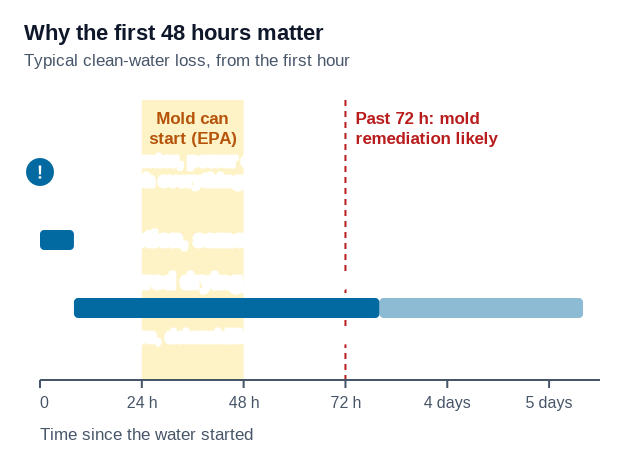
Enter how long ago the water hit and what got wet — see where you are in the 24–48 hour mold window and which materials can still be saved.
Use the free tool →Need help in Minneapolis, MN?
Send the short form — urgent requests get priority routing.