Water Damage Cleanup in Morris County, NJ
Water damage restoration typically runs $1,383–$6,369 nationally, per our cost guide. Independent local pros serving Morristown, Parsippany-Troy Hills, Denville and nearby communities. Describe the problem and we'll route your request — free, no obligation.
- 24/7 routing — active-water emergencies get priority
- Independent local crews with extraction and drying equipment
- Insurance-ready documentation from the first visit
- Free to use — no obligation, no markup
Fast response from independent local providers. No obligation.
Typical national cost$1,383 – $6,369Cost guide →Local Help in Morris County, NJ
Morris County's 2025 Hazard Mitigation Plan update describes riverine flooding along the Passaic, Pompton, Rockaway and Whippany rivers, and it names Lincoln Park Borough and Pequannock Township, on either side of the Pompton River, as the two most flood-prone municipalities in the county. The same plan says high groundwater can cause problems even where there is no surface flooding, and that basements are susceptible to it.
FEMA's OpenFEMA records for Morris County include the remnants of Hurricane Ida (DR-4614, declared September 5, 2021) and Tropical Storm Isaias (DR-4574, declared December 11, 2020). In those county rows, the Ida declaration marks the Individuals and Households Program as declared and the Isaias declaration does not; both mark Public Assistance and Hazard Mitigation as declared.
Morris County Service Details
What providers in this area actually see: coverage, common jobs, local pricing factors, and rules worth knowing.
Service Area Notes
- The county's Cities and Towns page lists 39 municipalities, among them Morristown, Parsippany-Troy Hills, Denville, Dover, Boonton, Lincoln Park, Pequannock, Montville and Randolph.
- Rockaway Borough and Rockaway Township appear on that list as separate municipalities, as do Boonton and Boonton Township, so confirm which one your property is in before contacting a construction office.
Common Jobs in Morris County
- Pumping out and drying basements after river or stream flooding
- Drying basements where groundwater seeps in without surface flooding
- Cleanup after a burst supply line or a leaking water heater
- Removing soaked drywall, carpet, flooring and insulation
- Checking for mold after slow leaks
- Photo and moisture records for flood or homeowners claims
What Drives Pricing Here
- HomeAdvisor's national cost guide (updated Jun 17, 2026) puts the expected rate at $3.50 to $7.50 per square foot, varying by water category. These are national figures, not Morris County quotes.
- The same guide says black water removal costs around $7 to $7.50 per square foot and that this price doesn't include repairing and replacing infected items, so those repairs come on top of the removal rate.
- In a Special Flood Hazard Area, repairs costing 50 percent or more of the structure's market value make it substantially damaged under FEMA's guidance, and it must then meet current local floodplain management standards.
Permits & Local Rules
- Ordinary maintenance can proceed without filing a permit application or notifying the construction official (N.J.A.C. 5:23-2.7). The rule's list includes installing, repairing or replacing interior finishes on less than 25 percent of the wall area in a one- or two-family dwelling, which covers plastering and drywall; vinyl wall covering in any amount; repairing, replacing or installing any flooring material with a new material; and installing insulation, other than foam plastic, adjacent to or not more than one and a half inches from an interior finish. Paneling is not ordinary maintenance, and the rule says its list is not all-inclusive. One limit sits in N.J.A.C. 5:23-2.14(a)1: notwithstanding the exceptions in 2.14(b), including ordinary maintenance, minor work and emergency work, a permit is required for any work to abate violations cited in a Notice of Violation and Order to Terminate (F213) issued after a certificate of occupancy has been issued.
- The same rule takes several kinds of work out of ordinary maintenance: cutting away any loadbearing wall or partition; removing or cutting a structural beam or bearing support; removing or changing a required means of egress, or rearranging parts of a structure in a way that affects exitway requirements; any work affecting structural or fire safety; work that increases a building's nonconformity with the regulations; lead abatement; and adding to, altering, replacing or relocating standpipes, water supply, sewer, drainage, gas, soil, waste, vent or similar piping, electrical wiring (apart from the communications wiring the rule allows) or mechanical or other work affecting public health or general safety.
- For burst pipes, the ordinary plumbing maintenance list includes repair of leaks involving the replacement of piping, while N.J.A.C. 5:23-2.17A lists replacing existing plumbing piping with new and approved material of like capacity as minor work. Ask the construction official which one fits your repair.
- Minor work (N.J.A.C. 5:23-2.17A) still needs a permit, but it may begin once the owner, or an architect or contractor acting for the owner, gives the enforcing agency notice before work starts. The rule sets what the notice must contain, requires the completed permit application, delivered in person or by mail, within five business days from the date of the notice, and requires inspections. Renovation or alteration in an existing one- or two-family dwelling falls in this category only when no primary structural members are altered in any way and the work does not constitute reconstruction; lead abatement is never minor work.
- Emergency work not involving lead abatement is also excepted from the permit-first rule (N.J.A.C. 5:23-2.14), but notice must be given as soon thereafter as is practicable and a permit applied for not later than 72 hours thereafter. The F213 limit above applies to emergency work too.
- Contractors: under the Contractors' Business Registration Act (N.J.S.A. 56:8-136 et seq., renamed and amended by P.L.2023, c.237), no contractor business may offer to perform, engage or attempt to engage in the business of making or selling home improvements unless it is registered with the Division of Consumer Affairs. The Act defines home improvement to include repairing and restoring the whole or any part of any residential property, and its exemptions are in N.J.S.A. 56:8-140. A registered contractor business must secure, maintain and file proof of commercial general liability insurance of at least $500,000 per occurrence and workers compensation insurance unless exempted by law, and, if either policy is cancelled or nonrenewed, must submit a certificate for a new or replacement policy as soon as practicable and no more than 10 days later.
- P.L.2023, c.237, approved January 8, 2024, also creates the New Jersey State Board of Home Improvement and Home Elevation Contractors, with the licensing sections (9 through 13) inoperative until the first day of the sixth month after the board adopts its rules; ask the Division of Consumer Affairs what a contractor needs today.
- In a flood hazard area, NJDEP may also be involved: it regulates those areas under the Flood Hazard Area Control Act (N.J.S.A. 58:16A-50 et seq.), and its Inland Flood Protection Rule, effective July 17, 2023, sets a new Design Flood Elevation that raises the fluvial (non-tidal) flood elevation mapped by DEP by two feet. DEP says the rule informs new development and reconstruction and does not apply to existing development; ask DEP and your floodplain administrator whether your rebuild needs a Flood Hazard Area permit.
Flood & Storm Risk Notes
- Pompton River: the county plan says it is formed by the Ramapo, Wanaque and Pequannock rivers and flows south between Lincoln Park Borough and Pequannock Township, significantly flooding both.
- Passaic River: the plan's list of municipalities it floods includes Chatham Borough, Chatham Township, East Hanover Township, Florham Park Borough, Hanover Township, Harding Township, Lincoln Park Borough, Long Hill Township and Montville Township.
- Rockaway and Whippany rivers: the plan names the Town of Boonton and the townships of Denville, Jefferson, Parsippany-Troy Hills and Rockaway as flooded by the Rockaway River, which set a new flood record in August 2011, and East Hanover Township, Morris Township, Morristown and Parsippany-Troy Hills Township as flooded by the Whippany.
- Season: the plan says the most extensive floods have occurred mostly in late summer and early fall and are usually linked to tropical disturbances moving north along the Atlantic coast, while spring flooding compounded by ice and snowmelt has also occurred.
- Repeat losses: the plan reports that NFIP data shows 886 repetitive loss and 293 severe repetitive loss properties in Morris County. It also reported that FEMA and NJDEP were updating the county's flood maps, so confirm the map in effect for your address.
- Climate: NOAA's 1991-2020 normals for the Boonton 1 SE station, which NOAA lists in Morris County, show 49.18 inches of annual precipitation and a January normal minimum temperature of 20.6°F.
Communities Served
Morristown · Parsippany-Troy Hills · Denville · Dover · Boonton · Lincoln Park · Pequannock · Montville · Randolph · Rockaway Borough · Rockaway Township
Emergency Response Expectations
Urgent repairs may start under the emergency-work exception in N.J.A.C. 5:23-2.14 described above, with its notice and 72-hour permit application duties; work to abate violations cited in an F213 notice issued after a certificate of occupancy needs a permit under N.J.A.C. 5:23-2.14(a)1. Requests sent through this site go to independent local restoration contractors.
Morris County FAQs
Which FEMA declarations have covered Morris County storms and floods?
OpenFEMA's county records include Hurricane Floyd (DR-1295, 1999), severe storms, flooding and mudslides (DR-1337, 2000), Hurricane Irene (DR-4021, 2011), Hurricane Sandy (DR-4086, 2012), Tropical Storm Isaias (DR-4574, 2020) and the remnants of Hurricane Ida (DR-4614, 2021), plus winter storm declarations DR-1954, DR-4264, DR-4368 and DR-4597.
Can I replace water-damaged drywall without a permit?
Often, if the job is small: in a one- or two-family dwelling, drywall or plaster work on less than 25 percent of the wall area is ordinary maintenance under N.J.A.C. 5:23-2.7, unless one of that rule's exclusions applies. Paneling does not qualify, and larger renovation may be minor work, which needs a permit. If the work abates violations cited in a Notice of Violation and Order to Terminate (F213) issued after a certificate of occupancy, N.J.A.C. 5:23-2.14(a)1 requires a permit even for drywall.
Does a restoration contractor need to be registered?
Yes, unless N.J.S.A. 56:8-140 exempts the business: restoring or repairing residential property is home improvement under the Act. Check a contractor's registration with the Division of Consumer Affairs.
Will my homeowners policy pay for flood cleanup?
Usually not. The Department of Banking and Insurance said in June 2026 that most homeowners and renters policies typically do not include coverage for water damage caused by floods, and that only flood insurance covers a home and personal property from floods. FEMA says an NFIP policy typically has a 30-day waiting period unless the coverage is required by a government-backed lender or is related to a community flood map change, and it describes a separate post-wildfire exception that applies only when its listed criteria are met.
Who decides whether a flooded house is substantially damaged?
Local officials. FEMA says state and federal officials do not make NFIP substantial damage determinations, that the 50 percent test uses the market value of the structure only, not the land, and that a community's higher standard, such as 45 percent or adding up repairs over a certain period of time, applies where adopted.
Does Morris County buy out homes that keep flooding?
Its Flood Mitigation Program funds municipal purchases of flood-prone homes from willing sellers; the house is demolished and the land preserved. Only towns may apply, project areas need a benefit-cost ratio of at least 1:1, and the program does not pay for elevations, other non-acquisition mitigation, or legal and administrative costs. Under its CORE track the county pays up to 75 percent, with the rest from the municipality, another funding agency or the homeowner; under MATCH it pays 25 percent or less of FEMA or Blue Acres projects.
Do sellers and landlords have to disclose flood risk?
Sellers do, and many landlords do. P.L.2023, c.93 requires a seller to disclose on the property condition disclosure statement, before the buyer is bound by a contract, whether the property is in a FEMA Special or Moderate Risk Flood Hazard Area and any actual knowledge of its flood risks. Before a lease is signed or renewed, a landlord must tell tenants in writing whether the property is in either of those FEMA areas and whether the landlord actually knows of flooding of the rental premises or its parking areas. The law defines a landlord as anyone who rents or leases commercial space or residential dwelling units for a term of at least one month, but not units in a premises of no more than two units, in an owner-occupied premises of no more than three units, or in hotels, motels or guest houses serving transient or seasonal guests (stays under 120 days); seasonal rentals of less than 120 days are also exempt. The tenant notice applies to leases signed or renewed on or after the 90th day after the Department of Community Affairs publishes its model notice. The law also sets each notice's questions and other required lease wording, so read it for the full requirements.
Sources
- FEMA OpenFEMA: Disaster Declarations Summaries, Morris County, NJ (queried Nov. 7, 2026)
- FEMA: New Jersey Remnants of Hurricane Ida (DR-4614)
- FEMA: New Jersey Tropical Storm Isaias (DR-4574)
- FEMA: Substantial Damage Quick Guide
- FEMA: Flood Insurance (NFIP waiting period)
- FEMA: National Flood Insurance Post-Wildfire 30-Day Exception
- NJ Department of Community Affairs: N.J.A.C. 5:23-2, Uniform Construction Code administration (2.7, 2.14, 2.17A)
- New Jersey Legislature: P.L.2023, c.237 (home improvement contractor registration and licensing)
- New Jersey Legislature: P.L.2023, c.93 (flood risk disclosure)
- NJ Department of Banking and Insurance: Notice Regarding Flood Damage Coverage, N.J.A.C. 11:1-5.5
- NJ Department of Banking and Insurance: 2026 hurricane season coverage release (June 8, 2026)
- NJDEP: Inland Flood Protection Rule
- Morris County: Hazard Mitigation Plan Update 2025, base plan
- Morris County: Flood Mitigation Program, Program Information
- Morris County: Flood Mitigation Program, Frequently Asked Questions
- Morris County: Cities and Towns
- NOAA NCEI: 1991-2020 annual normals, Boonton 1 SE (USC00280907)
- NOAA NCEI: 1991-2020 monthly normals, Boonton 1 SE (USC00280907)
- HomeAdvisor: Water Damage Restoration Cost (updated Jun 17, 2026) (third-party estimate)
Last reviewed 2026-11-07
Nearby Counties
Services Available in Morris County
Emergency Water Removal
Standing water extracted fast — urgent routing to independent local crews with truck-mounted extraction and drying equipment, 24/7.
Learn more →Flood Cleanup
Storm and flood water cleanup with contamination-aware handling — extraction, sanitization, and structured drying by independent local crews.
Learn more →Water Damage Restoration
From dry-out through rebuild — independent local restoration crews handle mitigation, mold prevention, and putting your home back together.
Learn more →Mold Remediation
Visible mold or musty odor after water damage? Independent local crews handle containment, removal, and moisture-source correction.
Learn more →Sewage Backup Cleanup
Sewage in the house is a health hazard, not a mop job — urgent routing to local crews equipped for Category 3 cleanup and sanitization.
Learn more →Fire Damage Restoration
Smoke, soot, and firefighting-water cleanup after a house fire — routed to independent local restoration crews who also document the loss for your insurer.
Learn more →Free Tools Before You Call
Ballpark the cost or narrow down the problem before talking to a Morris County provider.
Water Damage Restoration Cost Calculator
Estimate what water damage cleanup and restoration should cost — by area affected, water source, how far it spread, and how long it's been wet.
Use the free tool →Water Emergency — What Do I Do Right Now?
Burst pipe, leaking ceiling, or flooded basement? Answer a few questions for an ordered, do-this-now checklist — and know when to stay out.
Use the free tool →Mold Risk Timer — How Fast Does Mold Grow After Water Damage?
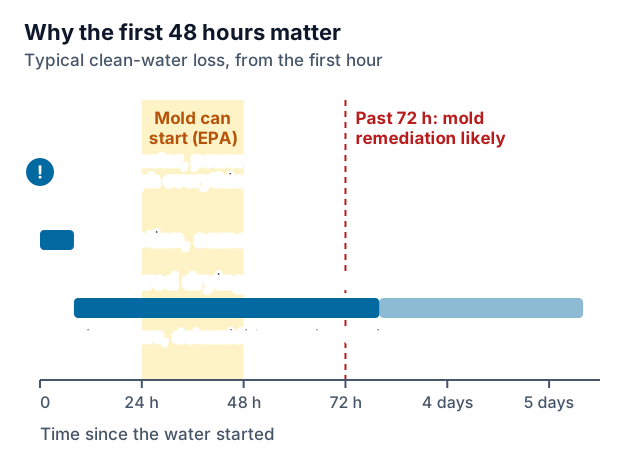
Enter how long ago the water hit and what got wet — see where you are in the 24–48 hour mold window and which materials can still be saved.
Use the free tool →Need help in Morris County, NJ?
Send the short form — urgent requests get priority routing.