Water Damage Cleanup in Elkhart County, IN
Water damage restoration typically runs $1,383–$6,369 nationally, per our cost guide. Independent local pros serving Elkhart, Goshen, Nappanee and nearby communities. Describe the problem and we'll route your request — free, no obligation.
- 24/7 routing — active-water emergencies get priority
- Independent local crews with extraction and drying equipment
- Insurance-ready documentation from the first visit
- Free to use — no obligation, no markup
Fast response from independent local providers. No obligation.
Typical national cost$1,383 – $6,369Cost guide →Local Help in Elkhart County, IN
The National Weather Service tracks the St. Joseph River at Elkhart, where its minor flood category starts at 24 feet, and the Elkhart River at Goshen, where it starts at 7 feet. For the Elkhart gauge, NWS notes that at 25 feet basement flooding begins in residential areas of the 6th Street area and along South Shore Drive. For the Goshen gauge, it lists a historic crest of 12.53 feet on Feb. 21, 2018.
That crest falls inside the incident period of DR-4363, Indiana Severe Storms and Flooding (Feb. 14 to March 4, 2018, declared May 4, 2018), one of the declarations OpenFEMA lists for the county. Indoor sources matter too: a split supply line, a leaking water heater or a frozen pipe can also soak a finished basement.
Housing units in Elkhart County have a median build year of 1977, plus or minus one year, according to Census Bureau table B25035 from the 2020-2024 ACS 5-year estimates.
Elkhart County Service Details
What providers in this area actually see: coverage, common jobs, local pricing factors, and rules worth knowing.
Service Area Notes
- The Census Bureau's 2020 place list for Elkhart County includes the cities of Elkhart, Goshen and Nappanee and the towns of Bristol, Middlebury, Millersburg and Wakarusa.
- Dunlap, New Paris and Simonton Lake appear on that list as census-designated places rather than incorporated towns. Osolo, Concord and Baugo are among the townships on the Census Bureau's 2020 county subdivision list.
- The Elkhart County Development Ordinance, which includes the county's zoning and floodplain rules, applies to land in the county outside the planning jurisdictions of the cities of Goshen, Elkhart and Nappanee; it names the towns of Bristol, Middlebury, Millersburg and Wakarusa and the unincorporated county as its jurisdictions.
Common Jobs in Elkhart County
- Pumping out and structurally drying a basement after river water or a sump failure
- Cleanup after a frozen or split water supply line
- Removing soaked drywall, insulation and carpet ahead of rebuilding
- Mold assessment and cleanup after a slow leak inside a wall
- Itemized repair estimates for a floodplain substantial-damage review
What Drives Pricing Here
- HomeAdvisor's water damage restoration cost guide (updated Jun 17, 2026) says the work cost homeowners an average of $3,874, with most spending between $1,385 and $6,381 in 2025. It is a general guide figure, not an Elkhart County survey.
- The same guide lists average restoration prices of $3.50 per square foot for Category 1 (clean water), $5.25 for Category 2 (gray water) and $7.50 for Category 3 (black water).
- In a special flood hazard area, the repair total also has regulatory weight. When the county's Floodplain Administrator compares repair cost with a structure's pre-damage market value, the Development Ordinance says the cost of all work must be counted, including work that might otherwise be considered routine maintenance, with the items included following FEMA guidance.
- County building permit fees sit in Elkhart County Code §151.11, as replaced by Commissioner Ordinance 2015-214, which states it is effective Aug. 1, 2015, subject to publication. The code's history note lists only the date that ordinance passed (July 6, 2015), not a publication date, so no amount from the schedule is repeated here. The schedule also sets a civil penalty for work started before the building permit or appropriate specialty fee is secured; ask the Building Department for current amounts, penalties included, before budgeting.
Permits & Local Rules
- Elkhart County Code §151.06(B)(2) lists construction, reconstruction, alteration, repair and remodeling of a building, along with plumbing, electrical, heating, ventilation and air-conditioning work, among the work that may not start until the Building Commissioner approves a written application and issues a permit. Section 151.06(B)(4) exempts interior or exterior painting and routine maintenance or repairs that do not affect electric, plumbing, heating, ventilation, air conditioning or structural stability, and §151.03 excludes certified industrialized building systems or mobile structures, regulated amusement devices, boilers, lifting devices and pressure vessels.
- The code does not mention extraction or drying by name, so ask the Building Department before tearing out or replacing anything that touches wiring, plumbing, heating and cooling equipment or framing.
- Under §151.08, the person doing permitted work must tell the Building Commissioner when it is ready for inspection, and no work may continue past an inspection point without approval. Its inspection table includes a pre-drywall energy inspection covering mechanical, plumbing and insulation.
- County permits expire one year after issuance and are void if the work has not reached final inspection within that year; under §151.06(E), extensions may be granted for three months on residential permits and six months on commercial permits.
- The cities handle their own permits. The City of Elkhart's Building Division approves construction permit applications for new construction and remodeling and is primarily responsible for building inspections within city limits. Goshen's Building Department issues permits for construction, alteration, remodeling, rehabilitation or additions and for new or altered electrical, mechanical or plumbing systems, water heaters included. Nappanee's Planning and Zoning Department posts its own residential permit forms. For an address in one of the towns or in unincorporated territory, confirm with Elkhart County Planning & Development which office issues the permit.
- Goshen's Building Department states that general contractors need no city license, that electrical and mechanical (HVAC) contractors working in the city must hold a city license, and that plumbing contractors must hold a current State of Indiana license. The county fee schedule carries a line for an annual builder/contractor license or registration due February 15; ask the county Building Department what applies to your contractor.
- Floodplain work needs its own approval. Within the Development Ordinance's jurisdiction, §158.09(D)(2) says an application for a floodplain development permit goes to the Floodplain Administrator, who is the Zoning Administrator or an authorized designee, before construction starts on any development wholly within, partly within or in contact with a special flood hazard area. The ordinance's definition of development covers reconstruction of a structure but excludes activities such as maintenance of existing structures (painting, re-roofing) that do not involve filling, grading, excavation or the construction of permanent structures.
Flood & Storm Risk Notes
- Climate: NOAA's 1991-2020 normals for South Bend Michiana Regional Airport (station USW00014848) list a January mean temperature of 24.1°F, a January mean minimum of 17.0°F, 64.5 inches of snowfall a year and 39.23 inches of annual precipitation.
- Flood maps: the county's floodplain rules rely on the Flood Insurance Rate Map for Elkhart County and Incorporated Areas dated Aug. 2, 2011, and any later FEMA updates, and on Indiana DNR's best available flood layer for A-zone streams where the upstream drainage area is greater than one square mile. DNR's Indiana Floodplain Information Portal shows both FEMA and DNR floodplain mapping for a selected location.
- Substantial damage: the Development Ordinance defines it as damage of any origin where restoring the structure to its before-damaged condition would cost 50 percent or more of the structure's market value before the damage. When the Floodplain Administrator finds that work is repair of substantial damage (land value excluded, with any added improvements counted), the applicant is told the standards of Sec. 158.09(E) apply; where base flood elevations or flood depths are mapped, those include protecting the structure from flood damage below the flood protection grade, the base flood elevation plus two feet. The ordinance's triggers also include repairs to a repetitive-loss structure, so ask the administrator which apply.
- State guidance: Indiana DNR's flood cleanup page says rebuilding a flood-damaged home requires coordination with the local Floodplain Administrator and that owners need to make sure a local official completed a damage assessment before starting repairs.
- FEMA declarations: OpenFEMA's response for Elkhart County, queried Nov. 7, 2026, reports a record count of 13. Those with flooding in the title are DR-891 (declared Jan. 5, 1991), DR-1573 (Jan. 21, 2005), DR-1740 (Jan. 30, 2008) and DR-4363 (May 4, 2018). The newest record is EM-3641, an emergency declaration for the severe winter storm of Jan. 23 to 27, 2026.
Communities Served
Elkhart · Goshen · Nappanee · Middlebury · Bristol · Wakarusa · Millersburg · Dunlap · New Paris · Simonton Lake
Emergency Response Expectations
If water is near outlets or appliances, keep everyone out and shut off power or water only where that is safe. Photograph damage before tear-out. This site passes requests to independent restoration contractors.
Elkhart County FAQs
Do I need a county permit to dry out a wet basement?
The county code does not name drying; its exemption covers routine maintenance or repairs that leave electric, plumbing, heating, ventilation, air conditioning and structural stability unaffected. Work that does affect those systems or the structure falls under the permit rule, and floodplain sites may also need a floodplain development permit. Ask the Building Department, or the city office in Elkhart, Goshen or Nappanee.
Who decides whether a flooded home is substantially damaged?
The Indiana Department of Homeland Security says the local government makes the official determination, counting repair cost whatever caused the damage, and that this review is separate from an insurance adjuster's inspection. Under the county Development Ordinance, the Floodplain Administrator conducts these determinations for structures in special flood hazard areas within its jurisdiction.
What was FEMA's most recent flood declaration covering Elkhart County?
DR-4363, Indiana Severe Storms and Flooding, declared May 4, 2018. The county's newest OpenFEMA record, EM-3641 from January 2026, is a winter storm emergency, not a flood.
Will homeowners insurance pay for river flooding?
Indiana's flood insurance page (Department of Homeland Security and DNR) says a standard homeowner's or renter's policy does not include flood insurance protection by default and that NFIP policies can take up to 30 days to go into effect. It adds that homes in high-risk flood areas with mortgages from federally regulated or insured lenders are required to have flood insurance.
Does Indiana have indoor air rules that cover mold in a house?
The Indiana Department of Health's indoor air quality page says that beyond 410 IAC 33 for schools and state agencies, there are no laws or regulations that can be enforced for indoor air quality. It mentions published guidelines from federal agencies and other organizations and links A Brief Guide to Mold, Moisture, and Your Home.
Sources
- OpenFEMA Disaster Declarations Summaries, Elkhart County, IN (queried Nov. 7, 2026)
- FEMA: DR-4363-IN, Indiana Severe Storms and Flooding
- FEMA: EM-3641-IN, Indiana Severe Winter Storm
- Elkhart County Code §§151.06-151.08: permits and inspections
- Elkhart County Code §151.11: fee schedule
- Elkhart County Planning & Development: Building
- Elkhart County Development Ordinance (amended May 18, 2026), §§158.01, 158.09
- City of Elkhart: Building Division
- City of Goshen: Building Department
- City of Nappanee: Planning and Zoning
- Indiana DNR: Flood Disaster Clean Up Guidance
- Indiana DNR: Indiana Floodplain Information Portal
- Indiana Department of Homeland Security: substantial damage FAQ
- State of Indiana (IDHS and DNR): flood insurance
- Indiana Department of Health: Indoor Air Quality
- NOAA NWS: St. Joseph River at Elkhart (EKMI3)
- NOAA NWS: Elkhart River at Goshen (GSHI3)
- NOAA NCEI: 1991-2020 normals, South Bend airport (USW00014848)
- Census Bureau: ACS 2020-2024 5-year Table B25035, Elkhart County
- Census Bureau: 2020 places by county, Indiana
- Census Bureau: 2020 county subdivisions, Indiana
- HomeAdvisor: Water Damage Restoration Cost (updated Jun 17, 2026) (third-party estimate)
Last reviewed 2026-11-07
Nearby Counties
Services Available in Elkhart County
Emergency Water Removal
Standing water extracted fast — urgent routing to independent local crews with truck-mounted extraction and drying equipment, 24/7.
Learn more →Flood Cleanup
Storm and flood water cleanup with contamination-aware handling — extraction, sanitization, and structured drying by independent local crews.
Learn more →Water Damage Restoration
From dry-out through rebuild — independent local restoration crews handle mitigation, mold prevention, and putting your home back together.
Learn more →Mold Remediation
Visible mold or musty odor after water damage? Independent local crews handle containment, removal, and moisture-source correction.
Learn more →Sewage Backup Cleanup
Sewage in the house is a health hazard, not a mop job — urgent routing to local crews equipped for Category 3 cleanup and sanitization.
Learn more →Fire Damage Restoration
Smoke, soot, and firefighting-water cleanup after a house fire — routed to independent local restoration crews who also document the loss for your insurer.
Learn more →Free Tools Before You Call
Ballpark the cost or narrow down the problem before talking to an Elkhart County provider.
Water Damage Restoration Cost Calculator
Estimate what water damage cleanup and restoration should cost — by area affected, water source, how far it spread, and how long it's been wet.
Use the free tool →Water Emergency — What Do I Do Right Now?
Burst pipe, leaking ceiling, or flooded basement? Answer a few questions for an ordered, do-this-now checklist — and know when to stay out.
Use the free tool →Mold Risk Timer — How Fast Does Mold Grow After Water Damage?
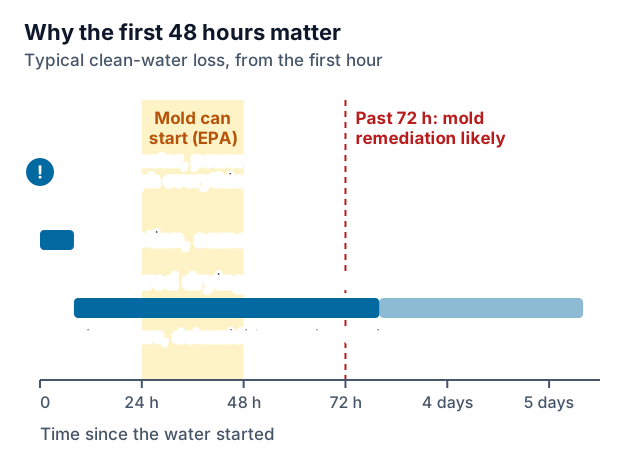
Enter how long ago the water hit and what got wet — see where you are in the 24–48 hour mold window and which materials can still be saved.
Use the free tool →Need help in Elkhart County, IN?
Send the short form — urgent requests get priority routing.