Water Damage Cleanup in Orlando, FL
Water damage restoration typically runs $1,383–$6,369 nationally, per our cost guide. Independent local pros serving College Park, Audubon Park, Baldwin Park and nearby areas. Describe the problem and we'll route your request — free, no obligation.
- 24/7 routing — active-water emergencies get priority
- Independent local crews with extraction and drying equipment
- Insurance-ready documentation from the first visit
- Free to use — no obligation, no markup
Fast response from independent local providers. No obligation.
Typical national cost$1,383 – $6,369Cost guide →Local Help in Orlando, FL
For an Orlando water-damage repair, establish the property's jurisdiction before choosing a permit application. The city's Check Your Address page warns that an Orlando mailing address can belong to unincorporated Orange County or another city. Its map identifies properties inside city limits. City Permitting Services handles the city's construction and renovation applications; Orange County's Division of Building Safety handles repairs and alterations in the unincorporated county.
Restoring a wet home involves more than replacing a stained finish. Orlando's floodplain guidance directs owners to contact Permitting Services before building, filling, altering or regrading property. Existing buildings in a Special Flood Hazard Area face substantial-damage and substantial-improvement review, and bringing the finished floor up to current floodplain standards may be necessary. Ask the city's floodplain staff about that review while the proposed repair scope is being developed.
For the cleanup itself, EPA treats fixing the moisture source and drying materials as central to controlling mold. Florida DBPR is the separate point of contact for construction-license questions and mold-related licensing. Use the city to resolve building approvals and DBPR to check the license relevant to the contracted work.
Orlando Service Details
What providers in this area actually see: coverage, common jobs, local pricing factors, and rules worth knowing.
Service Area Notes
- College Park, Audubon Park, Baldwin Park, Delaney Park, Lake Eola Heights and Thornton Park appear under Neighborhood Maps in Orlando's official Map Library. Those are the city neighborhood names used below.
- The city boundary is separate from the mailing address. Orlando's Check Your Address page provides a map for confirming whether a property lies inside city limits. For an unincorporated parcel, use Orange County's permitting resources. Winter Park has its own Building & Permitting Services Department, with its own permit application and inspection portal; Orlando's application process does not govern that municipality.
Common Jobs in Orlando
- Leaking plumbing and wet interior finishes: EPA recommends repairing leaks and other water problems promptly and drying the affected items completely.
- Mold on carpet or ceiling tile: EPA identifies these as porous materials that may need to be discarded because mold can be difficult or impossible to remove completely.
- Air-conditioning moisture: EPA's prevention guidance includes clean drip pans and drain lines that remain unobstructed and flow properly.
- Reconstruction after water removal: Orlando distinguishes construction and renovation permit types. Describe the actual wall, plumbing, electrical or mechanical repair to Permitting Services and use its project-specific forms and checklists.
What Drives Pricing Here
- A published reference, not an Orlando bid: HomeAdvisor's national water-damage restoration guide, updated June 17, 2026, reports an average of $3,874 and says most homeowners spent between $1,385 and $6,381 in 2025. Its guide links the cost to the affected area, damage severity and water source. Do not treat its location-adjustable calculator as a citywide restoration price.
- What the estimate includes: the same HomeAdvisor guide says the water source and extent of spread determine which materials need replacement. It advises budgeting for mold remediation and repairs to drywall, floors, ceilings and other structural parts. Ask a written estimate to distinguish water removal and drying from those repair items.
- Insurance is another budgeting question. FEMA says most homeowners insurance does not cover flood damage; a separate flood policy can cover the building, contents or both. Ask the insurer which policy responds to the documented cause of loss and which property is insured. Building coverage and contents coverage should not be assumed interchangeable.
- Permit charges belong in the project discussion with the appropriate building office. Orlando's permit guide directs applicants to its Permit Lookup tool to see and pay fees after reviews and contractor information are complete. Consult that office for the applicable charges rather than using an undated fee quoted for another Florida jurisdiction.
Permits & Local Rules
- City repair application: Orlando accepts plans digitally through ProjectDox after processing the application. Its Get a Permit guide links the forms, plan-upload requirements, permit lookup and inspection scheduling. Use the full city instructions for the repair type rather than a generic list of documents. The guide says approved plans must be printed to scale and posted at the job site before construction begins.
- Limited permit exemption: section 553.79(1)(g), Florida Statutes, covers an owner of a single-family dwelling or the owner's contractor for work valued at less than $7,500 on the owner's property. It excludes property partially or entirely in a flood hazard area as defined by the Florida Building Code, and excludes electrical, plumbing, structural, mechanical or gas work on property containing a single-family dwelling. A project cannot be divided to evade the rule. Qualification requires a written exemption request to the local enforcement agency with the contract or other documentation showing the nature and value of the work. The statute also says local government has no legal duty to the owner, contractor or their successors or assigns for exempted work. Orlando provides an exemption-request service and reviews submitted requests; use it before relying on the exemption.
- Rebuilding contractor: the Construction Industry Licensing Board within DBPR regulates construction contracting. For the license classification and status needed for your reconstruction scope, consult DBPR and the permitting office. Homeowners considering an owner-builder application should read section 489.103(7) and obtain the office's guidance on its eligibility and disclosure requirements.
- Mold work and construction work: DBPR licenses individuals for mold assessment and remediation under Chapter 468, Part XVI. Section 468.8411 defines assessment through sampling and evaluation of building history and inspection data concerning mold growth greater than 10 square feet. Its remediation definition concerns removal, cleaning, sanitizing, demolition or other treatment, including preventive activities, of mold or mold-contaminated matter greater than 10 square feet that was not purposely grown there. Work requiring a Chapter 489 license must be performed by someone licensed under that chapter or comply with that chapter. Review section 468.841 with DBPR for the applicable exemptions rather than assuming every cleanup activity has the same licensing requirement.
- Assessment and remediation relationships: section 468.8419 contains separate 12-month restrictions for assessment followed by remediation and remediation followed by assessment, along with an exception for a certified Division I contractor. Ask DBPR to apply the full section to the proposed arrangement, including related companies. Under section 468.8422, the mold assessment or remediation contract must be a document or electronic record signed or otherwise authenticated by the parties.
Flood & Storm Risk Notes
- Orlando's floodplain page names excessive rain, tropical storms and hurricanes, nearby water bodies, and inadequate or overloaded drainage systems as causes of property flooding. It offers current and historical lake-level information and a public-records route for asking about documented flooding near a property. Use those property-level resources when describing a recurring water-entry problem.
- The city's published substantial-damage explanation applies to existing buildings in the Special Flood Hazard Area: expected building repairs costing at least 50% of the building's appraised value can require raising the finished floor to current floodplain standards. FDEM defines substantial damage under the NFIP by the cost to restore the structure to its condition before damage, compared with its market value before damage, regardless of the damage's origin. The local Building Official and floodplain administrators make the determination. Ask them to confirm the valuation and all locally applicable review criteria for the address.
- Florida Hurricane Milton is FEMA declaration DR-4834-FL, declared October 11, 2024, with an incident period of October 5 through November 2, 2024. Its initial notice specifically designates Orange County for Individual Assistance and for debris removal and emergency protective measures under Public Assistance. The disaster page now says the application period is closed; this historical declaration is not an offer of current assistance.
Neighborhoods & Suburbs Served
College Park · Audubon Park · Baldwin Park · Delaney Park · Lake Eola Heights · Thornton Park
Emergency Response Expectations
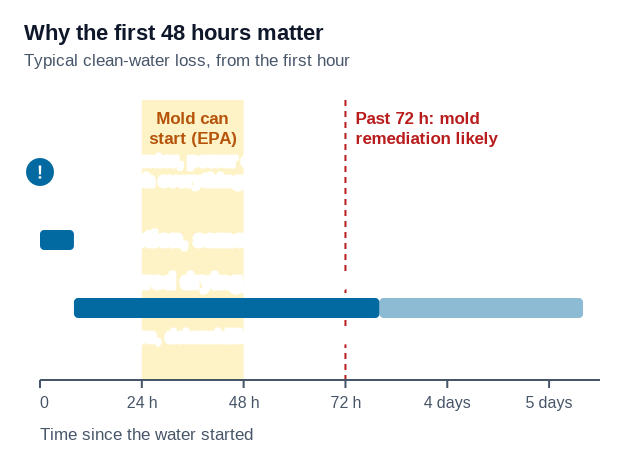
Orlando warns against walking through flowing water, entering standing floodwater or approaching electrical wires. Move to higher ground during flooding. For wet materials after a leak or spill, EPA says drying within 24–48 hours prevents mold growth in most cases. Do not run an HVAC system known or suspected to be contaminated with mold; consult EPA's linked HVAC guidance before taking further action.
Orlando FAQs
Where should I ask about permits for an Orlando mailing address?
Check the city boundary first using Orlando's address tool. A parcel in unincorporated Orange County belongs with county Building Safety. Bring the repair scope to the office responsible for that parcel; a neighboring city's permit checklist is not a substitute.
Should mold be painted over once a wet room looks better?
EPA advises cleaning mold and drying the surface before painting; painting over mold is likely to peel. It also says the water or moisture problem must be completely fixed before remediation can be considered finished. For a ceiling or wall with suspected hidden growth, consult its hidden-mold guidance before disturbing the material.
Does every damp room need a mold sample?
EPA says sampling is unnecessary in most cases when visible mold is present, and that sampling cannot establish compliance with federal mold standards because no federal limits for mold or mold spores have been set. Its guidance is not a waiver of Florida's mold-related licensing law. Ask DBPR about the statutory scope and any exemption relevant to the work being offered.
What should happen after the permitted rebuilding is inspected?
Orlando's permit guide says the permit becomes final once the inspections are completed and passed. It directs owners to check that final status through Permit Lookup and warns that leaving a permit unclosed can cause problems when selling the property. Use the same guide for requesting the Certificate of Occupancy or Certificate of Completion relevant to the project.
Sources
- Orange County: current Fast Track Permitting Services
- Orlando: Check Your Address and city limits
- Orlando: Get a Permit, plans, inspections and final status
- Orlando: Map Library, official Neighborhood Maps list
- Orlando: Floodplain and Flooding Information
- Orange County: Building Safety jurisdiction, 2022 Year in Review
- Florida DBPR: Construction Industry Licensing Board
- Florida DBPR: Mold-Related Services FAQs
- EPA: A Brief Guide to Mold, Moisture and Your Home
- Florida DEM: Substantial Damage Resources
- Florida Statutes 553.79: permit exemptions
- Florida Statutes 489.103: owner-builder exemption referral
- Florida Statutes 468.841: mold exemptions
- Florida Statutes 468.8411: mold definitions
- Florida Statutes 468.8419: mold prohibitions and exceptions
- Florida Statutes 468.8422: mold contracts
- Orlando: Apply for a Residential Building Permit Exemption
- Winter Park: Building & Permitting Services
- FEMA: Florida Hurricane Milton, DR-4834-FL
- FEMA: Milton initial notice, Orange County designation
- FEMA: Flood Insurance, building and contents policies
- HomeAdvisor: national Water Damage Restoration Cost, updated June 17, 2026 (third-party estimate)
Last reviewed 2026-11-14
Services Available in Orlando
Emergency Water Removal
Standing water extracted fast — urgent routing to independent local crews with truck-mounted extraction and drying equipment, 24/7.
Learn more →Flood Cleanup
Storm and flood water cleanup with contamination-aware handling — extraction, sanitization, and structured drying by independent local crews.
Learn more →Water Damage Restoration
From dry-out through rebuild — independent local restoration crews handle mitigation, mold prevention, and putting your home back together.
Learn more →Mold Remediation
Visible mold or musty odor after water damage? Independent local crews handle containment, removal, and moisture-source correction.
Learn more →Sewage Backup Cleanup
Sewage in the house is a health hazard, not a mop job — urgent routing to local crews equipped for Category 3 cleanup and sanitization.
Learn more →Fire Damage Restoration
Smoke, soot, and firefighting-water cleanup after a house fire — routed to independent local restoration crews who also document the loss for your insurer.
Learn more →Free Tools Before You Call
Ballpark the cost or narrow down the problem before talking to an Orlando provider.
Water Damage Restoration Cost Calculator
Estimate what water damage cleanup and restoration should cost — by area affected, water source, how far it spread, and how long it's been wet.
Use the free tool →Water Emergency — What Do I Do Right Now?
Burst pipe, leaking ceiling, or flooded basement? Answer a few questions for an ordered, do-this-now checklist — and know when to stay out.
Use the free tool →Mold Risk Timer — How Fast Does Mold Grow After Water Damage?
Enter how long ago the water hit and what got wet — see where you are in the 24–48 hour mold window and which materials can still be saved.
Use the free tool →Need help in Orlando, FL?
Send the short form — urgent requests get priority routing.