Water Damage Cleanup in Texas, TX
Water damage restoration typically runs $1,383–$6,369 nationally, per our cost guide. Independent local pros serving Houston, Dallas, Austin and nearby areas. Describe the problem and we'll route your request — free, no obligation.
- 24/7 routing — active-water emergencies get priority
- Independent local crews with extraction and drying equipment
- Insurance-ready documentation from the first visit
- Free to use — no obligation, no markup
Fast response from independent local providers. No obligation.
Typical national cost$1,383 – $6,369Cost guide →Local Help in Texas, TX
This guide covers the statewide Texas rules behind water damage cleanup, drying and mold work. The Texas Department of Licensing and Regulation (TDLR) licenses mold assessors and remediators under Chapter 1958 of the Occupations Code and 16 TAC Chapter 78. The Texas Department of Insurance (TDI) explains which water losses home policies usually pay for. The Texas Water Development Board (TWDB) supports the local officials who decide whether a flooded building in a mapped flood hazard area must meet current floodplain rules before repair.
TDI's flood insurance page says Texas is particularly prone to floods along the coast and across a wide band it calls Flash Flood Alley, which extends through Central and North Texas, and that almost every major Texas city is in an area at high risk of flooding. FEMA's OpenFEMA NFIP Redacted Claims (v3) API, queried November 7, 2026, returns a count of 4,718 claim records for Texas with a 2024 year of loss; FEMA last refreshed the dataset September 9, 2026 and notes that it lags the program's system of record.
Much Texas water damage involves no rising water at all. TDI gives a burst pipe, a toilet overflow and a broken washer hose as examples of the sudden and accidental water damage most homeowner and renters policies cover, while flood damage needs a separate flood policy.
Texas Service Details
What providers in this area actually see: coverage, common jobs, local pricing factors, and rules worth knowing.
Service Area Notes
- This page covers the whole state. The site also has city guides for Houston, Dallas, Austin and San Antonio, linked at the bottom of this page; local permit offices, floodplain maps and flood history are covered there, not restated here.
- Fort Worth and other Texas cities have no guide of their own on this site yet; the state rules below still apply there, and requests from those areas are referred to independent local providers.
- For a building permit, ask your city's building office, or the county if you live outside city limits. TWDB's Flood Community Assistance Program page links to a lookup for your community's floodplain administrator.
Common Jobs in Texas
- Extracting water and drying floors, walls and cabinets after a supply-line, water-heater or appliance leak
- Cleanup and drying after a pipe bursts in a freeze
- Flood cuts, removal of soaked insulation and drywall, and drying after storm or flash-flood water enters a home
- Drying ceilings, attics and insulation after a roof leak
- Mold remediation by a TDLR-licensed remediator working from a separate licensed assessor's protocol
- Photos, moisture readings and damaged-item lists for a homeowners or NFIP flood claim
What Drives Pricing Here
- Which policy pays: TDI says most home policies don't cover water damage from gradual leaks or seepage, including the mold that follows, and that mold from a flood would not be covered because home policies don't cover floods.
- Mold cleanup coverage: TDI notes that most home policies don't include mold cleanup and testing after a damaged item is removed, though your insurer may let you add coverage for cleanup caused by a covered loss. Ask your agent before work starts.
- Separate assessor and remediator: TDLR's FAQ says a licensed remediation contractor hired by a consumer, whatever the size of the area, must develop a work plan that follows a protocol developed by a licensed mold assessment consultant, and section 1958.155, apart from one school-district exception, keeps the two roles apart (see the FAQs).
- State notification fee: 16 TAC section 78.80, as amended effective September 1, 2018, sets $25 for an initial mold remediation notification, for owner-occupied residential dwelling units and all other properties alike; TDLR's notification page says amendments and cancellations are free.
- Floodplain rebuilds: TWDB's Substantial Damage Quick Guide (February 2026) lists broad examples of costs counted in a repair estimate, among them materials (including donated and discounted ones), labor (including owner or volunteer labor), costs of complying with codes such as elevation and floodproofing, and contractor overhead or profit.
Permits & Local Rules
- Licensing: subject to the exemptions below, Occupations Code section 1958.101 bars a person from engaging in mold assessment without a mold assessment license or in mold remediation without a mold remediation license, and section 1958.1011 makes a license valid for two years. Under 16 TAC section 78.80 (amended effective September 1, 2018), a mold remediation contractor license or renewal is $450 and a remediation worker registration or renewal is $50; section 78.30(e) requires employees of a licensee performing remediation under a licensee's supervision to be registered.
- Exemptions in section 1958.102: (a) an owner or tenant, or a managing agent or employee of an owner or tenant, needs no license for mold assessment or remediation on property the owner or tenant owns or leases, except when the managing agent or employee is in the business of mold assessment or remediation for the public, when the remediation area has mold contamination affecting a total surface area of 25 contiguous square feet or more, or for a person exempt under (e); (c) no license is needed to remediate an area where contamination affects a total surface area for the project of less than 25 contiguous square feet; (d) a person who constructed or improved a one-family or two-family dwelling needs no license there when the work is done at the same time as the construction or improvement, or at the same time as repair work on it, unless the person engages in the business of performing mold assessment or remediation for the public; (e) an owner, or the owner's managing agent or employee, needs no license on residential property the owner owns with fewer than 10 dwelling units, unless the managing agent or employee is in that business for the public. 16 TAC section 78.30(b) says (d) and (e) apply regardless of surface area. TDLR's At A Glance sheet (December 2025) words (e) as buildings of 10 or fewer units, unlike the statute, so confirm a 10-unit building with TDLR.
- Losing the small-area exemption: under 16 TAC section 78.30(d), someone working under exemption (a) or (c) who finds more mold, bringing the total to 25 contiguous square feet or more, must immediately stop all remediation, set up emergency containment if necessary, and tell the person who requested the work that the exemption is lost and that further remediation and the post-remediation assessment there must be done by a person licensed or registered under the chapter.
- Notification: under 16 TAC section 78.110, a mold remediation contractor or company must notify TDLR when contamination affects a total surface area of 25 contiguous square feet or more, no less than five calendar days before the anticipated start date. In an emergency, meaning a delay in remediation after a water damage occurrence would increase mold contamination, the notice is due as soon as practicable and no later than the following working day after the licensee identifies the emergency; TDLR says the licensee, not the department, decides whether an emergency exists. The required form contents, fee, confirmation and amendment deadlines are set out in section 78.110 and on TDLR's notification page.
- Owner paperwork: TDLR's FAQ says licensed mold assessors and remediators must give the client, and the property owner if different, the Consumer Mold Information Sheet before any mold-related activity begins. After the job comes the Certificate of Mold Damage Remediation (see the FAQs).
- Floodplain rules: TWDB's Community Resources page says NFIP communities must adopt and enforce a flood damage prevention ordinance or court order that meets or exceeds the minimum standards at 44 CFR 60.3, and its guide says local officials oversee all development in Special Flood Hazard Areas by issuing permits and enforcing local floodplain regulations.
Flood & Storm Risk Notes
- Outside mapped flood zones: according to TDI, floods can happen anywhere, and on average 40% of NFIP flood insurance claims occur outside the high-risk flood areas.
- Hurricane Beryl: FEMA's page for Texas Hurricane Beryl (DR-4798-TX) lists an incident period of July 5 to July 9, 2024, declared July 9, 2024.
- Winter storms: FEMA's page for Texas Severe Winter Storms (4586-DR-TX) lists an incident period of February 11 to February 21, 2021, declared February 19, 2021.
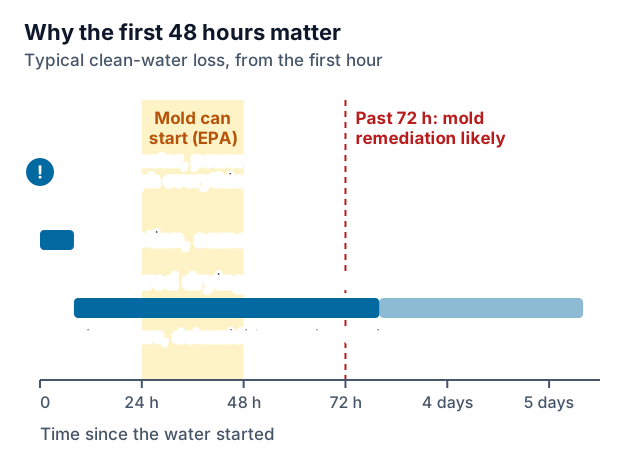
- Drying speed: TDI's tips say mold can start growing within a day after a leak.
Neighborhoods & Suburbs Served
Houston · Dallas · Austin · San Antonio · Fort Worth
Emergency Response Expectations
TDI's tips: stop the water at the main valve or the valves under sinks and near appliances, remove pools of water and start drying, move wet items to a dry room, and pull up wet carpets and rugs. Tell your insurer as soon as possible, photograph the damage before repairs, keep damaged items until the adjuster has seen them, and make no permanent repairs until the insurer sees the damage. In a mapped flood hazard area, TWDB's guide tells local officials to advise owners not to begin repairs until assessments are made and permits issued, so call the floodplain administrator before rebuilding.
Texas FAQs
May one licensed firm both assess and remediate the same mold job?
Not on the same project. Occupations Code section 1958.155 bars a license holder from doing both mold assessment and mold remediation on one project and bars a person from owning an interest in both the assessing and the remediating entity on that project. That section does not apply to a license holder employed by a school district working on a project for that school district.
Does a small mold job need a TDLR notification?
TDLR notification is required when mold contamination affects a total surface area of 25 contiguous square feet or more. TDLR's FAQ says the small-area exemption covers only unlicensed people: a licensed contractor hired for a smaller job still follows the law and rules but does not submit a notification.
Does homeowners insurance cover a burst pipe or a flood in Texas?
TDI says most homeowner and renters policies cover sudden and accidental water damage, such as a burst pipe, but usually not gradual leaks, and home policies don't cover floods. TDI also says you usually must report water damage that was hidden from view within days after you first see it. Your own policy wording controls.
How soon does a new NFIP flood policy take effect?
FEMA says there is typically a 30-day waiting period for an NFIP policy to go into effect, unless the coverage is purchased as required by a government-backed lender or is related to a community flood map change. Ask a flood insurance agent which applies to you.
What is a Certificate of Mold Damage Remediation and why keep it?
Under 16 TAC section 78.150, the licensed remediation contractor or company must give the owner the before-and-after photos and this certificate, on the Commissioner of Insurance's form, within ten calendar days after the project stop-date. Its top section is signed by a licensed mold assessment consultant and a mold remediation contractor and carries the consultant's statement (not the remediator's) that, based on visual, procedural and analytical evaluation, the contamination identified for the project has been remediated as outlined in the protocol, plus a statement that the underlying cause has been remediated if the consultant determines it is reasonably certain the mold will not return from that same cause. On projects unlicensed people may legally perform, a licensed consultant signs the bottom section, certifying that the property does not contain evidence of mold damage. Keep it: section 1958.154 requires a seller to give the buyer a copy of each certificate issued for the property in the five years before the sale.
Who decides whether a flood-damaged home is substantially damaged?
Local officials. TWDB's guide says NFIP communities must assess damage to structures in a Special Flood Hazard Area before repairs, whatever the cause. If repairs to pre-damage condition will equal or exceed 50 percent of the structure's market value, land excluded, it is substantially damaged and must meet current local floodplain management regulations, and a community's stricter standards apply where adopted. State and federal officials do not make these determinations.
Sources
- Texas Occupations Code Chapter 1958 (Mold Assessors and Remediators)
- 16 TAC section 78.30, Exceptions and Exemptions (Texas Secretary of State)
- 16 TAC section 78.80, Fees (Texas Secretary of State)
- 16 TAC section 78.110, Notification (Texas Secretary of State)
- 16 TAC section 78.150, Certificate of Mold Damage Remediation (Texas Secretary of State)
- TDLR: Mold Remediation Notifications
- TDLR: Mold FAQs
- TDLR: Mold At A Glance (December 2025)
- TDI: When are water damage and mold covered by insurance?
- TDI: Flood insurance: Why you need a policy
- FEMA: Flood Insurance
- FEMA OpenFEMA: NFIP Redacted Claims v3 (queried November 7, 2026)
- FEMA: Texas Hurricane Beryl (DR-4798-TX)
- FEMA: Texas Severe Winter Storms (4586-DR-TX)
- TWDB: Substantial Damage Quick Guide (February 2026)
- TWDB: Flood Community Resources
- TWDB: Flood Community Assistance Program
Last reviewed 2026-11-07
Services Available in Texas
Emergency Water Removal
Standing water extracted fast — urgent routing to independent local crews with truck-mounted extraction and drying equipment, 24/7.
Learn more →Flood Cleanup
Storm and flood water cleanup with contamination-aware handling — extraction, sanitization, and structured drying by independent local crews.
Learn more →Water Damage Restoration
From dry-out through rebuild — independent local restoration crews handle mitigation, mold prevention, and putting your home back together.
Learn more →Mold Remediation
Visible mold or musty odor after water damage? Independent local crews handle containment, removal, and moisture-source correction.
Learn more →Sewage Backup Cleanup
Sewage in the house is a health hazard, not a mop job — urgent routing to local crews equipped for Category 3 cleanup and sanitization.
Learn more →Fire Damage Restoration
Smoke, soot, and firefighting-water cleanup after a house fire — routed to independent local restoration crews who also document the loss for your insurer.
Learn more →Free Tools Before You Call
Ballpark the cost or narrow down the problem before talking to a Texas provider.
Water Damage Restoration Cost Calculator
Estimate what water damage cleanup and restoration should cost — by area affected, water source, how far it spread, and how long it's been wet.
Use the free tool →Water Emergency — What Do I Do Right Now?
Burst pipe, leaking ceiling, or flooded basement? Answer a few questions for an ordered, do-this-now checklist — and know when to stay out.
Use the free tool →Mold Risk Timer — How Fast Does Mold Grow After Water Damage?
Enter how long ago the water hit and what got wet — see where you are in the 24–48 hour mold window and which materials can still be saved.
Use the free tool →Need help in Texas, TX?
Send the short form — urgent requests get priority routing.