Basement Flooded: What to Do Right Now
A flooded basement is stressful, but the order you do things in matters more than speed. The single most important rule: electricity and standing water don't mix.
Handle the safety steps below first, then focus on stopping the source and getting water out fast. EPA advises drying water-damaged areas within 24-48 hours to prevent mold growth.
If this is unsafe or getting worse right now, don't wait — send an emergency request and it's flagged for priority routing to an independent local pro.
What to do in the first 5 minutes
- Before stepping into any standing water, shut off power to the basement at the main panel, but only if you can reach the panel without standing in water. If not, stay out and call an electrician or your utility.
- Identify and stop the source if it's safe: a burst pipe (find the main shutoff), an overflowing appliance, or storm water coming in at the walls.
- Once power is confirmed off, move valuables, documents, and electronics up and out of the water.
- Start removing water only after the power is off: a wet/dry vac or pump for smaller amounts; leave deep or fast-rising water to the pros.
- Photograph everything for insurance before you clean up, then call a local water-damage crew to extract and dry properly.
Do not do this
- Never enter or wade into standing water until power to the flooded area is confirmed OFF; submerged outlets, cords, or appliances can make the water live and deadly.
- Never touch electrical panels, outlets, or plugged-in devices with wet hands or while standing in water.
- Never assume flood water is clean; storm or ground water is contaminated and shouldn't be handled without gloves and boots.
- Don't run a furnace, water heater, or gas appliance that's been submerged until a pro inspects it.
Common causes
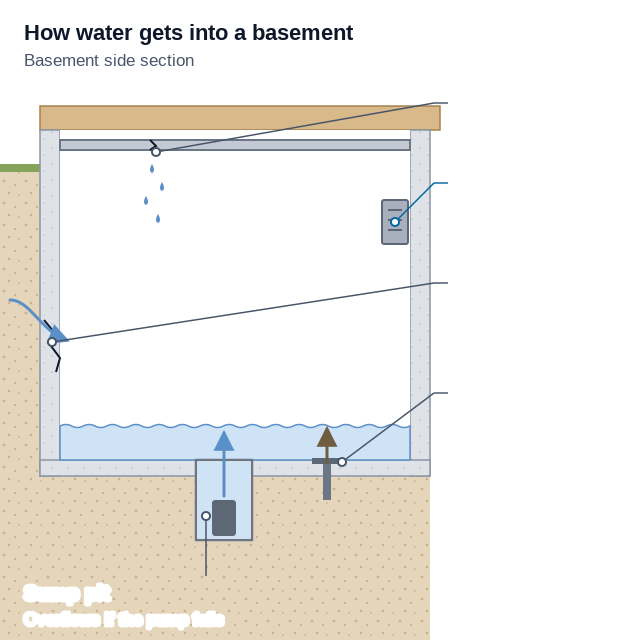
Burst or leaking pipe
A failed supply line, water-heater tank, or frozen-then-burst pipe can dump water fast. Finding and closing the main shutoff stops it; it's clean water, but it still needs quick extraction and drying.
Storm or ground water intrusion
Heavy rain, a high water table, or poor grading pushes water in through walls, floor cracks, or window wells. This water is contaminated and needs professional cleanup.
Sump pump failure
A dead, overwhelmed, or power-lost sump pump lets groundwater rise. It's common during the same storms that cause the flooding, so a battery backup is the usual prevention.
Sewer or drain backup
A backed-up main line or floor drain sends Category 3 (black) water into the basement. This is the most hazardous type and always needs professional, protected cleanup.
Diagnose it now
What it typically costs
HomeGuide's third-party estimate puts water extraction and drying at $4 to $6 per square foot for clean water and $9 to $12 for black water such as groundwater or sewage, with most restoration jobs at $2,000 to $6,000. If mold follows, remediation runs $15 to $30 per square foot (HomeGuide). A crew will scope the exact figure on site.
Frequently Asked Questions
What should I do first when my basement floods?
Electricity first. If you can reach the main panel without standing in water, shut off power to the basement. If you can't, stay out of the water entirely and call an electrician or your utility. Only after power is off should you deal with the source and start removing water.
Is it safe to go into a flooded basement?
Not until power to the area is off. Submerged outlets, cords, or appliances can energize the water. There's also a contamination risk if the water came from storms or a sewer. When in doubt, wait for professionals.
How fast do I need to dry out a flooded basement?
Fast. EPA says that if wet materials are dried within 24-48 hours, in most cases mold will not grow. Quick professional extraction and drying is the biggest factor in avoiding a much larger mold-remediation bill.
The service that handles this
Guidance only — independent local providers assess and price their own work. Last reviewed: October 16, 2026.
Sources for the cost figures
- HomeGuide: Water damage restoration cost (third-party estimate, updated Feb. 6, 2026) (third-party estimate)
- EPA: A Brief Guide to Mold, Moisture and Your Home
Related Resources
Prefer to just talk to someone?
Send the short form — we'll route you to an independent local pro.