Water Mitigation vs Water Restoration: What's the Difference?
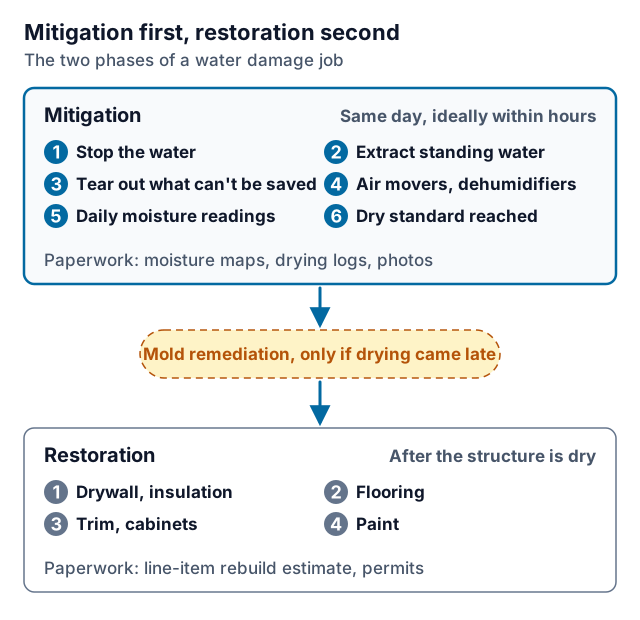
Water mitigation is the emergency phase: stopping the water, getting it out and drying the structure so the damage stops spreading. Water restoration is the repair phase: replacing and rebuilding what the water ruined, from drywall and flooring to cabinets and paint. Most losses need both, in that order, and many companies do both. The split matters because the two phases are scoped, priced, documented and sometimes licensed differently.
HomeGuide's third-party estimate puts water extraction and drying at $4 to $12 per square foot depending on how dirty the water is, and most complete water damage jobs at $2,000 to $6,000, with a full span of $150 to $100,000 (HomeGuide).
At a glance
| Water Mitigation | Water Restoration | |
|---|---|---|
| Goal | Stop the damage from getting worse | Return the home to its pre-loss condition |
| Timing | Same day, ideally within hours | After the structure is dry |
| Typical work | Water extraction, removing soaked carpet pad and drywall, air movers, dehumidifiers, moisture readings, antimicrobial treatment | Drywall, insulation, flooring, trim, cabinets, paint, sometimes plumbing and electrical |
| Cost basis (HomeGuide) | $4 to $6 per sq ft clean water, $6 to $9 gray water, $9 to $12 black water | Drywall $1.50 to $3.50 per sq ft, carpet $2 to $8, hardwood $7 to $25, plaster $2 to $10 |
| Paperwork | Moisture maps, daily drying logs, photos | Line-item rebuild estimate, permits |
| Licensing | Usually none at state level, but mold work is licensed in Texas (TDLR) and Florida (DBPR) | General or residential contractor license in many states above a dollar threshold; permits for structural, plumbing and electrical work |
What mitigation covers
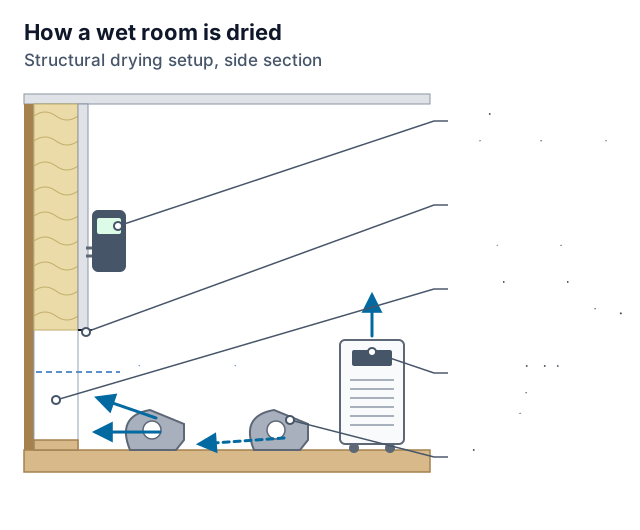
Mitigation starts when someone shuts off the water. A crew extracts standing water, pulls materials that can't be saved (carpet pad almost always, drywall below the waterline when the water was dirty), and sets air movers and dehumidifiers. They take moisture readings each day until materials reach a dry standard. Speed is the point: EPA advises drying water-damaged areas and items within 24-48 hours to prevent mold growth.
The water's category drives the mitigation price. HomeGuide lists Category 1 clean water (a broken supply line) at $4 to $6 per square foot to extract and dry, Category 2 gray water (a washer or dishwasher overflow) at $6 to $9, and Category 3 black water (sewage, rising floodwater, groundwater) at $9 to $12, because more material has to come out and the area has to be disinfected.
What restoration covers
Restoration begins once the drying log shows the structure is dry. It's ordinary construction work: hanging and finishing drywall, replacing insulation and flooring, rebuilding cabinets and trim, and painting. HomeGuide puts drywall at $1.50 to $3.50 per square foot, carpet replacement at $2 to $8, hardwood flooring at $7 to $25, and plaster wall repair at $2 to $10.
If mitigation came late and mold took hold, remediation sits between the two phases. HomeGuide puts mold remediation at $15 to $30 per square foot of affected area, or $1,500 to $15,000 or more for a whole job, and a mold inspection at $300 to $650.
How the damage class sets the size of both phases
HomeGuide groups jobs by class, which describes how far the water spread: Class 1 ($150 to $500) is a small leak in part of one room. Class 2 ($1,500 to $5,000) is up to 12 inches of standing water in at least one room, with walls and flooring wet. Class 3 ($5,000 to $15,000) is water through every part of one or more rooms, including ceilings and subfloor. Class 4 ($15,000 to $100,000) is disaster-level flooding with long soak times.
A fast mitigation phase is the cheapest way to keep a Class 2 loss from turning into a Class 3 rebuild.
Who pays for each phase
Homeowners policies generally treat sudden water damage, like a burst pipe, as covered, and pay for both mitigation and the rebuild minus the deductible. Rising water from outside is excluded and needs flood insurance (NFIP or a private flood policy). Sewer backup usually needs its own endorsement. Insurers expect you to mitigate: if you wait, they may decline the damage that waiting caused, which is why the drying log and photos matter as much as the invoice.
Licensing and permits differ by phase and by state
Texas: TDLR licenses mold assessment and remediation under Chapter 1958, Occupations Code; a remediation contractor license costs $450 (TDLR). Florida: DBPR licenses mold assessors and remediators under Chapter 468, Part XVI, F.S., with a $125 application fee and $100 licensure fee (DBPR). California: CSLB requires a contractor license for any job of $1,000 or more, any job needing a permit, or any job using hired workers (CSLB bulletin 24-07, AB 2622).
Georgia, North Carolina, Tennessee, Minnesota, Nevada: rebuild work over state thresholds needs a contractor license ($2,500 in Georgia under O.C.G.A. 43-41; $40,000 in North Carolina under G.S. 87-1; $3,000 to $24,999 home improvement license in Davidson County, Tennessee; repairs of $1,000 or more in Nevada under NRS 624.031). Restoration work that touches structure, plumbing or electrical generally needs a local permit; mitigation alone usually doesn't.
Should one company do both?
It's common and often convenient: one crew, one claim file, no gap between drying and rebuild. Two cautions. First, in Florida and Texas, the company that assesses mold may not also remediate the same job (Section 468.8419, F.S.; Texas Occupations Code § 1958.155). Second, get separate line items for mitigation and restoration so you and the adjuster can see what was emergency work and what was rebuild.
Frequently Asked Questions
Is water mitigation the same as water removal?
Removal (extraction) is the first part of mitigation. Mitigation also includes tearing out unsalvageable materials, drying and monitoring.
How long does mitigation take?
Drying usually runs several days, and the crew should show daily moisture readings until materials are dry; EPA's 24-48 hour window is about starting the drying, not finishing it.
Can I skip mitigation and just rebuild?
No. Closing up wet walls traps moisture and invites mold, and insurers can deny damage caused by not mitigating.
What does mitigation cost compared with restoration?
HomeGuide lists extraction and drying at $4 to $12 per square foot by water category; rebuild costs depend on finishes, from $1.50 per square foot for drywall to $25 for hardwood.
Information only — not legal or financial advice. Data last reviewed 2026-10-16.
Sources
- HomeGuide: Water damage restoration cost (third-party estimate, updated Feb. 6, 2026) (third-party estimate)
- EPA: A Brief Guide to Mold, Moisture and Your Home
- TDLR: Mold Assessors & Remediators At A Glance
- Florida DBPR: Mold-Related Services FAQs
- CSLB: Industry Bulletin 24-07 (AB 2622)
- Georgia Secretary of State: O.C.G.A. Title 43, Chapter 41
- NCLBGC: G.S. 87-1 threshold
- Tennessee Board for Licensing Contractors: Home Improvement
- Texas Occupations Code Chapter 1958 (§ 1958.155)
- Nevada State Contractors Board: NRS 624.031
Need help figuring out next steps?
Send the short form — we'll route you to an independent local pro.