Sewage Backup in the Basement: What to Do Right Now
Sewage coming up through a floor drain, toilet or shower is Category 3 (black) water. It carries bacteria and viruses, and porous materials it touches usually have to be removed rather than dried.
The steps below keep the backup from getting worse and keep people safe until a crew with protective gear arrives.
If this is unsafe or getting worse right now, don't wait — send an emergency request and it's flagged for priority routing to an independent local pro.
What to do in the first 5 minutes
- Stop running water anywhere in the house: no flushing, showers, laundry or dishwasher. Every gallon down the drain can come back up in the basement.
- Keep children, pets and anyone with a weakened immune system out of the area.
- Shut off power to the basement at the panel if you can reach it without walking through the water.
- Call your city's sewer utility to check whether the blockage is in the public main; if it's in your lateral, call a plumber or drain service.
- Photograph the damage and call a water-damage crew that handles sewage cleanup.
Do not do this
- Don't touch sewage or contaminated items with bare skin; use gloves and boots, and wash thoroughly after any contact.
- Don't try to save carpet, pad, upholstered furniture or drywall that sewage soaked.
- Don't use a household vacuum or fans that blow contaminated air through the house.
- Don't run a furnace or water heater that sat in sewage until a pro inspects it.
Common causes
Clogged lateral line
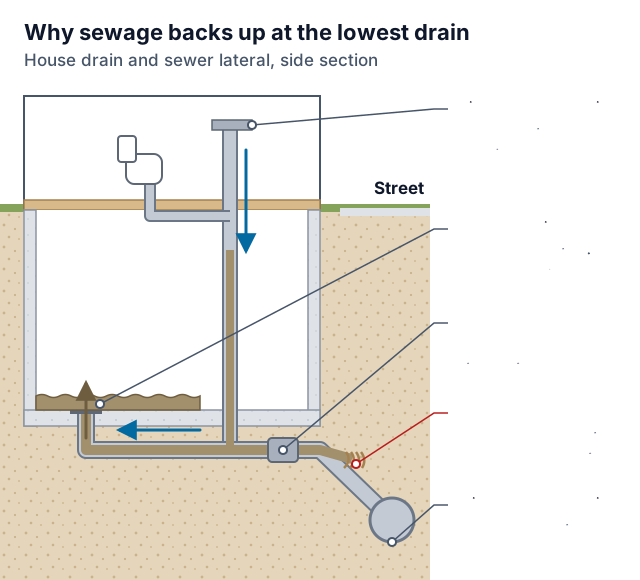
Grease, wipes and tree roots block the private line between the house and the street, so wastewater backs up at the lowest drain.
Blocked or overloaded city main
Heavy rain can overload combined or aging sewer mains and push water back into basements through floor drains.
Collapsed or bellied pipe
Old clay or cast-iron laterals crack, sag or collapse. A camera inspection finds the problem.
No backwater valve
Homes without a backwater valve on the main line have nothing to stop a surcharged sewer from flowing back in.
Diagnose it now
What it typically costs
HomeGuide's third-party estimate puts black water extraction and drying at $9 to $12 per square foot, versus $4 to $6 for clean water, because contaminated materials are removed and the area is disinfected. Mold remediation, if drying is delayed, runs $15 to $30 per square foot (HomeGuide). Many homeowners policies need a sewer backup endorsement to cover this.
Frequently Asked Questions
Can I clean up a sewage backup myself?
Small, clean-water backups maybe; sewage, no. Category 3 water needs protective gear, removal of porous materials and disinfection, and DIY cleanup can spread contamination.
Who pays for sewage backup cleanup?
If the city main caused it, ask the utility about its claims process. Otherwise it's usually your homeowners policy, and only if it includes a water backup or sewer backup endorsement.
How do I stop it from happening again?
Have the lateral camera-inspected and cleaned, keep grease and wipes out of drains, and ask a plumber about a backwater valve on the main line.
The service that handles this
Guidance only — independent local providers assess and price their own work. Last reviewed: October 16, 2026.
Sources for the cost figures
- HomeGuide: Water damage restoration cost (third-party estimate, updated Feb. 6, 2026) (third-party estimate)
Prefer to just talk to someone?
Send the short form — we'll route you to an independent local pro.