Sump Pump Failed and the Basement Is Flooding: What to Do
When a sump pump quits during a storm, groundwater keeps coming and the basement fills from the pit outward. Most failures are power, a stuck float, or a clogged or frozen discharge line.
Work through the checks below only while you can stay out of standing water, and get extraction started early if water is already on the floor.
If this is unsafe or getting worse right now, don't wait — send an emergency request and it's flagged for priority routing to an independent local pro.
What to do in the first 5 minutes
- If water has reached the floor, shut off power to the basement at the panel from a dry spot before going down.
- If the floor is still dry, check that the pump is plugged in and its outlet or GFCI has power; reset a tripped GFCI.
- Look into the pit: a float stuck against the pit wall or a cord tangled in debris can keep the pump from starting.
- Check the discharge pipe outside for a clog, ice or a disconnected hose.
- If the pump hums but won't move water or won't run at all, use a backup pump or wet-vac and call for help.
Do not do this
- Don't reach into a sump pit or touch the pump while it's plugged in.
- Don't run an extension cord across a wet floor to power a pump or a fan.
- Don't run a generator in the basement, garage or near windows; carbon monoxide can kill.
- Treat groundwater as contaminated and wear gloves and boots.
Common causes
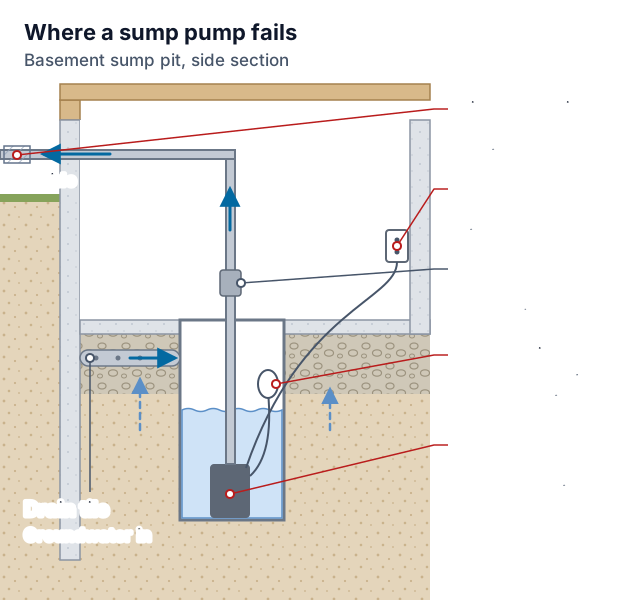
Power outage
Storms that cause high water often knock out power, too. A battery or water-powered backup pump covers that gap.
Stuck float switch
The float can catch on the pit wall or debris and never signal the pump to run.
Clogged or frozen discharge line
If the water can't leave the house, the pump runs without lowering the pit, or it shuts off from overheating.
Worn-out or undersized pump
Older pumps wear out, and a pump too small for heavy inflow can't keep up in a big storm.
Diagnose it now
What it typically costs
HomeGuide's third-party estimate puts a new sump pump at $600 to $2,500 and full basement waterproofing at $6,000 to $18,000. Groundwater that floods the basement is Category 3, priced at $9 to $12 per square foot to extract and dry (HomeGuide).
Frequently Asked Questions
Why did my sump pump stop working?
Most often power loss, a stuck float or a clogged or frozen discharge line. A pump that hums without pumping may have a jammed impeller or a failed motor.
Is basement flooding from a failed sump pump covered by insurance?
Often only with a water backup or sump overflow endorsement on the homeowners policy. Flood policies cover surface flooding, not usually a pump failure. Check your policy and photograph everything.
Should I add a backup sump pump?
If the basement is finished or the pump runs often, a battery or water-powered backup is worth asking about; it covers power outages, the most common failure during storms.
The service that handles this
Guidance only — independent local providers assess and price their own work. Last reviewed: October 16, 2026.
Sources for the cost figures
- HomeGuide: Water damage restoration cost (third-party estimate, updated Feb. 6, 2026) (third-party estimate)
Prefer to just talk to someone?
Send the short form — we'll route you to an independent local pro.