Water Heater Leaking: What to Do Right Now
A puddle under a water heater can be a loose fitting or a tank that's about to let go. Either way, stop the water and the heat source first, then figure out where the leak is coming from.
Clean supply water is the cheapest kind of water damage to fix, but only if it's dried quickly. EPA advises drying wet materials within 24-48 hours to prevent mold.
If this is unsafe or getting worse right now, don't wait — send an emergency request and it's flagged for priority routing to an independent local pro.
What to do in the first 5 minutes
- Turn off the heat source: flip the breaker for an electric heater, or turn a gas heater's control knob to OFF or PILOT.
- Close the cold-water supply valve on the pipe above the heater. If you can't find or turn it, shut the main water valve to the house.
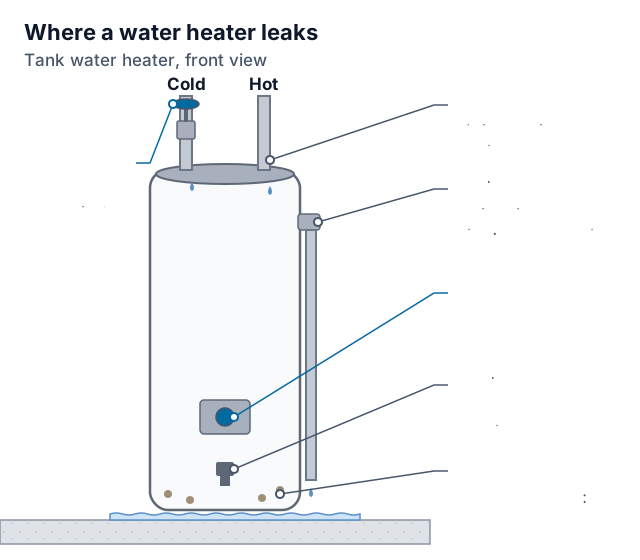
- Look for the source: the pressure relief valve or its discharge pipe, the drain valve at the bottom, the inlet and outlet fittings, or the tank itself.
- Move boxes and stored items away from the heater and mop or wet-vac standing water.
- Photograph the heater, label and floor, then call a plumber for the heater and a water-damage crew if water reached drywall, carpet or a finished room.
Do not do this
- Don't touch an electric heater's wiring or junction box if the floor around it is wet; turn the breaker off from a dry spot.
- If you smell gas, leave the house and call the gas utility from outside; don't operate switches.
- Tank water and the relief valve discharge can scald; let the tank cool before opening the drain valve.
- Don't cap or plug a dripping pressure relief valve; it's a safety device and a plumber needs to find out why it's opening.
Common causes
Corroded tank
Sediment and corrosion eventually rust through the tank bottom. A leak from the tank body itself means replacement, not repair.
Temperature and pressure relief valve
The relief valve can drip from high pressure or temperature, or from a worn valve seat. It needs a plumber's diagnosis.
Drain valve
The drain valve at the bottom can loosen or fail after flushing; sometimes a cap or replacement fixes it.
Inlet or outlet connections
Loose or corroded fittings and supply lines at the top of the heater drip down the jacket and look like a tank leak.
Diagnose it now
What it typically costs
HomeGuide's third-party estimate puts extraction and drying of clean water at $4 to $6 per square foot, and a leak contained to one area is usually Class 1 at $150 to $500. If water soaked into walls and flooring in a room or two, Class 2 runs $1,500 to $5,000 (HomeGuide). The heater repair or replacement is billed separately by the plumber.
Frequently Asked Questions
Is a leaking water heater an emergency?
A steady leak from the tank is, because it can let go. Shut off the heat source and the cold supply now. A slow drip from a fitting is less urgent but still needs a plumber soon.
Can I still use hot water if the heater is leaking?
Not until a plumber checks it. Running a leaking heater can worsen the leak, and an electric heater with wet wiring is a shock risk.
Does homeowners insurance cover a leaking water heater?
Policies often cover sudden water damage from a failed heater but not the heater itself or slow, long-term leaks. Photograph the damage and ask your carrier before work starts.
The service that handles this
Guidance only — independent local providers assess and price their own work. Last reviewed: October 16, 2026.
Sources for the cost figures
- HomeGuide: Water damage restoration cost (third-party estimate, updated Feb. 6, 2026) (third-party estimate)
- EPA: A Brief Guide to Mold, Moisture and Your Home
Prefer to just talk to someone?
Send the short form — we'll route you to an independent local pro.